I was saddened to learn today that Lloyd Alexander, the renowned author of fantasy novels for young adults, had died May 17 at age 83, from cancer. A good long life, to be sure, but one can only hope that a favorite writer will be as immortal as his books!
I grew up reading and rereading his Prydain Chronicles, a five-book series set in an imaginary kingdom inspired by Welsh mythology, which deserves comparison to The Lord of the Rings. Like that famous trilogy, it takes a humble protagonist (a likeable, gawky assistant pig-keeper) on a hero’s journey to defeat the lord of death.
Alexander’s other fine works include the Westmark trilogy and The Remarkable Journey of Prince Jen. The former series (Westmark, The Kestrel, and The Beggar Queen), which takes place in an invented European country with an 18th-century period feel, is a dark and morally complex tale of republican freedom fighters against a tyrant. It’s really mis-labeled as a young adult book; more like a Victor Hugo novel with a length and vocabulary that a mature teen could enjoy, but substantial enough to captivate and inspire readers of all ages. Prince Jen is a witty, profound fable about a young Chinese prince who roams his kingdom incognito to learn wisdom.
One thing I loved about Alexander’s books was his wise, sassy and competent heroines, a welcome update to the classics of sword-and-sorcery fiction. They’re the foremothers of Harry Potter’s Hermione. His novels are works of philosophy embodied in a humorous and exciting tale. Alexander gave young readers a vocabulary to ponder the big questions, like “what does it mean to be human rather than animal” or “when does the end justify the means in wartime”. Thank you, Mr. Alexander. I’ll miss you.
Christian Hawkey: “Night Without Thieves”
The day is going to come—it will come—put on
your nightgown,
put on your fur. And yea unto those who
go unclothed,
unshod, without fear, fingering the corners
of bright countertops
and calmly, absentmindedly, toeing the edges
of clouds
drifting in a puddle. Put on your deep-sea gear,
your flippers, and walk to the end
of the driveway.
It will come. Be not afraid to chase large animals.
Once, I had a conversation with the eye
of a moose, looming wetly
through the branches.
I was terrified. I froze. I backed away.
I imagined it.
And then on the other hand there
are those
truly fearless: schools of silver minnows
darting in and out
of the gills of blue whales—how many invisible
organisms
do we sustain without knowing it? Our own,
for one. Put on your crowded body,
like Vallejo,
who pulled the sea over his shoulders in
the morning
and stepped firmly onto ground. Thus,
when the day came, he conducted
electricity
perfectly—unknowingly—and wrote by the red
light of his teeth
after a glass of dark wine. Put on your
lampshade.
Put on your cage. If, in the shape of a key,
the shape of a woman,
a bank of swollen clouds surging over the
tree-line,
a word basipitally descends
break it open: how pome
and granate
meet in dense honeycombs, red seeds erupting
inside a mouth.
And though we lose eleven eyelashes a day
by blinking alone we cannot enter
the Kingdom,
nor can we move sideways, high on this narrow
goat-path,
without the proper footgear; a pebble’s kicked
loose,
and the echo returning
from the ravine
sounds like an avalanche, and is. Put on your
helmet.
Take off your clothes. If anyone even thinks
about laughing
it will be
the end of us—Rita, hand over the kazoo. Thank
you.
Now hand over the other one. Good.
And in case of an emergency
realize, quickly,
there is no emergency and move on. Like a thief in
the night
the day came. Then night came,
and emptied out its thieves
into the furious sunlight.
reprinted by permission from The Book of Funnels (Wave Books, 2006)
May Hell Be Empty
Apparently some in the blogosphere have been speculating, not without glee, that the late televangelist Jerry Falwell is now in the hell to which he so quickly consigned gays, liberals, and other folks outside the Moral Majority. Cautioning today against this uncharitable behavior, Hugo Schwyzer has some reflections on hell that I wholeheartedly endorse:
Do I believe there’s a hell? Reluctantly, I do. I believe there’s a hell because Scripture and tradition says there is, and because I believe God gives us the free will to turn away from Him. But I also reserve the right to believe and pray that hell is absolutely empty. I pray that every last creature on this planet will live eternally in paradise. I pray that prayer every danged day.
Episcopal theologian Robert Farrar Capon puts it beautifully in this sermon on the Prodigal Son:
This is the wonderful thing about this parable, because it isn’t that there was a Prodigal Son who was a bad boy and who, therefore, came home and turned out to be a good boy and had a happy ending. Then the elder brother—you would think Jesus, if he was an ordinary storyteller, would have said, “Let’s give the elder brother a rotten ending.” He doesn’t. He gives the older brother no ending. The parable ends with a freeze frame. It ends like that with just the father, and the sound goes dead—the servants may be moving around with the wine and veal—but the sound goes dead and Jesus shows you only the freeze frame of the father and the elder brother. That’s the way the parable has ended for 2,000 years.
My theory about this parable is that if, for 2,000 years, he has never let it end, then you can extend that indefinitely, that this is a signal, an image of the presence of Christ to the damned. When the father goes out into the courtyard, he is an image of Christ descending into hell; and, therefore, the great message in this is the same as Psalm 139, “If I go down to hell, You are there also.” God is there with us. There is no point at which the Shepherd who followed the lost sheep will ever stop following all of the damned. He will always seek the lost. He will always raise the dead. Even if the elder brother refused forever to go in and kiss his other brother, the Father would still be there pleading with him. Christ never gives up on anybody. Christ is not the enemy of the damned. He is the finder of the damned. If they don’t want to be found, well there is no imagery of hell too strong like fire and brimstone and all that for that kind of stupidity. But nonetheless, the point is that you can never get away from the love that will not let you go and the elder brother standing there in the courtyard in his own hell is never going to get away from the Jesus who seeks him and wills to raise him from the dead.
Theory: Love It or Hate It?
Two of my greatest passions in life are creative writing and Christian faith, and I’ve been wondering what it means that I approach them in very different ways with respect to the role of the theoretical intellect. In fact, the first sentence of this post was originally “…creative writing and theology,” which I changed to “…and Christianity,” and finally to a more active and experiential phrase that is more of a goal than an honest description of my spiritual life. As a writer, I flee from literary theory like a helicopter escaping a war zone. As a Christian, I spend much of my time insisting on the importance of clear thinking about theology, and trying to provide a foundation for the same.
Does this discrepancy reflect a natural difference in subject matter, or is it a sign that my religious life doesn’t go deep enough, compared to my enjoyment of my own imagination? Is this related to the fact that I talk to my novel characters when I should be praying? Sometimes I feel like I’ll never be done hunting for idolatry in the corners of my mind, hidden under things that always seemed admirable before. It’s like my bedroom ceiling during ladybug mating season. Eventually I have to put down the Bugzooka (the Buddhist answer to flyswatters) and go to sleep, knowing that I may be sharing a pillow with a few spotty little friends.
So, some thoughts. What they add up to, I hope my loyal readers will tell me.
Theory & writing: I get so discouraged when poets launch into jeremiads against literary movements that differ from their own preferred style. The world will not end because someone is writing free verse or using less than 17 syllables in a haiku. Poets whose writing explores problems at the boundaries of language despise poets whose work could be understood if you read it aloud on the bus, and vice versa. Poetry may be at special risk for this phenomenon because it’s already more meta-textual than fiction, more concerned with its own workings; also because the crumbs of academic security and public acclaim are so much smaller that the pigeons squabble over them more fiercely. Intolerance is never pretty, but the “One True Religion” attitude seems particularly absurd in creative writing, which is by definition personal, original and idiosyncratic.
I write to find out things I don’t already know that I know. Anne Lamott’s excellent book Bird by Bird: Some Instructions on Writing and Life compares writing a novel to taking dictation from the little boy who’s playing in the basement of your subconscious. At least for the first drafts, you just listen in while he’s doing his thing; you don’t give him an outline of the themes his make-believe is supposed to embody. Theory would get in the way. By the same token, I’ve come to believe that I shouldn’t set out to write an “innovative” or “experimental” poem. Innovation, if it happens at all, arises naturally out of the need for a new form to express a new thought, and often isn’t crowned as a breakthrough till years later.
I love Bird by Bird mainly because it validates the novel-writing process I’ve discovered for myself as the most comfortable and productive one: namely, having absolutely no idea what I’m doing, but complete confidence in it anyhow. Other books by equally good writers would give the opposite advice. I don’t care. All I need to know is that someone did it my way and didn’t die. I have no need to insist that all writers go through my particular dharma door.
Theory & faith: In my religious life, what came first was my childhood sense of wonder and my passionate longing for something that lay just beyond the horizon of human perception. In that respect, it’s not unlike the leap of faith I take as a writer. The ineffable draws me onward. Only the desire implanted unshakeably in my heart tells me that my journey will lead somewhere worthwhile. The absence meanwhile is a bittersweet pleasure, a spur to forward motion, a space in which to embrace my role as lover and seeker.
One of the beauties in which I see God’s presence is the beauty of theology. Long before I found Christianity convincing, I fell in love with its harmonious intricacy, its ability to address life’s most important questions within a system that was satisfyingly complex yet coherent. Perhaps I don’t see the same beauty in a lot of literary theory because the latter is about second-order questions. Theology is not God, and isn’t always prayer, but it goes right up to the limits of the sayable. It knows where the action is. Literary theory is words about words, theology is words about Reality.
There’s also an anti-intellectualism in today’s religious climate that’s mercifully absent from how we think and talk about literature. Few people expect to become good writers without studying the thoughts and methods of one’s predecessors, and learning how to think critically about one’s preconceived notions. If the same level of intellectual seriousness was expected in our religious life, I wouldn’t need to spend so much time defending the very idea of the Nicene Creed, not to mention its content.
Writers are expected to master their shame and fear in order to learn from tradition. Though the diversity of acceptable techniques increases at the more advanced levels of the craft, there’s wide agreement on some basic standards that quality writing should follow. There are respected authorities in the field. A beginning writer who rejects the notion of authority, who feels invalidated by the suggestion that anybody has something to teach her, would be advised to get her ego under control.
The church, by contrast, too often coddles that kind of immature personality, either from a loss of belief that there are any standards for Christian faith, or from fear that doctrinal specificity will lead to fatal dissension. The stakes are higher, it’s true. The Thirty Years’ War wasn’t waged by rival MFA programs. Still, I think the liberal churches in particular could learn something from the self-discipline and detachment that their members expect from themselves when they’re wearing their “academic” hat instead of their “Christian” hat.
I care more about unity in theology than in literary theory because for me, religion is about describing our shared reality, while writing creates a multiplicity of alternate realities that reflect different small pieces of the human condition. Also, the church as community needs something loftier than the roof-repair fundraiser to unite around, while the writer’s work is solitary.
At a time when fewer and fewer Christians can articulate why the Trinity, the Crucifixion and the Resurrection make a difference in how God’s forgiving love transforms our lives, it’s hard for me to get past the task of rebuilding an intellectual foundation for belief. I need this foundation to create the community that will safely support me on my scary walk toward God.
Imagine being a writer in a society where good books and bad ones were given equal and superficial respect, and reading too much of either type was suspect; where English teachers and literary critics were routinely mocked, in pop culture and within schools themselves, as crushing the natural beauty of creative souls with their arbitrary rules of grammar and exposition. Writers shouldn’t have to be that lonely; Christians, even less so.
Out in Scripture: Revelation 21
The Human Rights Campaign publishes an e-newsletter called “Out in Scripture” that applies the weekly lectionary reading to themes of interest to the GLBT community. This week’s commentary on Revelation 21:22-27 appealed to me:
[This passage] is a word of hope for God’s ultimate and eternal blessings to those who have been faithful in spite of being excluded, oppressed or even exiled. However, that initial exclusion can be problematic to many readers. Revelation 21:27 says that “anyone who practices abomination or falsehood” (New Revised Standard Version) or “does what is shameful or deceitful” (New International Version) will not enter the city. Most members of the LGBT community know the pain of having the words “abomination” and “shame” as labels placed on them and their lives. LGBT people should not internalize these words as a particular condemnation of them. All of humanity is subject to the shame of idolatry. It is not sexual orientation or gender identity that creates an “abomination” but our raising those things of the created order to the level of “gods” in our lives.
God calls us to be good stewards of all the gifts and blessings given to us, including human sexuality. When we make idols of money, power, institutions, relationships and, yes, even our sexuality, then we are in danger of not entering the city of light — simply because we’d rather stay in the shadows.
Northampton Pride March 2007
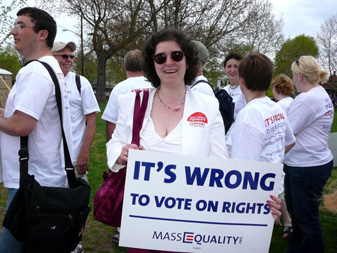
If you’re registered to vote in Massachusetts and support gay marriage, contact your state representatives and ask them to keep the anti-gay-marriage constitutional amendment off the ballot this year. The Constitutional Convention reopens on June 14. If this doesn’t apply to you, just enjoy the picture of my fabulous Laila Rowe handbag.
Jesus Blah Blah Blah
I’m a good theologian. I believe nearly everything I say, and can talk myself into the rest. And yet sometimes it all seems rather ridiculous. To talk about God? Shouldn’t I just be sitting here with my mouth hanging open in awe…”buh-buh-buh”?
At the Wheaton conference on the church fathers, keynote speaker Christopher Hall cited St. Gregory of Nazianzus‘ admonition that you shouldn’t do theology unless you have a pure heart and meditate often. Otherwise it becomes a competitive sport, or an arrogant attempt to penetrate all of God’s mysteries through human reasoning. Unless one simultaneously engages in perceptual and behavioral habit-formation within a church community, it’s best not to bloviate about the Almighty.
So I won’t.
William “Wild Bill” Taylor: “Time Served”
the face of the broken man appears to one man
with the loud
mouth and shaking godspeed
in the crack houses where the lost and found
are gathered in the speakeasy future
of dying dung wounds
and the alabaster holding tank screams
you have warrants out sinner
credit for time served?
the pregnant mother whose back is covered
in a black tattoo haze of the Mexican
subculture
no insurance suspected driver’s license
INS has a hold on you
Christ is processed through
he needs to see the nurse
his chest x-ray is negative for TB
but his wide MIA sternum shows a broken
heart
unseen tears for those soon to be booked
checking out with duplicate fingerprints
he gave me his baloney sandwich
and I knew my that my warrants had been
erased
this time…
Poetry Roundup: Templar Poetry, Kore Press
Review copies of several poetry books have found their way to my desk this month, and I wanted to mention a few I’ve enjoyed. I remember how greedy I was for books in high school, when the $15 cover price of a slim volume seemed impossibly extravagant. I read the same few authors repeatedly: Auden, Sexton, Eliot, Robert Hass, Mark Strand. Now I can hardly do justice to the many books that I get in the mail, and I don’t have the luxury of rereading. Something is wrong with this picture. It’s probably the same character flaw that’s responsible for my novel’s excess of subplots. Too many competing priorities.
Some books worth slowing down for: I was very pleased to discover a new publisher from England, Templar Poetry, which runs a chapbook contest with a good-sized prize and better-than-average book design. A lot of chapbooks look like they were xeroxed and stapled together at Kinko’s (the name does mean “cheap book,” after all). Templar’s have full-color covers with French flaps, and are printed on nice ivory matte paper. So far I’ve read and admired two of last year’s winners, Angela Cleland’s Waiting to Burn and Judy Brown’s Pillars of Salt.
Cleland is a masterful writer who never over-explains her meaning. Like Robert Frost, she writes poems that work on many levels. The surface narrative is quite clear, but the more you study it, the more you see that she is using that narrative as an extended metaphor for something more important. Where a lesser poet might say, “X is like Y,” Cleland spends the whole poem telling the story of “X”, but with such subtly loaded language that the reader makes the connection to “Y” on his own. Take for instance her opening poem, “A Guided Tour”:
We asked to see the mechanism.I read this as a poem about original sin, but note how wisely Cleland avoids the familiar tropes (garden, apple, good and evil) in order to seduce us into identifying with the knowledge-seekers until the very last lines, when we see that the protagonists are not trustworthy after all. The tour guide’s “huge, jealous” hands and his “brow like the sky” are clues to his God-identity, while the unexpected “delicate” drops the first hint that he is not just a mean authority figure but a compassionate protector against the real damage that his audience could do.
Asked if he would show us how
it worked, this exquisite machine.
Cogs turned, clean and golden;
oiled springs, fine-coiled stamen
quivered in our minds as we imagined.
But he frowned, his brow like
the sky, and with huge, jealous,
delicate hands, he hid his design,
as if afraid we might cheapen it
with ham-fisted home-made attempts.
Behind his hands the catch snapped
shut. It echoed round his workshop,
rattled screws in the countless devices
that spun and circled us like questions.
One of us nodded. We all nodded,
agreed, of course, this was for the best,
each one with his hand in his pocket,
each one fingering his lock-pick.
What I appreciated most about Judy Brown’s chapbook was her eye for physical details that captured a place or a character. Because her authorial voice is not intrusive, the occasional aphorism or emotional revelation has that much more impact, as in these lines from “Life in the Green Belt”:
Far away in the real countryside
I was slimmer
and one thing led to another.
But here and now
at the edge of a deserted golf course at dusk,
we lay spikily in unattractive positions.
Your unhappiness and my unhappiness
lay between us like two of my relatives.
Most of her poems are more hopeful than that; one of my favorites is “Passenger,” about a shard of glass embedded in her head from a car accident, which fell out 17 years later:
…When I lifted my hand, it fell, a diamond
from the devil’s spittoon, onto the crested paper,
the nailtip of a stalactite breaking.
Did I feel alone without my tough glass star,
its chunk of crystal shining by the bone?
It had brought me more darkness than light
so, for all our long companionship, I let it go.
The other review copies I’ve been reading are from the Kore Press First Book Award series. Kore Press is a well-regarded publisher in Tucson that specializes in poetry by women. I am still trying to find something intelligent to say about Sandra Lim’s Loveliest Grotesque. Her language is beautiful and fascinating, but so nonlinear, so anti-narrative, that I often can’t figure out “why this word and not another?” So far, about one-quarter through the book, I’m most enamored of the title poem and “The Horse and Its Rider”. The latter’s mood reminds me of all those great old ballads about the girl who’s swept away by the sexy bandit. Here are the last lines (the line-break slashes are part of the poem):
someone who belongs to another / what difference does it make to be here alone?
/ take this street, take this hand / eros has a thousand envoys /
now / now / wait for all the arrows to hit their mark / now / now I am going to be
happy / conditional / hardly birthright / strange, worn, contented dolls /
the piano nobile / an endless pageantry / now / let you be lifted / as a frost, old age
will take us /
cleave then / which way
The title, of course, made me picture a literal horseman, but it could also be an allusion to the classical image of reason as the charioteer who masters the horses of passion. Evidently, from the emotions and disjointed style of the poem, the horse is the one in control here. “Which way?” It doesn’t matter; the speaker is along for the ride, even if it ends badly (“as a frost, old age will take us”).
Another Kore Press winner, Elline Lipkin’s The Errant Thread, is quite different. She writes clear, controlled narrative poetry with a deep awareness of connection to history — mostly European history and culture, but also the mythic figures who symbolize women’s struggle in a man’s world: Philomela, Dickens’ Miss Havisham, and in this poem (my favorite from the collection), the Maiden Without Hands from the Grimms’ fairy tale.
Conversation With My Father
After we speak I go to the hardware store
to decide on a drill, feel each black–packaged tool
bristle with its will to do harm. I interlope
among bit sets, arrays of blade and shaft,
gun–like metal shapes that brag of power.
The word–whir of our talk still buzzes its drone
a hot saw always left in the corner, ready to hack.
Important — safety instructions flutter then drop.
I follow your advice on what’s needed to needle
a skin of paint, the force it takes to punch the wall.
How much better if I could have been like Athena,
springing clear as a doe, neat as a sum, blasted out
of your head like a sweep of clean logic. If only I could
have been pure as a product of the mind’s mitosis,
justified as when ‘if’ begets ‘then,’ and ‘a’ equals ‘c,’
each chamber of reason I passed smelting an iron–ore
layer over my breast. How alike we could be when
I emerged, balanced as an axiom, threaded straight
as a theory, and born armed, with bow and arrow in hand.
Instead, in your grip, I was Thumbelina, a glass angel,
a set of porcelain arms crossed behind a back.
My hand was to stay undissolved as a spun–sugar
lump until asked for, approved of, then towed down
an aisle. But I’ve told you I can’t be good as
Grimm’s girl, when we stand near the ax I draw
my wrists back. Each pointed finger is my true weapon.
I won’t let you bronze the cut cups of my palms.
Poem: “Wishful Thinking”
To avoid you I go to the toilet,
push dust around the cellar, swipe the
slick decay
of leaves from the gutter. Nothing revolts you.
You’re so bored you’re falling out of the sky
but persistent as sleet,
not like myself whose Bible stops at January,
page-a-day saved by inertia from Easter.
Sometimes you ask me to lie down in the middle
of haste
like a madman’s blanket. Before how many
doorways
will I be thrown down?
Sometimes at dawn I climb the rope with
monkey hands
up past fear and gravity, beyond hoarding
myself.
An animal knows how much it can take.
I hoist the weights like a rower, one and
the other and one.
Don’t tell me yet what trial this is training for.
You’re the pillow under my head
and over it. You’re the hole in the road
that the gas truck hits, jacknifing into
gorgeous flame.
The woods above the highway are dark
with bears.
A lost child sees the glow, stumbles back to
her parents’ camper.
And what if there were no one pursuing? No storm
to blow my windows out? I could sleep
without whispers,
wake without guarding my eyes.
My friend the rational sunshine
says you’re wishful thinking, Santa-Claus daddy
come down through ashes just to indulge me.
Oh, but it’s cold on the roof of my life
under the flashbulb moon,
with no rumors of hooves sharpening above.
No one to know when I’ve been sleeping,
or with whom.
Now that you’ve gone, I won’t look at the shapes
of clouds,
dream-beasts that can’t resist your tearing apart.
No face remains; love’s rubbings even unpaint
the doll’s cheeks.
Spare me this corner, I said, and you left
the whole field bare
under an endless platter of good weather.
Wishful thinking: that moment darkened by the
brush of evening
when the child locked in the toystore wants
to be found.
published in Literature & Belief, Vol. 26.1 (2007)