Letter to an Evangelical Friend, Part 1: Why I Don’t Read Anti-Gay Theology


“Denise”, a close friend from the days when I was an evangelical fellow-traveler, has long wrestled with the question of the salvation of non-Christians, with the same intensity that I devote to gays-and-God. Her compassionate heart inclines toward as inclusive a vision as possible, yet she also holds the firm conviction that she needs to find Scriptural warrant for any position she takes, in order to be fully obedient to Jesus as Lord.

Perhaps this is where our theological paths diverge most, though I can’t say I’ve really settled exactly what role the Bible does play in my life–some as-yet-unarticulated third way between Denise’s view that “every word in Scripture is exactly as God wanted it to be”, and the liberal view that it’s an important source of history and mythology but not uniquely authoritative.

Earlier this month, I had the honor of giving a talk at my church about how my faith and my creative writing inform one another. I sent Denise a copy of my notes, excerpted below, and she sent back some profound questions that inspired another six-page letter. She’s given me permission to share excerpts from our dialogue. I think it encapsulates the core issues in this debate, and some of the reasons why affirming and traditional Christians often seem to be talking past each other.

First, here’s a section from my speech notes:

…When I began this novel, I knew two things in my heart that didn’t make much sense to me: these characters came to me from outside, and I felt the Holy Spirit empowering me to do things I’d never done before. At the time, my mentor was an evangelical writer who said that a book about “sodomy” couldn’t possibly be honoring God. I didn’t have the Biblical expertise to stand up against that. I just couldn’t shake the conviction that these characters had been entrusted to me somehow, and I shouldn’t abandon them in order to secure my spot in heaven.

To make a long story short, this led me on a journey into progressive theology and political activism. I thought more about the reasons we are attracted to certain Biblical interpretations, and the importance of taking responsibility for our emotions and prejudices when we approach the Bible. The human element appeared inescapable. I kept coming back to Jesus’ words, “By their fruits ye shall know them.” You can make clever arguments for just about any interpretation, but if the net result isn’t more love and more equality, you’re probably off-base, whatever the text seems to say.

But along the way, I lost a lot of confidence in the authority of the Bible, and I still wrestle with guilt and uncertainty about my Christian identity because of this. It’s not that I don’t think you can make a good Scriptural case for inclusion, but that I really don’t care as much as I used to, either way. I hope this is more of a way station than a final stance.

How radical it felt to me, how scary, to begin to believe that creative writing is a source of theological knowledge! Though we have Scripture and tradition to tell us what Christians have historically believed, I think we equally need personal, contemporary experience to understand the world to which those doctrines are being applied. The arts, guided by the Holy Spirit, can give us that experience, particularly by widening the circle of our compassion.

There’s a lot of hidden privilege in our theologizing. The question about gay inclusion, for instance, is often framed as “Should we (normal straight people) let them into the church?” Writing, or reading, a story from the perspective of a gay person makes us think twice about assuming that we deserve to be the gatekeepers in the first place. If we’re open to it, we can see that this very different person is just as human as ourselves, and that their life and love has the same potential to manifest the divine spark. This seems to me to be very much in line with the gospel stories, where Jesus constantly reverses the expectations of people who think they’re God’s favorites.

And here are Denise’s questions:

The main theme as I read it in all of the above centers around this question: Does an orthodox doctrinal faith operating as “container” for prayer, the creative imagination, and one’s personal living, help or hinder? Do the constraints of a doctrine one doesn’t feel free to question cramp prayer, the imagination, and living, or does an orthodox doctrinal Christian faith free one up from “slavery” to more subjective ideological preferences and agendas for the deeper freedom Paul speaks of, that we have in Jesus Christ?

You know, I’m sure, how much I always resist many of the constraints of a tightly systematized doctrine–both because of my temperament and because I honestly believe the paradox and mystery of the Bible argues against its importance, or even its possibility. At the same time, it seems to me that absolute commitment to Jesus as Savior and Lord has to be at the heart of any true Christianity. How much does that commitment mandate faith in doctrine (as opposed to faith merely in a Person?).

We all have our own issues here– issues that are so crucial to us that any threat to our preferential position shakes us at our very core. For me it has always been the salvation issue, and specifically some perspectives on predestination. For you I sense that the gay issue is the most important, though obviously the salvation issue raises questions for you as well. Speaking just for myself here, I have had to say to Jesus: “If it turns out those aspects of Calvinism which so trouble me are right, and that faithfulness to You means I have to accept their views, then I have to choose You.” I don’t know where you would come out on this “forced choice” were you to be faced with it. I realize that you don’t believe, and probably can’t imagine, you would ever be faced with this choice, since you are so convinced faith in Jesus does not require us to consider homosexual behavior a sin. Quite the opposite, in fact.

But what if it did????? Might it be that one reason you don’t any longer want to read books/arguments contradicting your position is that deep down you wonder if you ever might be faced with that choice, and definitely don’t want to “go there”?
I’m not trying to persuade you of anything here, Jendi. As you know, this is not one of my “issues”. But I just wonder which would come first, were it to come to that? Jesus, or your position on the gay issue?

Here is the first half of my response (with minor edits for style):

Why I Don’t Read Anti-Gay Theology

[1] Non-affirming theologians are often starting from such different premises, regarding the “inerrancy” of the Bible or the “infallibility” of the Catholic magisterium, or an essentialist and complementarian view of gender roles, that there isn’t sufficient common ground for me to get any value from their arguments. I disbelieve in the above-mentioned premises on wholly separate philosophical grounds, not because of the outcomes they might produce for the gay issue.

[2]I don’t need to seek out these arguments because they are all around us in politics and the media, as well as in the writings of conservative Christians whom I read on other subjects. Every time gay people are lobbying for secular civil rights such as marriage, adoption, employment non-discrimination, and anti-bullying programs in schools, Christian leaders who oppose these measures are given an opportunity to air their Biblical position. The Proposition 8 trial alone generated hundreds of pages of this.

Generally, it is not only easier but inescapable for a minority group to know what the majority thinks about them, including the rationales for their subordination. It’s the majority that needs to make a special effort to notice that other perspectives even exist.

[3] Entering one-sided conversations makes me wary. I’d like to flip the question around and ask why non-affirming Christians are so reluctant to listen to gay Christians’ narratives of their own lives? Why, in other words, is it incumbent upon GLBT people and their families to seek out arguments against us, from people who often choose to be uninformed about something we know about first-hand?

A recent instance of this occurred at Harding University, a Church of Christ college in Arkansas. A group of students (anonymously, for fear of retaliation) created a website and print magazine collecting their personal narratives of living with same-sex attraction as Christians at Harding. They spoke about bullying, coerced “reparative therapy”, and suicide attempts—all merely because of their orientation, not sexual activity. The administration responded by blocking the website and declaring the magazine to be in violation of the student handbook.

[4] Let’s concede for a moment, for purposes of this discussion, that non-affirming Christians have the better of the textual argument—namely that the authors the relevant passages in Leviticus and the Epistles intended to condemn all same-sex activity, not only male prostitution and rape of the defeated enemy during wartime, as affirming theologians have argued. That’s a reasonable position, though not the only one.

From that, however, most non-affirming Christians make the questionable leap that the social mores that pertained in Biblical times must be timeless universal commands. This ahistoricism seems to me to foreclose important justice-based critiques of the status quo.

Whichever society you look at, the norms concerning family and sexuality have almost always been formed under conditions of gender inequality—a structural sin that Jesus cared about quite a lot. We conveniently erase a key political dimension of Christianity when we adopt a presumption against progressing beyond ancient social structures.

The direction of the Biblical narrative, especially in the New Testament, is toward ever-expanding equality before God, breaking down barriers based on ethnicity, ritual purity, socioeconomic class, and gender, to name a few. The first Christian communities didn’t perfectly achieve this, and neither have we, but we should try to head in that direction. It would be a shame if we froze that development 2,000 years ago by reifying their imperfections instead of continuing their forward movement.

[5] I would respect, though disagree with, a Christian who conceded that there were no personal pathologies or societal harms associated with homosexuality and that sexual orientation is unchangeable for most people, yet who still believed that the prohibition on same-sex intimacy was a Biblical command, albeit one with no explainable reason behind it except God’s mysterious design.

However, that is hardly ever how the debate unfolds. Probably suspecting that most modern people would not accept such starkly deontological ethics, non-affirming Christian writers/leaders/activists nearly always feel the need to bolster their case with derogatory and long-discredited factual assertions about homosexuals and homosexuality. Such assertions include:

*gay men are pedophiles

*gay people “recruit” others into homosexuality

*gays are incapable of, and/or opposed to, sexual fidelity and monogamy

*gays who want equal rights under civil law are persecuting Christians and interfering with their religious freedom

*gays are unfit parents

*recognizing gay marriage (under civil law, not in the church) will create a sexual free-for-all that undermines marriage and families

*people become gay because they experienced child abuse

*people become gay because their father was emotionally unavailable and their mother was domineering

*all people are naturally heterosexual—”gays” are just confused

*homosexuality can be changed through prayer and therapy

*the “homosexual lifestyle” leads to poor health outcomes and unstable relationships because it’s inherently wrong (in other words, not because of social stigma, parental abuse of gay kids, and discrimination in health care and employment)

Not only do these errors fatally undermine these writers’ credibility in my eyes, but I hold them somewhat accountable for the hate crimes and gay suicides that result from the spread of false stereotypes about gay people as dangerous, perverted, and unnatural.

****
Next in this series: Would I choose Jesus first? Does the question have any meaning? What do you think?
My Poem “not with the old leaven” Now Online at the St. Sebastian Review


My poem “not with the old leaven” is now online in the first issue of the St. Sebastian Review, a new literary journal for GLBTQ Christians and allies. Yes, we do exist! As editor Carolyn E.M. Gibney says in her introduction:

Many times over this past year, in the midst of my clumsy attempts to get this journal going (It’s sort of
felt like learning stick shift all over again: You think you’ve got it, then you lurch forward violently for a
few seconds, sit stunned for a moment, and start the damn car once more.), I’ve had people – mostly
genuinely concerned and gentle people – ask me: Why would you create a journal for queer Christians?
How many of you are there?

My answer is always the same: Twelve. There are twelve of us. (At this point in the conversation I smile
and tell them I’m kidding. Which I am. Mostly.)

It’s true that this seems like a bit of a strange niche. Queer Christians tend to fall into the section of the
Venn diagram that most people either A) don’t think exists (which in most cases is easily rectifiable), or B)
vehemently deny is metaphysically possible. ‘You can’t be gay and Christian!’ they say.

Word on the street, though, is that metaphysics can only take you so far. (Buy Martin a beer and he’ll tell
you why, in the end, he never could finish Being and Time.) And, in any case, the problem, unfortunately,
has never been metaphysical. The problem is not whether gay Christians can or should exist. The problem
is that we do exist, and that people still consider our existence a metaphysical question.

The question of being queer and Christian is deeply, terribly physical. And immanent. And quotidian. (‘See
my hands?’ I would like to say back. ‘See, here: Touch the wound in my side.’)

That’s partly why I started this journal. I want to affirm that the question of the intersection of queer and
Christian has moved, must move – entirely and completely – from the realm of the metaphysical to the
realm of the ethical. The question, now, dear friends, as I’m sure you already know, is not ‘What?” but
‘How?’


The issue is available for download as a PDF here.

Bad Daughters of Eve


One of the lectionary readings for yesterday, the first Sunday in Lent, was the Genesis story of Adam, Eve, the snake and the apple. On its face, this text suggests that we disobeyed God by using our own judgment instead of obeying blindly, and all of humanity’s problems go back to this root. Given how easily and often this interpretation has lent itself to abuses of church authority, I feel compelled to search for more creative ways of understanding one of the foundational myths of Western culture.

Without proposing a reduction of religion to mere psychodrama, I’d like to suggest that the Garden of Eden story expresses (among many other things!) an early stage in the maturation of the individual. It’s a poetic representation of how the child looks at the parent’s authority. And because, in St. Paul’s words, we are eventually meant to “put away childish things”, it’s not the last word on the interplay between independence and obedience.

Remember how it felt to be a small child. Our parents made a lot of rules whose purpose we didn’t always understand. As we got older, hopefully we saw more of the reasons for rules that seemed arbitrary at the time. Meanwhile, though, the bargain looked a lot like Eden: nurture and protection, and the freedom to ignore the hard choices that adults had to puzzle through (“the knowledge of good and evil”), in exchange for being a dutiful son or daughter.

But one day, we decided to test those limits. Ride that bike into traffic. Eat a whole box of cookies. What happened when we got caught? If we tried to hide the evidence, or shift the blame, that reaction, rather than the disobedience itself, was the greatest proof that we really weren’t mature enough to write our own rulebook yet.

Even so, Eden was kind of nice. They do your laundry for you and there’s always popcorn in the cupboard. From the teenage perspective, being kicked out feels like punishment. What are you talking about, go earn your own bread by the sweat of your brow? Without that responsibility, though, you’re not really living into the independence that you said you wanted.

What I’m suggesting is that the Fall and expulsion only look like a crime and a penalty from the human viewpoint because we’re ambivalent about growing up–“growing into the full stature of Christ”, to quote St. Paul again. Adam and Eve’s first act of self-awareness is to clothe themselves, to create physical separation and privacy between themselves and their divine parent. Individuation is a necessary but lonely process, and both parent and child sometimes feel nostalgic for the Edenic oneness of the womb.

For Christians, this trajectory comes full circle in the Incarnation and Atonement. Where Adam and Eve fell short of God’s design for full human maturity because they didn’t take responsibility for their own transgressions, Jesus embodies that design by taking on and cleaning up the transgressions of others. Where Adam and Eve clothed themselves in fig leaves to become different from their creator, God clothed Godself in human form in order to restore that connection, but still in a way that respected human freedom.

Again, this has its parallels in family life. As we develop an adult’s broader perspective, we discover that our personal autonomy, which may have seemed so absolute during adolescence, is shaped and limited by family obligations and by the behavior patterns we’ve inherited from our forebears. Though our abusive ancestors weren’t our fault, it falls to us to say “The buck stops here”–to face and reform those abusive tendencies in ourselves, and to bind up the wounds of our loved ones.

Ellery Akers: “The Word That Is a Prayer”


Debates about the Word of God can preoccupy us so much, we forget that Christ’s real message, compassion, is much simpler but far from easy. That’s why I like this poem, reprinted here by permission from American Life in Poetry, a project of the Poetry Foundation.

American Life in Poetry: Column 312

BY TED KOOSER, U.S. POET LAUREATE, 2004-2006
Ellery Akers is a California poet who here brings all of us under a banner with one simple word on it.

The Word That Is a Prayer

One thing you know when you say it:
all over the earth people are saying it with you;
a child blurting it out as the seizures take her,
a woman reciting it on a cot in a hospital.
What if you take a cab through the Tenderloin:
at a street light, a man in a wool cap,
yarn unraveling across his face, knocks at the window;
he says, Please.
By the time you hear what he’s saying,
the light changes, the cab pulls away,
and you don’t go back, though you know
someone just prayed to you the way you pray.
Please: a word so short
it could get lost in the air
as it floats up to God like the feather it is,
knocking and knocking, and finally
falling back to earth as rain,
as pellets of ice, soaking a black branch,
collecting in drains, leaching into the ground,
and you walk in that weather every day.

American Life in Poetry is made possible by The Poetry Foundation, publisher of Poetry magazine. It is also supported by the Department of English at the University of Nebraska-Lincoln. Poem copyright ©1997 by Ellery Akers, whose most recent book of poetry is Knocking on the Earth, Wesleyan University Press, 1989. Reprinted from The Place That Inhabits Us, Sixteen Rivers Press, 2010, by permission of Ellery Akers and the publishers. Introduction copyright © 2011 by The Poetry Foundation. The introduction’s author, Ted Kooser, served as United States Poet Laureate Consultant in Poetry to the Library of Congress from 2004-2006. We do not accept unsolicited manuscripts.

The Erotic Christ: Jesus in Love Blog Interviews Hunter Flournoy


This month on the Jesus in Love Blog, a resource for queer spirituality and the arts, Kittredge Cherry interviews Hunter Flournoy, a psychotherapist and shamanic healer who teaches “Erotic Body of Christ” workshops to help gay and bisexual men make a mystic, sensual connection with the divine. Here’s an excerpt. I was struck by the commonalities with Buddhism: the idea that the root of suffering is separation not only from God but from one another, and that we can attain transcendence by embracing the suffering of the world, not as self-punishment but as compassionate participation.

KC: Many LGBT people have been wounded by the false teaching that homosexuality is a sin. What message does the erotic Christ have for them?

HF: Our sexual energy is the most powerful tool we have to shatter the illusion of separation, which is what the original Christians meant by “sin.” The essential question we must ask ourselves is, am I using sex to bring myself alive, to overcome separation and incarnate the divine, or am I using it to medicate or avoid my own experience of being alive? This was the original understanding of chastity: it calls us to the highest possible relationship with our own sexual energy. All sexual experience can break down the boundaries and defenses we use to separate ourselves from each other and from God – we become one body, one being. Sex can also teach us how to give ourselves totally (kenosis) to each other, how to receive each other completely (plerosis), and how to surrender to the transfiguring power of our own erotic experience. As LGBT people, we also have an innate understanding that our erotic experience, our pleasure, desire, ecstasy, and union, can serve a purpose other than reproduction. Our erotic joy is a source of profound creativity, deep empathy, and a wild ecstasy that can take us out of who we are into a far greater sense of being.

KC: As you say, the idea of “suffering as Christ suffered” has been abused in legalistic religious systems. But gay bashing and other forms of “crucifixion” continue. How can the erotic Christ help in situations of real human suffering?

HF: There is nothing inherently spiritual or useful in suffering; it is useless to suffer as Jesus suffered. Nor did Jesus advocate cooperating with abuse and injustice. What he advocated and demonstrated – what really matters – is loving as he loved, embracing everything and everyone, including suffering, as Jesus embraced it. Instead of rejecting our suffering, trying to medicate, numb, get rid of it or distract ourselves from it, we learn how to embrace it, without indulging it or running from it. We let our suffering shatter our sense of self, our sense of control, and our need to make sense of the world. This is what the Christian mystics called katharsis. Second, our embrace transforms suffering into a searingly powerful erotic experience . . . it is like a fire that fills our whole being, a great trembling ache that breaks into the profound peace the mystics called theoria. Finally, we discover through this embrace that we are welcoming not only our own suffering, but the world’s suffering . . . we begin to experience ourselves as the world, as Christ’s body, and ultimately as God, in the mystery of theosis.


Read the whole interview here. Visit the Erotic Body of Christ website to learn more.

Anti-Colonialism and Gay Rights in Uganda


Dr. Jillian T. Weiss, a regular contributor at the GLBT news blog The Bilerico Project , recently posted a thoughtful article, “Understanding Uganda”, in which she explores why gay-rights activism directed at African countries often provokes an anti-colonialist backlash. Since gay people have existed in all societies, and were actually treated better in some African cultures before the advent of Christian missionaries, how is it that gay rights have been successfully branded as a decadent Western import? Weiss suggests that the Christian imperialist roots of African homophobia are now so old that they’ve faded from public consciousness, while secular human rights language is more immediately identified with NGOs run by privileged foreigners. An excerpt:

…Similar charges [of elitism] are leveled against large LGBT rights organizations that are disparagingly referred to by some as “Gay Inc.”, implying that they are out of touch with ordinary LGBT people and seek to promote an elitist and oppressive agenda. Another analogy is imagining a strong force of groups across the United States, well-funded by countries we generally dislike, attempting to put messages in the media that we ought to embrace human rights by giving up American democracy and going with a One-World-Government plan. Of course, these analogies are vastly different from the Ugandan situation, and I don’t mean to compare their specific facts, but only the motivations that can stir dislike even of those espousing human rights.

I recently spoke to an African scholar regarding this issue. While his expertise is in Ethiopia, and in particular the issues of development and sustainability, his knowledge of Africa is useful in this context. I asked him why it is that human rights movements, including the African LGBT rights movement, are viewed as colonialist encroachment on African identity, whereas U.S.-imported evangelical Christian homophobia is viewed as compatible with African identity. To me, it seems a sad contradiction.

His answer made it clear to me that the subtext of the LGBT rights movement for many Africans is that of foreign imperialism, a “Western corruption” not native to Africa. Christianity, to the contrary, despite its origins in missionary activities designed to indoctrinate the “savages” into compliance with European dominance by means of a fatalist philosophy of acquiescence, was introduced so long ago to Africa that its imperialist subtext is completely obscured. Its handlers have deftly messaged it as supporting African autonomy, sovereignty and ownership. They truly believe it is African, despite the fact that, as discussed by Eugene Patron in his Harvard Gay and Lesbian Review article, “Heart of Lavender: In Search of Gay Africa,” Africans have lived without discord with LGBT identities in the past, despite the efforts of Christian missionaries.

The history of post-colonialism is a reaction against oppression of autochthonous rule, particularly the successful attempt to neuter those who might be independent-thinking local leaders. As Matthew Quest has noted, anything that appears to imply effeminacy is often rejected by Africans as smacking of imperialism.

Thus, it is impossible to understand the state-supported open homophobia imported from the U.S. that likely killed David Kato without understanding that rights advocates in Africa are seen as imperialist agents bent on the destruction of a pure and strong Uganda identity independent of the imperialist West. All this is confirmed by the condemnation of Western leaders, ensconcing the homophobic Ugandan leaders with the mantle of defiance against the imperialists.

None of this is meant to excuse or condone the homophobia of Ugandan leaders, or the complicity of U.S. evangelical Christians who stoke these fires while wearing the mask of African independence. But the solution is not going to come from condemnation. This issue is shot through with the same thorny problems raised by the homonationalist movement. Though speak out we must at the murder of a brave rights activist who was unwilling to let his LGBT brothers and sisters continue to suffer, despite the known danger to himself, let us not fool ourselves that heaping condemnation will solve this problem. It adds fuel to the fire….


Gay Ugandan Human Rights Activist David Kato Murdered


Human rights activist David Kato of Sexual Minorities Uganda was brutally murdered on Jan. 26. Previously, Kato had received death threats for his advocacy on behalf of GLBT human rights. The Ugandan government is still considering a bill that would impose the death penalty for homosexual acts; the bill would also make it a crime to know that someone is GLBT and not turn them in. American conservative Christian leaders have been instrumental in drafting and promoting this genocidal legislation. Read more at Truth Wins Out.

Kato worked closely with Other Sheep, a courageous program of ministry to GLBT Christians in the developing world. It was he who invited them to establish a presence in Uganda. Read a tribute to him by Steve Parelli on the Other Sheep blog.

In a 2007 unpublished editorial that he co-authored with Parelli, Kato wrote:

…Integrity Uganda calls upon the Christian churches of
Uganda to reexamine the scriptures in light of the stories
of gay Christians of Uganda, the social sciences and
psychology. But, says Integrity, though the churches of
Uganda may not reexamine its theological position on
homosexuals, they must be clear on its teaching of
fundamental human rights and the liberty of conscience
when it comes to its official policy on gay rights.

The Christian doctrine of the liberty of conscience
teaches that no mere human authority – civil government
or religious institutions – has power to grant or to withhold
from men the exercise of freedom in matters of religion.
Homosexuality is a private religious matter between God
and the individual. Liberty of conscience teaches that it is
the individual’s inalienable right to exercise his judgment
without restraint in religious matters and to give
expression, freely and fully to his religious convictions,
without human dictation or interference. Not all religious
people believe homosexuality is irreligious, ungodly or
sinful. More and more, Christians in South Africa, Nigeria,
the Americas, Europe and other parts of the world are
changing their views on the Bible and homosexuality….

Protestants have historically taught that government is the
government of all the people and that government must
not put into law the doctrines of any one religion.

For government, the question of gay rights is a
fundamental human rights question only and can never
become a theological question. For the church, because
of the Christian doctrine of liberty of conscience, the
church is not to impose upon others its teachings on
homosexuality through government legislation….


I was tempted to file this news item under “Signs of the Apocalypse” because if there is an Antichrist, surely a sign of his reign is the hijacking of “Christianity” to justify killing people because of whom they love.

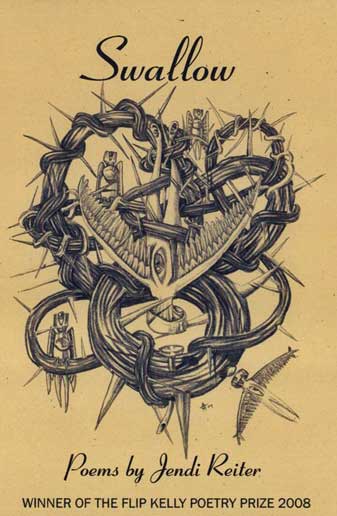
“Swallow” Gets Downright Eucharistic on Logic’s Ass


Martha Rzadkowolsky-Raoli has written a fantastic review of my chapbook Swallow (Amsterdam Press, 2009) for the Ampersand Books website. She’s reverse-engineered these rather difficult and prickly poems to make clear the theology behind them. The miracle of writing: when our readers mirror back to us more than we consciously realized we had said. I wrote Swallow by mad intuition, but an astute reader finds “method in it” after all. Some highlights:

Jendi Reiter created a tidy poetry book in which swallow means everything you can expect swallow to mean. She exhausts the word; its mashed remains a mix of cow meat, desire, intestines, bird. If you read the book, and you should, you’ll experience the beating of the word. Swallow. How else to learn something new ?(about the parameters of language) — – something only poetry can do, and these poems do it….

****

…By suggesting disparate contexts, these aphorisms maintain a collaged-world view. I like Reiter’s objection to a poetics bound by singular points of view. I like when word-artists comply with the rules of our new universe (a mess of sources coming at you from everywhere: billboards, email, the doorman). This kind of work feels real….

****

…Reiter’s rhetorical tricks can remind me of the riddle-ish catechism I was taught. The relationship between premises in these poems get downright eucharistic on logic’s ass. Mysterious pronouncements sound as zany as any church stories of body-magic: The body jesus lived in, the jesus body that is the eucharist, and the jesus body that you put into your body….


Read the whole review here.

You know you want it now:


Doubt Series, Part Two: Trust in (Some of) the Word(s) of the Lord


Trust. It’s an inference from the seen to the unseen, from the past to the future. Though “live in the moment” is the spiritual catchphrase of our supremely distracted society, trust tells us to do the opposite. This mood will pass, it says; this person or situation deserves to be seen in context, not judged on a surface reaction.

In order to learn from our teachers at a deeper level, we have to trust them. I first realized this when I took voice lessons in my 20s. Before then, I thought of my teachers as the people who gave me assignments, which I would figure out for myself, or decide not to complete if I didn’t consider them worthwhile. I really wanted to learn to sing, but unlike schoolwork, I didn’t even know what the necessary skills were or how to acquire them. My voice coach used a delightfully absurdist method that involved interfering with my normal control mechanisms (e.g. holding my tongue while I sang an aria as “glah glah glah”) to bring out the natural, relaxed voice. I couldn’t understand why this would work; all I could do was surrender to it, or not. Fortunately, I did. I not only learned how to sing, but how to trust.

Spiritual development happens the same way. All the human minds in the world, put together, can’t encompass the infinity of God. If we share our insights, though, we can get a bigger picture of God than if we each had to start from zero. Sometimes we can test others’ beliefs against our own experience, but (as with history, or science, or any other knowledge field) many times we also have to rely on second-hand reports.

The question is, which ones?

When I was preparing for baptism into the Episcopal Church, about 10 years ago, a conservative Catholic friend explained the magisterium to me as follows: The more we find that the Church has been reliable in areas of our direct experience, the more we realize we should trust the Church’s commands even when we don’t understand them so well. Later, Protestant friends would make a similar claim about the Bible.

For a long time, I was open to this, never to the point of believing in papal or Biblical infallibility (an incoherent concept, in my view), but generally feeling that as a Christian I ought to give tradition the benefit of the doubt. St. Paul’s words about grace in Romans 7-8 were lifesaving to me, and this encouraged me to hope that the rest of the Bible was infused with the same wisdom and power. Sure, I knew about the sexist, violent, tribalistic, unscientific, and plain weird bits of the Bible, but these were “a few bad apples”.

That was before I started hanging out with actual Christians.

My teachers in the faith were only human. They could have a gospel-inspired heart for the poor and a hardened heart toward unbelievers; a radically welcoming stance toward doubters and marginalized people and a smug liberal contempt for my “personal relationship with Jesus”.

But this complicates the issue of trust. Human psychology, like the Bible, being irreducible to a consistent philosophical system, it’s an oversimplification to say “Pastor X or Prophet Y was right about war, therefore he must be right about sexuality.”

Yes, the Bible is the place where I’ve found transformative forgiveness and comfort, and a vision of full equality for all people. It’s also the place where I’ve found condemnation of innocent people, and justification for oppressive social structures.

I’m at a point where I feel comfortable using the ethics of Jesus, as found in the gospels, to judge and prioritize all other Biblical texts. But then what remains of the Bible as a unified thing? The unraveling can be compulsive. I still read the Scripture passages each morning in the Daily Office, but with the mind of that combative high-schooler I used to be. I might like to believe the promises of vindication in the Psalms, for instance, but a little voice nags me that I have no basis for this, no reason to trust these words merely because they’ve historically been part of the same collection as other documents that I currently find convincing.

Oh, taste and see?
 

Charles W. Pratt: “Evening Meditation in a Cathedral Town”


Charles W. Pratt’s From the Box Marked Some Are Missing: New & Selected Poems (Hobblebush Books, 2010) is the most delightful poetry collection I’ve read this year, and I read many. The comparison that first springs to mind is Richard Wilbur, as both poets have more than ordinary gifts for writing formal verse that is light-footed, elegant, and full of surprises. Think of a Fred Astaire dance routine, or a Bach minuet: the underlying order is there, but never belabored on the surface. There’s no egotism or careerism in Pratt’s displays of skill. Not that I have anything against “confessional” poetry, but it’s also refreshing to read an author who echoes an earlier age, when poems could be reticent about personal details yet full of emotion.

From the Box… was the first volume in Hobblebush Books’ Granite State Poetry Series, which publishes authors with a connection to New Hampshire. Many of Pratt’s poems concern his work as an apple-grower, describing the farming life with humor, wistfulness, and reverence. There are also poems of family life, European travel, meditations on aging and and the mystery that lies beyond.

The poem below is reprinted by permission. This one stood out for me because of the mood, delicately balanced between modern empiricism and timeless wonder, and the intricate pattern of the rhymes. Note the deft double meaning of the closing line.

EVENING MEDITATION IN A CATHEDRAL TOWN

Transparent on transparency,
A lacewing on the windowpane.
Pale green traceries of vein
In the lancets of its wings sustain
A membrane too fine for the eye.
As tranquil on the mystery
Of glass as if taught by its wings
How to put faith in invisible things,
In slow sweeps back and forth it swings
Its frail antennae thoughtfully,
Like compasses that leave no mark:
Geometers imagining the arc.

In the cathedral treasury
I’ve gazed, unmoved, at the Virgin’s shift,
Draped like dead insect wings—enough,
The histories repeat, to lift
That heap of masonry so high.
Others believed in it; now I
Where the great stained windows raise
Their winged parabolas of praise
Day after day can bring to graze,
Sheepish, my agnostic eye.
Such precious straining of the light
Surprises stone and souls of stone to flight.

Small concentration of the evening air,
Lacewing, I look through you and glass to where
Beyond the fields the late sun condescends
To denseness, and its true brightness bends
And bursts to beauty where the transparent ends.