Monday Random Song: Jason Bravo, “Isn’t Love Reason Enough?”


My good friend Jason Bravo wrote this beautiful song about being true to yourself. Maybe I’m biased, but I think it could be the next “Born This Way”. No YouTube video yet, but you can stream the MP3 from his website. Purchase Jason’s album Between Head and Heart at CD Baby or on iTunes.

ISN’T LOVE REASON ENOUGH?
(Words and music by Jason Bravo)

Remember that summer when you and I walked on the sand?
We talked about life in a heart to heart that was unplanned.
We climbed on the rocks and we followed them along the shore.
You talked in a way that I never heard you talk before.

And I could hear your words unsaid.
I could feel your pain.

CHORUS:
You’ve been looking for a reason not to hide it all away.
But ISN’T LOVE REASON ENOUGH?
You’ve been looking for a reason to be who you are someday.
But ISN’T LOVE REASON ENOUGH?

There are so many things that I wish you could learn from my past.
So many decisions that I’d change if I could go back.
I’d shake off my fear and my armor and let down my guard.
I wish someone told me life didn’t have to be so hard.

But I can’t live your life for you.
I can’t dream your dream.

CHORUS:
You’ve been looking for a reason not to hide yourself away.
But ISN’T LOVE REASON ENOUGH?
You’ve been looking for a reason to be who you are someday.
But ISN’T LOVE REASON ENOUGH?

The love that dares not speak its name
Is love just the same.

CHORUS:
You’ve been looking for a reason not to hide your heart away.
But ISN’T LOVE REASON ENOUGH?
You’ve been looking for a reason to be who you are someday.
But ISN’T LOVE REASON ENOUGH?

Love, love should be reason enough.

Winners of the Alabama State Poetry Society David Kato Prize for Poems about GLBT Human Rights


The Alabama State Poetry Society offers a twice-yearly contest with a variety of themed prizes sponsored by different individuals and poetry organizations. For the Fall 2011 award series, I sponsored the David Kato Prize for poems about the human rights of gay, lesbian, bisexual, and transgendered people. (Prizes: $50, $30, $20, plus HM’s at judge’s discretion.) The award honors a Ugandan gay activist who was murdered this year. With the permission of the authors and the ASPS, I am pleased to publish the winners below.

First Prize:

what more is there to say
by Barry Marks

oh mama mama
oh god mama
how can i not believe
believe you made me what i am
you and papa
god papa what do i say
what do i say when i say who i am
who am i to question you mama
when you say i should not
i should not fit myself into another self
it is not enough that a self is warm
is loving is wanting my self
the self you made the way i am
the way you are
you must be
as i must be
who is anyone to say
to say this does not fit there
or there or where i do not fit
do not fit whose formula
you formed me god mama
god papa should i speak of
god papa on god mama to make
baby god me or was god mama
on top how irreverent how shameful
to think of a god mama god papa
oh my god
mama oh my god
papa if that is so awful
shameful then why should anyone
throw his her mind into my pants
my heart my private self i am
god baby just like they are
just like you are
oh god
mama
oh god
papa
i love you both
i love god
god loves me
what more
is there
to say

****

Second Prize

A Good Holt
by John Foust

I am giving you these words to savor your heartaches.
Am I? I give words to you, salt and pepper, heartaches.

I talk about cold morning and the lift they bring.
The cold splashing of the springs assault icy heartaches.

Standing in the wind waiting for the bus all my life,
It is good to feel warm hands on the vault of heartaches.

Running, all the time running with fare to catch love.
The doors open stepping up, I jolt fares into heartaches.

On the sidewalk, in the coats and swishing, I am alone.
Walking down the street, wrenches bolt tight heartaches.

Row strong in the winter waters of the human stream,
Keep warm, keep a good holt on your hidden heartaches.

****

Third
Prize:

daymares
by Janet Anderson

consider the bliss sitting
absolutely still, your
mind completely numbed.
no free-fall ideas trickling
off into childhood, or tomorrows,
only anonymity.

uneasy to be human, to feel
like an outcast with a brutal
imagination. To beat and beat
yourself against your slab of mind,
the convolution of colors raking
into a long, white, outstretched reach,
the flame groping for the spread
of fire, the floating, diving words
wanting out, freedom
from discrimination, freedom
to be, to clam your own bones
to nest in.

****

First Honorable Mention:

Closet Elegy
by Susan Luther

In the middle of the night I felt the urge.
Got up, and went down the hall. It was not
my house, but — not exactly strange either. I knew
where to find the necessary door. Business finished,
I turned the doorknob back into the room
I had come from. which… wasn’t. Was unfamiliar
hostile darkness — half awake, a blank abyss, nothing
to know who or where I was by, like the time,
staring at Uniform Reality in the reception line
I forgot my own name. No shred of illumination,
adjusted vision. Only black on black
vertigo, the floor capsizing underneath.
Is this how you felt when Alzheimer’s first
augured holes — boarded entrances — into your mind?
How you felt before, under the sentence of your daughter’s
(to you) banish-imperative not-in-my-house bad news? Is this
how she felt you felt have felt feel, others feel, trapped
in telescoping rooms of denial panic incomprehension
difference Open the door Open the door OPEN THE DOOR

****

Second Honorable Mention

the right to be very human
by Catherine Moran

And I say,

being human holds all the glamour
of a rainy picnic on Mars.
We have to fashion our own umbrellas
to hold the elements at bay,
and juggle to keep
the food warm and ready.
All the while we project a certain image
demanded by the social circle.
Those who don’t look like they belong,
are left drifting into puddles
and being soaked by stray drops.

And I say,

everyone has a right to be warm and dry
at the picnic.
Loving and caring for another person
is the most basic human gift
we can bestow on each other.
Sexual orientation
matters little when it comes to kindness.
And when one person
touches
the deep humanity of another with a spirit
of love and concern,
we are being the best creatures we can be.

And I say,

what people wear or
with whom they prefer to spend their time
become such a minor issue.
In a world where humanity can
dish out meanness like a leftover casserole,
any semblance of compassion
is as welcome as fresh thyme.
Being human has its drawbacks.
If we can open the umbrella a little wider,
the picnic can progress
with everyone dry
and plenty to eat.

****

Third Honorable Mention

Prometheus Bound
by Caren Renee Davidson

You met the cold hammer
Cast from Vulcan’s own fury.
You chose to have the fires
Show the sameness
of your face.
You are still Prometheus
the Teacher.

New Poem by Conway: “Tree of Uncertainty”


My prison pen pal “Conway” sent this poem in his Aug. 31 letter, written on the back of a disciplinary notice he received for participating in a hunger strike to end inhumane conditions in California prisons. Sign the online petition to support their protest.

Tree of Uncertainty

Begin with a gallery
  hung up high.
     Who was I, was I not
        a lost thought,
         or shattered thinker?

Fingers point, look closer
  in-out at everywhere.
    Full-blown kaleidoscopes
      show new-views
        if hopes dare.

Paint chips, in the musical time
  of crackling things, tripping
    over too many, themed questions.

How many more designs, laws
  years, flaws, locked-up tiers?

Stacked absence, bad dreams
  muffled screams, slipping
    while existence’s sad smile
      silently cracks;
      Like the sidewalk, Avenue
    you used to skip
      on the way to school; Now
      A void, now a prison
      no win, deep end,
  as chain-bound sleep
    blankly yanks away
    another dusty,
      day plus day.

Still
  I miss, what nothing needs.
    (Excepting maybe weeds,)
      That feed upon, another caustic dawn
    which was lost again
       when I was found, gone.

So, escort mere mourning
  that drove time here
    minds migrating
      to counts we cleared.

Leaf through these pages
  like History, or listen
    to leaves, fall off this tree
      burdens of, uncertainty…

Ten Years After 9/11: Poetry and Some Thoughts


This weekend marks the tenth anniversary of the September 11 terrorist attacks on the World Trade Center and the Pentagon.

Back then, our family was still living on the Lower East Side of Manhattan. At 9 AM, I came upstairs to my office at a publishing company in the West 30s to find everyone peering out the window at smoke billowing from the WTC. We could only see the top floors in the distance so we were not sure what had happened. We saw the flash that was the second plane hitting, but only found out later what had caused it. After that, the grey cloud of smoke and ash was all we could see. Shortly thereafter we learned from the radio that the towers had collapsed and another plane hit the Pentagon. It was then that I became really scared: this was not an accident, it was an attack, and anything could happen now. I don’t remember how we evacuated from the 21st floor, but I assume we must have taken the stairs. Fortunately my husband worked in midtown too and I could email him to come meet me, since the phones were not working.

We walked about three miles downtown to our apartment, part of a stunned crowd. The funereal silence and slowness of these typically high-adrenalin New Yorkers really brought home to us that our world had changed. (I am so proud of the residents of my birth city for not panicking and responding with such courage.) My moms lived across the street from us so we went up to their place to let them know we were all right. One of them was there and the other was making her way downtown from West 96th St., driving her co-workers home, as far as the emergency personnel would allow cars to go. Like everyone that day, we obsessively watched the televised footage of the disaster, hoping for information that would make sense of it all, although it was clear that only speculation and tragedy were on offer.

We were spared the pain that thousands of our fellow New Yorkers endured, in that we did not know anyone who was in those buildings. Our upstairs neighbor lost his brother, Robert Foti, a firefighter. We went to his funeral a few weeks later. Rest in peace, Robert. I will never forget his mother’s words when we paid her a condolence call. “They’ll never find their bodies,” she said, wiping her hand along the table. “See this dust? We’re breathing them in right now.”

What I remember most from those early days was the fear of what might be demanded of us. What sacrifices would we have to make? Would it be like World War II, when the homefront was part of the battle? I was worried that Adam would feel a sense of duty to enlist. Though I am the least bureaucratic person in the world and had just escaped from my legal career, I sent away for a pamphlet about joining the Judge Advocate General’s Corps.

Our preoccupations of the week before were tinged with tragic irony. Walking home from dinner, in a rush to watch the U.S. Open, Adam and I got sidetracked into an argument about his wish for children. Newly independent of my parents, I was afraid I wouldn’t get to experience life and make progress in my writing career before being submerged in someone else’s needs. After 9/11, I felt keenly the truth that “no one knows the day nor the hour”. Plans are uncertain; family matters most in a crisis. (Double irony since we still haven’t been able to make this happen…)

There was something beautiful about the mindfulness and tenderness with which New Yorkers went about their business in the following weeks. On a crowded midtown bus at rush hour, truly one of the more unpleasant aspects of New York life, I noticed that people gave way to one another instead of jostling and taking offense. We were suddenly grateful that each person next to us was still alive.

And simultaneously there was the crassness of the “Fight Back New York: Go Shopping!” campaign, the alarming speed with which the sidewalk vendors cranked out death-to-Osama T-shirts and flag-festooned junk. The mutual contempt of the pro- and anti-war camps, everyone desperate for a simple narrative, as if death always came to people with a reason and a forewarning, visible if we looked hard enough.

It was supposed to be the end of irony. Even if that had been true, I don’t think it would be a good idea. We need all possible interpretive tools to make our way in a world where 9/11’s happen. What it was, instead, was a collective moment of appreciation that life is precious and mysterious, and that no one is really a stranger. That consciousness was too painful, though, and too unprofitable, to keep up for long. “Go, go, go, said the bird; humankind/Cannot bear very much reality.”

But for that little while, we cried at baseball games, we wore our flag lapel pins and bootleg NYPD and FDNY caps, we prayed over the names in the newspaper and asked forgiveness for being unable to read one more obituary, and we wrote poetry about crashing planes and falling towers and heroes.

Adam and I had just started Winning Writers that summer, and we were putting together the rules for our first annual contest. Distressed by the simplistic verses being written by both the blame-America liberals and the kill-the-Muslims conservatives, we decided that our contest should solicit high-quality and nuanced poetry about war. (2011 will be this topic’s tenth and final year, to be replaced by the Sports Poetry Contest.)

These poems from Israeli author Atar Hadari, honorable mention winner in our 2003 contest, best express how New York felt to me in the aftermath. The “two lights” are the memorial Tribute in Light that represented the lost towers with spotlight beams.

Read more 9/11 reminiscences at the WNET-Channel 13 public television website.
****

SUMMER RAIN

by Atar Hadari

This is the season people die here,
she said, Death comes for them now.
Sometime between the end of winter
and the rains, the rains of summer.

And the funerals followed that summer
like social engagements, a ball, then another ball
one by one, like debutantes
uncles and cousins were presented to the great hall

and bowed and went up to tender
their family credentials to the monarch
who smiled and opened the great doors
and threw their engraved invitations onto the ice

and dancing they threw their grey cufflinks
across each others’ shoulders, they crossed the floor
and circles on circles of Horas
filled the sky silently with clouds, that chilled the flowers.

And funeral trains got much shorter
and people chose to which they went
and into the earth the flowers
went and no one remembered their names

only that they died that summer
when rains came late and the streets emptied
and flags flying on car roof tops
waved like women welcoming the army
into a small, abandoned city.

TWO LIGHTS
by Atar Hadari

Two lights were fixed over the town
high up, higher than any star had business being
and yet they shone, not like helicopter beams,
like flames, like something burning and not being consumed.

I stepped two steps toward the fence
to see, to try to see, the fire –
they stayed two gold balls in the sky
and I trod on some stones and smelled dog piles.

Whenever I tried to hear roar
of propellers’ wings, the milk trucks
would careen by in their floats
and commuters late home whizzed by in droves
like ice cream vendors.

Eventually one went out
then the other and suddenly
way above them both
another lit, preternaturally still,
an emptying cinema’s white bulb.

A jogger came out of the dark
my side of the fence
I waved, “Do you know what that is?”
“It’s light to find the terrorists,” he said

and ran and I walked away
looking thru at darkness
and left one bulb in the middle
of the empty cinema

like traces of a flame
after you’ve closed your hand
and clenched your lids
and walked out of the shot

and lights still burn in that sky
and I translate the word of God
out of Hebrew. And wanderers in that dark
mistake those lights for guides through the ruins.

“Prayer”: A Poem from “The Voodoo Doll Parade” by Lauren Schmidt


Lauren Schmidt’s The Voodoo Doll Parade was selected by Terry Wolverton for the Main Street Rag Author’s Choice Chapbook Series. The profane becomes sacred under this poet’s unflinching attention, in earthy poems about illness, sex, and prayer (and sometimes all three tangled up in bed together). The heart of this chapbook is a series of unforgettable narratives about homeless and mentally disabled clients of The Dining Room, a soup kitchen in Oregon where the author volunteered. The poem below is reprinted by permission. See her author page on the MSR website for more samples and purchasing information. Please order books from MSR to support this excellent small press that publishes writing with a social conscience.

PRAYER
for Jeremy

When I clear your table after you’ve gone, there’s a small scrap
of paper which reads: “God Bless You. You are Beautiful.
I Promise to Pray for You.” Pray for me? Pray for me?
Then pray for me that I wake up in the morning in a bed
and lie there, that I give my blessings their proper names
and faces, the blessings that keep me from a life too like
yours, pray for me. Because the first thought of my day

is hunger, pray for me that I eat. But pray for me that I know
hunger, pray for me. Pray for me that I feel myself in
the growl of your belly, that I remember I am more like you
than I remember, pray for me. Pray for me that I am Rodney
with his weary eyes who is all at once teacher, cousin,
neighbor, friend, and the stranger who held the door for me
when my arms were full of bags, please pray. Pray for me

that I am the woman with earth-rich skin. Pray for those hands
that slammed her plate face-down into the table for me to clean.
Pray for me that I know no such grief, pray for me.
Pray for me that I am Larry whose fingers shoot music
into the belly of the piano; those same seven songs spark
from its upright head. Pray for me that I have the comfort
of knowing what comes next, pray for me. Pray for me that I am
the blind man because the room knows to make room for him.
People move tables, chairs, themselves, part a path for him as if
he were a king. But pray for me that I make way, pray for me.

Pray for me that I am Amber with her Vaseline face,
whose words are frenzied centipedes that scatter from her lips
and braid above her head. She stares at them like a mobile
or a noose. She stares at them like she would a heaven. Pray for me

there’s a heaven. That the demons inked along Leanne’s spine
do not exist, pray for me. Pray for me that my back can carry
such blackness if it needs to, pray for me. Pray for me that I am
the pregnant girl who is allowed a second plate. Pray that I know
the power I hold in my body, for a tiny king can grow eyes in my body,

please pray. Pray for me that I am the man in this same room, seated
at another table, the man that gives the girl his milk. Pray for me
that I remember to give up my milk. Pray for me that I am the milk.

Two Poems from “Slouching Towards Guantanamo” by Jim Ferris


Jim Ferris is an award-winning poet and professor of disability studies at the University of Toledo. His first full-length collection, The Hospital Poems, won the Main Street Rag Poetry Book Award in 2004. In The Hospital Poems, Ferris writes about the multiple surgeries he endured as a child to correct skeletal abnormalities. He questions the purpose of the isolation, pain, and stigma he experienced as a perpetual patient. Was this course of treatment really for his benefit, or primarily to bring him closer to society’s idea of a proper-looking human body, to make others comfortable looking at him?

In his new book Slouching Towards Guantanamo, also from Main Street Rag, Ferris extends this radical inquiry to our body politic. Our discomfort with the body’s vulnerability forces certain lives offstage–the lives of the crippled, the war-wounded, the oppressed–and once we can no longer see them, we can allow ourselves to think that they don’t have feelings equal to ours. Who sees and who is seen? What is the difference between being seen and merely being looked at?

This prophetic poet asks us to shed the burden of our ego so that differences between ourselves and others can simply coexist without comparison or judgment. Notwithstanding the spiritual weight they carry, these poems are playful, musical, satirical and passionate. The poems below are reprinted by permission. Read more on his MSR author page.

FACTS OF LIFE

Where’s the glory in it? I am not
a survivor. Whatever the state
of my legs, whatever happened
there, know this: I walk down the street
whole, whether I limp or stumble,
cane or crutches, roll in a chair.
This is my body. Look if you like.
This is my meat, substance
but not essence, essence but not
fate, sum of all its particles
back to the big one but particular
to no single interpretation
in a cosmos of possible ontologies
that we all try to limit with all
our soft might but which accepts
only the most temporary
instructions: you, sir, explain
that birthmark, and you, how about
that nose? We are not signs,
we do not live in spite of
or because of our facts,
we live with them, around them, among,
like we live around rivers, my cane,
your warts, like we live among animals,
your heart, my brace, like we live with,
despite, because of each other.

****

MANIFEST DESTINY

I love Mark Twain and the Mississippi steamboats and Abraham Lincoln’s dogs.
I love the fields of wheat and corn and the smell of Virginia tobacco.
But I am not American.
. . .
Take the stripes of your flag
and give us the stars.
     –SAADI YOUSSEF, “America, America”

I see you, America.
I am your dying son.
I recall your stories
of hope and of glorious
trails to true freedom.
Give me liberty, go west, go deep.
One small step one giant

I hear you, America.
I am your deaf-blind child.
I may have been cute once,
up on that poster, but America,
you are my inspiration.
We hold these truths
to be self-evident,
we who have hands to hold
and eyes to see.

You watch me as I cross the street—
I must be something to see.

Send me your tired,
your poor, your huddled masses
yearning to breathe free—
take a deep breath—now ask
why they look at us that way.
Greatest country on earth—
in the history of the earth.
In the universe. Ever. Top that.

I smell you, America
you are in my pores, you
are the dirt beneath my nails—
you are my nails. All I eat
and drink and breathe are you.
Why am I no longer high?
Why does my head hurt?
Why do I have so many staplers?

You watch me as I buy groceries—
I must be something to see.

I feel you, America,
even deaf-blind I feel you go by,
I am your comatose wife.
Yoked together by a vow
made long ago, now I lie
here, and you lie away. When you love,
when you honor, will you protect
me from yourself? Just who is

your self, America? Do I
count? Three-fifths, say? I
am the crippled newsy on the corner,
the guy on the knuckleboard, not a leg
to stand on. Now I am the standard-bearer,
standing out not up. Stand by, America—
this just in: you need me. I am your face
in the family portrait, just as you blink.

You watch me though you are discreet.
I must be something to see.

I taste you, America,
pilgrims pride and fruited plain,
turkey dinner once a year,
I am your orphan child.
I am your silenced majority.
You would pave me to make me whole,
bronze our laughter to save it,
feed the world on hamburger,
coke, fries, and freedom’s tales,
talk of choice and honor
and a thousand channels.

I watch you, America,
I am your slow son,
your dumb-blonde daughter,
you are what’s on. Is anyone
listening? I am the deaf-blind cripple
who is always listening,
watching, waiting to be fulfilled.
I see you, America, I see you,
see me, hear me, be me too.

You watch me like I am quite chic.
I must be something to see.

I am too hard for poems, America,
too empty. You are too brittle, too small.
One drop overflows me,
the oceans cannot fill you,
nothing soaks through.
The maw of America is open,
friendly is our middle name,
the only thing we have to fear is fear itself.
We take care of our own. We’ll take care
of you, too, if you don’t watch out, bud.
We have no room for poems, no time
for poems, no place for the people
of poems. Be one of us, be
a winner, be a saint, be secure
in righteousness, look forward to glory,
and take rewards both here and hereafter.

You watch me as I eat.
I must be something to see.

Liberty or death, America,
and you stand for both, indivisible,
one nation under the wrath of an angry God,
meting out liberty and justice to all
who get in our way. Forty acres and a mule,
America, paddy wagons and loyalty
oaths, banned books and internment
camps, peace pipes and more treaties,
and how about some blankets, too.
The policeman isn’t there to create
disorder, America—the policeman
is there to preserve disorder.

You watch me as I walk down the street.
I must be something to see.

I have a dream, America. Ask not.
I have lost my way, America,
but I’m right here with you.
Oh, you who would eat the earth
and call it free, the only thing we have to fear
is fear itself. Take this hand, you who love arms,
take this hand, America, opposable thumb and all. We
are the people of poems. Let us bind up our wounds
and refit the prostheses we all require.
I need you, America,
I am your child and I need you.
We are all your children, the atoms of your hope.
Let the better angels of our nature
form a more perfect union,
and let us be orphans no more.
The tired, the poor, the high and low—
we are all watching.
I see you, America. We see you.
Ruth Sabath Rosenthal: “Bad Apple”


Ruth Sabath Rosenthal’s full-length poetry collection FACING HOME and beyond (Paragon Poetry Press, 2011) includes and expands upon her chapbook Facing Home (Finishing Line Press), 2010, which I excerpted on this blog last year. Ruth’s clear and sharp-witted writing addresses themes of family alienation, Jewish heritage, and the hard-won wisdom of an older woman who’s had to learn to rely on herself. The poem below, reprinted by permission, captures the spirit of this collection, by way of some lesser-known details about the Jewish legend of Lilith. Visit Ruth’s website to learn more about her work.

Bad Apple

What anguish when Lilith figured out
her Adam was a die-hard prick, repeatedly
refusing to let her flower atop his stem.

From the get-go, he commanded she be
on the bottom. Wanting his seed, she was dutiful
wife, coy lover swallowing bile, biting her tongue,

bearing him sons, and yet, the stiff-neck refused
to soften his manner or change his position:
He wanted her always under his thumb,

kissing his feet, the ground he stood on. She revolted,
and under threat of God-awful wrath, took one hell
of a lover — a swain who liked her on top,

but said kids were not fit to live with.
She sided with him, decided to leave Adam,
against the wishes of three angels who warned

they’d kill off the hundreds and hundreds
of sons she expected to bear, if she carried
out her plan. She turned that around by conceiving

her own twist on their threat: She would kill all
the newborns she cared to — a diabiblical campaign
the angels condoned only after she swore to

spare those infants wearing a talisman inscribed
with the angels’ names. And furthermore,
she’d seek to demonize men by having her way

with them in the deep of sleep, turning each
into licentious pricks lusting to distraction,
perversion. As for women, she’d instruct each

to cease acting beneath men in any manner or form.
Her plan carved in stone, she bid Adam farewell,
but not before ribbing him unmercifully

about his dream of finding the perfect wife,
“a fit wife.” And likely he would, as one man’s poison
is another man’s pleasure
, or so it is written.

Alegria Imperial: “this change of name”


Alegria Imperial, a frequent contributor to this blog’s poetry pages, shared with me this meditation on an important upcoming transition in her life. Originally from the Philippines, she will now have dual citizenship in her adopted country, Canada. Her spare, elegant language and attunement to nature show the influence of yet another country, Japan, as her writing has been shaped by the discipline of studying haiku and tanka.

Alegria says of her multiple identities: “I’m about to take my oath as a Candian citizen and pledge allegiance to Queen Elizabeth II! I find it both exhilarating and ironic (the pledge of allegiance, in particular); here I am coming from a country that fought for freedom from Spanish royalty for 300 years, regained it, lost it again, and gained it back, but chosing to move to Canada I will now willingly become a subject to a queen in a few days.”

this change of name
by Alegria Imperial

it is
a matter of spelling
only
this change of name

or am i fooling
the skies i look up to
the clouds
none i can name

the mountains
that shimmer
stealing in in stead
the names

of mountain ranges
facing East
among its jungles
my spirit roosts

alien snow
now smothers
my laughter
i drift aground

is earth
unlike the sun
untouched
by sorrow?

i hear
from mourning doves
the language
of dawns

i mismatch
evening clouds
in my dreams
the chill stays

yet the sparrow
shares its songs
that seep into my sleep
lull my world

i regain my name
on Hollyburn
where a lotus by itself
on the lake

–such poignancy–
mirorring my loneliness
soaks the sun
as if enough

i trail the buds
lined along the Fraser’s North Arm
winding down and up
the river bed

the tide cuts a line
between my dreams and the sky
ripples catch my breathing
in rhythmic sighs

i’m scaling the breast
of Burnaby Mounains
my soul resists
its longings

i’m close to home
close to sinking
in the foam
skirting Horseshoe Bay

an eagle skims
my rhyming
my longings weave
in and out of the air

on a skein
of cherry blossoms
once only paintings on scrolls
i learn to haiku

–thinking of moths
in my childhood those slivers of light
that die on the light
and fade in the morning–

on my waking
i am who has always been
the city aground on my steps
whose name i can now say

even in sleep–
Vancouver


Carolyn Howard-Johnson: “Inevitably Walls”


Carolyn Howard-Johnson is a widely published poet and the author of several marketing manuals for writers, including The Frugal Book Promoter. Her site The New Book Review features original and reprinted reviews, to help authors maximize the exposure of a good review. (This month, they’ve re-posted a review of my chapbook Swallow that first appeared on the Ampersand Books website.)

Carolyn’s poem “Inevitably Walls” was recently accepted for the first issue of the literary journal Solo Novo Wall Scrawls. The journal is published by Solo Novo Press, Carpinteria, CA and North Wilkesboro, NC. Editor Paula C. Lowe says, “‘Wall Scrawls’ is inspired by an Iowa farmhouse wall. Eighty years abandoned and orphaned, it is a hive of letters, a busy kitchen of words. Every kid with a can of spray paint somehow gets here and leaves his or her native tongue on the walls.” They’ve kindly given me permission to share it below.

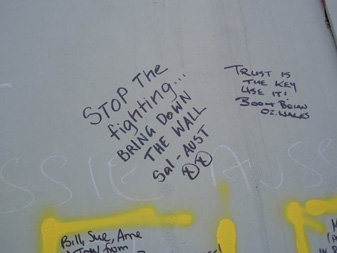
Inevitably Walls

Near Jerusalem’s edge razorwire
coils above concrete slabs that trace

an imaginary line across the brutal
desert much like a wall we found

years ago when we lost our way
in a dark forest somewhere

in Germany, cried when we
found it there—unexpected—and it

not so different

from one in Ireland we visited only
last year, walls to cleave Irish

from Irish. Foreign walls, chains-linked,
wire-barbed, Krylon smeared walls

not so different

from our own, that fence that crawls
from Baja, through mountain passes

along the Rio Grande. Walls. Feeble, useless,
unholy billboards. Even poets

once wrote of mending walls…


Thursday Random Song: Talib Kweli, “Cold Rain”


Some of the most creative rhyming among contemporary writers can be found in hip-hop and rap music, but it’s a guilty pleasure because of the misogyny, homophobia, and violence that the lyrics often glorify. A welcome exception is rapper Talib Kweli, who fits within the social protest tradition of slam poetry. His album The Beautiful Struggle is in my frequent playlist. He recently appeared on The Colbert Report to promote his new album, Gutter Rainbows. Enjoy this clip of him performing “Cold Rain”. Lyrics below courtesy of killerhiphop.com.

Cold Rain


Lets try something new
It’s been a long time coming!
Let me try something brand new
Hey yo Ski!
What you ever do, man?
Come on!
Yo, what we doing it for?

This is for all the day-trippers and the hipsters
Whores and the fashionistas
Spiritual leaders practicing all the laws of attraction
The teachers who read the passages from the Bhagavad Gita
That be bustin off Dalai Lama’s or flashing heaters
the last of the boosters
With the shooting, the thugging and all the booning and spooning
and all the crooning, and cooning and auto-tuning, alive
You be tellin, peddlin’ to consumers I’m helping them to see through it
get with this new movement,
Let’s move it!

Feel the cold rain
Still I’m standing right here
Even the winter summer days

Yeah I’m a product of Reaganomics
From the blocks where he rocking a feds like J Electronica
drop and make this a lock
if he promises where the heart is
whether Jesus or Mohammad
regardless of where the Mosque is (word)
They hope for the Apocalypse like a self-fulfilling prophecy
Tell me when do we stop it?
Do they ask you your religion before you rent an apartment?
Is the answer burning Korans
So that we can defend Islamics?
The end upon us with a hash tag, a trending topic
You take away the freedoms that we invite in the game
Then you disrespect the soldiers; you ask them to die in vain
In a desert praying for rain
The music’s like a drug, and they tend to take it to vein
It ain’t for the well-behaved
The soundtrack for when you’re great but its more for when you’ve felt afraid
More than your average rapper
So you sort of felt the way
The brain is like a cage, you a slave, that’s why they lovin’ you
This is the book that Eli that start with a K-W.

I do it for the trappers, other rappers
the Backpackers, the crackers
the n-ggas, the metal-packers
the victims of ghetto factories
I do it for the families, citizens of humanity
Emcee’s, endangered species like manatees
I do it for the future of my children!
They the hope for the hopeless
Karma approaches, we gon’ be food for a flock of vultures
The end of the World
Ain’t nothing left but the cockroaches
and the freedom fighters
We’re freedom writers like Bob Moses
the chosen, freedom writers like Voltaire
For my block, my borough, my hood, my city, my state, yeah
My obligation to my community is so clear!
yeah, we gotta save them, this opportunity so rare!
We do it so big over here that it’s no bare
To the punks, bitches, the chumps, the snitches, the sneak in the game
We let them live with all they’re weak and they’re lame
The bozo’s and joker’s, promoting when they’re speaking my name