Beer-Battered Squirrel (‘n’ Dumplings)


Turning Point Books, the publisher of my first collection A Talent for Sadness, is an imprint of WordTech Communications in Cincinnati. WordTech’s various imprints have published well-known poets like Robert Hass, Allison Joseph, and Rachel Hadas, as well as many emerging writers. Their monthly e-newsletter keeps us all up-to-date on one another’s readings and book reviews.

That’s where I discovered Richard Newman’s memorable poem “Wild Game“, from his collection Borrowed Towns (Word Press, 2005). “Wild Game” was featured on Garrison Keillor’s NPR broadcast The Writer’s Almanac on June 22 and can be read on their website. In this poem, the narrator reminiscences about his great-grandma Lizzie, whose scandalized in-laws were unable to polish away her zesty backwoods ways. I appreciate Newman’s use of the sonnet, that highbrow and tightly controlled form, to symbolize and poke fun at their containment efforts:

…It wasn’t that her wildness was tamed—
Lizzie used the finishing they taught her
to sneak the savagery in under their noses.

Roast haunch of venison, roast possum
with cranberry sauce, hare pie, quail on toast
points, merckle turtle stew, and the most
famous dish of all: cherry blossom
gravy, dumplings, and beer-battered squirrel.


Read the whole poem here .

Also in the WordTech newsletter, I enjoyed Meredith Davies Hadaway’s “Hall of Records“, an honorable mention winner in the 2010 Robinson Jeffers Tor House Prize for Poetry. Her book The River is a Reason is forthcoming from Word Press next year. They also published her first collection, Fishing Secrets of the Dead, in 2005.

Somewhere in a strange city,
my father cradled me in one arm while
gesticulating to the man in charge of records:

a birth—to write it down.

He’d always said we should go back there.
As if it proved that once and far away
we’d been part of the same enterprise.


The 2010 Tor House first-prize winner, Jude Nutter’s “Legacy“, is also amazing, as is every poem of hers that I’ve read. See her 2005 first-prize entry in the Winning Writers War Poetry Contest here .
New Poem by Conway: “Coliseum”


“Then I saw that the wall had never been there, that the ‘Unheard of’ is here and this, not something and somewhere else, that the ‘offering’ is here and now, always and everywhere — ‘surrendered’ to be what, in me, God gives of Himself to Himself. So long as you abide in the ‘Unheard of’, you are beyond and above — to hold fast to this must be the first commandment in your spiritual discipline.”  –Dag Hammarskjold, Markings

My prison pen pal “Conway” shared this quote with me in his latest letter. Too well, he understands that the impulse to pin down and possess the sacred can fuel the self-righteousness of the oppressor. Hammarskjold suggests that God is a mystery that we abide in, with humility. Believing we can comprehend God is a short step away from believing that our group has the divine right of superiority over someone else who disagrees with us.

Conway also sent me a revised version of his poem “Screw”, which I published here here in May. Though I miss a few of the phrases from the original, I like this version’s tighter rhymes and slam-poetry energy, and the new title, which adds a dimension of political commentary.

Coliseum

Which bowl do I pick to torture me
I’ll choose one or two, but never three
that’s an unlucky number for me.

    All screw-ball;
Captured with fiction (false prevention)
for a warrant scored, law ignored
in turn arrested, past inspected
stuck in the county jail congested.
Forced to sleep on a nasty-ass floor,
as time passes by but never clicks
on phantom clocks (in our mind) that tick,
unless of course, someone pays for bail
cares enough perhaps, to spare those straps?

    Only then;
Can we be dragged, from beneath of it
this God-forsaken — bottomless pit
Where a pancake tastes like pigeon shit.

Jailbirds, bound against each other nude
then lewdly gagged with rude restraint
beseeching eyes express their complaint
scooching voiceless, along corridors.
Where chains, dragged in exploit (bragged about)
by infinite banes of committee —
sparing no scrap of humane pity.
Suffer the fools, this ruthless city
Controlled lies can never compromise.

    Show us when;
Take this summons they say “Come along”
It matters not, if you’ve done No wrong!
Blind’s the law, to an innocent’s song.

What is all of this, our time of day?
Without a window sun’s light to see
What would you say, if you had grown cold
while nakedly sold, then told “No way!”
you cannot wear their warm clothes today.
“Rue ice-cold talons of punishment”
chilled bones are part of this correction;
We must oppose (who chose) to strip skin
of warm clothes (like the fooled emperor).

    They say, while —
wearing a poison barbedwire smile:
“You’ll harm yourself for quite a long-while”
receive reprisal without god’ style.

Fool! pick your poison, get on inside
regardless if, you will not decide
to ever get caught-up on this ride
screaming so loud, to start a landslide,
where razor-wire, divides the road;
One, our ancestors surely have strolled,
built on fanatical persuasion —
on some poor fool’s screwed-up vision
sanctified rule of prohibition.

    Do you know?
To break free-spirit, is their main goal.
We only leave when we’ve paid that toll,
then, some lost soul just refills their bowl…

Tuesday Random Song: “Great Is Thy Faithfulness”


This song touched my heart when I heard it about four years ago, when I was just beginning to write my novel and was scared by the unpredictable ebb and flow of feeling close to my characters. I’ve always been hyper-aware of the transience of human lives, and for that reason, all the more grateful for the hope that God’s love is an unchanging foundation.

This clip is from The Big Sing at the Royal Albert Hall, featuring soloist Aled Jones and a whole lotta choirs.

1. Great is Thy faithfulness, O God my Father,
There is no shadow of turning with Thee;
Thou changest not, Thy compassions, they fail not
As Thou hast been Thou forever wilt be.

(Refrain)
Great is Thy faithfulness! Great is Thy faithfulness!
Morning by morning new mercies I see;
All I have needed Thy hand hath provided—
Great is Thy faithfulness,” Lord, unto me!

2. Summer and winter, and springtime and harvest,
Sun, moon and stars in their courses above,
Join with all nature in manifold witness
To Thy great faithfulness, mercy and love.

(Refrain)

3. Pardon for sin and a peace that endureth,
Thy own dear presence to cheer and to guide;
Strength for today and bright hope for tomorrow,
Blessings all mine, with ten thousand beside!

(Refrain)

Alicia Ostriker: “The Blessing of the Old Woman, the Tulip, and the Dog”


The column below is reprinted by permission from American Life in Poetry, a project of the Poetry Foundation. Sign up for their free weekly e-newsletter here . I was enticed by the fairy-tale sound of this poem’s title, and then nourished by its deeply joyful and embodied spirituality.

American Life in Poetry: Column 274

BY TED KOOSER, U.S. POET LAUREATE, 2004-2006
Alicia Suskin Ostriker is one of our country’s finest poets. She lives in Princeton, New Jersey. I thought that today you might like to have us offer you a poem full of blessings.

The Blessing of the Old Woman, the Tulip, and the Dog

To be blessed
said the old woman
is to live and work
so hard
God’s love
washes right through you
like milk through a cow

To be blessed
said the dark red tulip
is to knock their eyes out
with the slug of lust
implied by
your up-ended skirt

To be blessed
said the dog
is to have a pinch
of God
inside you
and all the other
dogs can smell it

American Life in Poetry is made possible by The Poetry Foundation, publisher of Poetry magazine. It is also supported by the Department of English at the University of Nebraska-Lincoln. “The Blessing of the Old Woman, the Tulip, and the Dog” from The Book of Seventy, by Alicia Suskin Ostriker, © 2009. All rights are controlled by the University of Pittsburgh Press, Pittsburgh, PA 15260. Used by permission of the University of Pittsburgh Press. Introduction copyright ©2010 by The Poetry Foundation. The introduction’s author, Ted Kooser, served as United States Poet Laureate Consultant in Poetry to the Library of Congress from 2004-2006. We do not accept unsolicited manuscripts.

TC Tolbert Interviews Performance Poet Sonya Renee Taylor


The blog Persephone Speaks is a project of Kore Press, an excellent feminist literary press based in Arizona. Persephone Speaks features interviews with authors and performers about the creative process, gender issues, social justice and antiwar activism, and much more.

Their latest newsletter introduced me to the work of performance poet Sonya Renee Taylor. Her first full-length collection of poetry, A Little Truth on Your Shirt , has just been released by GirlChild Press. See this video of her powerful and heartbreaking poem “Still Life” from the National Poetry Slam:

TC Tolbert, a genderqueer feminist poet and educator, recently interviewed Renee for Persephone Speaks. The two artists talk about sexual identity, the difference between poetry written for the stage and for the page, and the challenges of telling difficult personal truths in a way that is also healing and respectful toward the people in your life. Here’s an excerpt:

TC: How do we, as artists, – or, do we – consider the reader or audience? At what point do their needs influence what we create?

SR: It’s difficult. Nothing starts, for me, with the reader. It starts with me and my place in the experience, in the observation, in the thought process. That’s where it starts, for me. My decision to share that is about where I believe the reader exists in the work. There are things that I have written that I feel very clear that the reader does not exist at all in that work. And I feel very clear about that. Usually the poem will tell me if it is for more than just me. And if the poem tells me that, then I share it.

TC: A personal question I found myself wondering – has her mom read this? Has her dad read this? How do the folks who are very much present in this work, how do they respond? How do you navigate that?

SR: They know that they are in the book. There are a lot of pieces that they have heard already. I read “Penance” to my mother long before I considered publishing. We were having a conversation about how I could establish boundaries around her drinking and what I could do that does not re-traumatize me and I didn’t know what to say so I said let me read you this poem. Just yesterday I read the piece, “Dreams for My Father,” on the radio in Portland, Oregon and my father called me b/c he had heard me read it and he said, “When I hear the poem it reminds me that I need to call and tell you I love you unconditionally. So I’m calling to tell you I love you unconditionally.” And this is its own art in that experience b/c that is not where we started when I wrote that piece. The piece, “Fragility of Eggs,” I read to my mother when I first wrote it and she cried and asked me to never do it publicly. I obviously didn’t honor that. And here is my perspective. Whenever the experience impacts me, it becomes my experience. And as an artist, I want to honor the space where that came from. And I’m not going to not tell my truth b/c that makes you uncomfortable. Because it is mine. But what I feel committed to doing is writing from a space that honors, that doesn’t exploit, that shows the humanity in the experience. I can do that. I feel committed to doing that. But I don’t feel committed to keeping other’s secrets, for their sake. Not when it makes them my secrets too.

TC: That is interesting as it relates to other kinds of writing, like memoir, and the expectation that everything that is written is factual. I wonder what is the line in your work between what is factual and what is true?

SR: There is a difference. Truth is often conceptual. Knowing isn’t about detail. It is about core and spirit and synthesis. That is not about detail. That is not about making a left turn instead of a right turn at two in the afternoon. In my work, knowing and truth are about destination. And facts are about roads. How did you get there? Sometimes I absolutely believe in factuality. I am interested often in how do you make fact poetic. Fact is newspaper and newspaper isn’t often poetic and I’m interested in that line between fact and poetry and where do you create that. But I think poetry is about creation and creativity and nuance and language and I feel free to utilize that when I need to. And I feel like the truth in my work is always present. The other thing is that truth, in my work, is never about exploitation. I have read work that is more about exploiting the subject, reader, or audience to get the reaction you want but I never want to exist in that space. My story is about truth and people’s ability to find their own truth in my truth.

Here is a concrete example. In the Bonus section “Liking Me” it is about me and an interaction with a guy who does not want to use a condom. Did that scenario happen in that exact way? No. Have lots of scenarios similar to that happened? Yes. Have those always ended with me being super strong and saying “Get the fuck out of here – I’d rather masturbate.” No. Sometimes I’ve bent. But the truth of my spirit is that I know that I am more important than someone who is getting me to compromise my safety. That is my knowing. And that work is a vehicle to get me to live in my knowing and to get other people to live in their knowing.


Read the whole interview here .

Susan Stinson: “Tell”


Susan Stinson is the new poet-in-residence at Forbes Library, our public library in Northampton, where I recently had the pleasure of hearing her read from several of her books. Her published novels include Martha Moody and Fat Girl Dances With Rocks, and she’s also working on a novel about the Puritan theologian Jonathan Edwards.

The poem below is reprinted by permission from her chapbook Belly Songs: In Celebration of Fat Women (Orogeny Press, 1993). Stinson says that it came out of the process of writing Martha Moody. Like her, I sometimes find that the best way to get inside my fictional characters’ heads is to step outside the narrative, let them write a poem, and see what comes up.

Tell
 
   I realized I had to tell Martha.

   She’d given this gift to me: sex and an outpouring ofwords. I wanted Martha to be an adamant vision in theworld, with her low-slung belly swaying in the morning ofa culture. Martha: the woman standing on the scallopedshell emerging from the sea. Martha’s hair is red foam, herfist is tight, her knees are dimpled. She poured water on myfeet, and there’s no part of me that can forget that.

   I changed under the water and under her hands to anoutspoken woman. It was inspiration. She brought me tosex and to voice. She gave me a mouthful of wine. I drank,oh, I put my tongue along her tensed lips.

   The way I feel when I’m moving the words is so closeto what she gives me with her knee between my legs, herfingers spreading me.

   Please and thank you.
   She’s talking.
   Rich. Reach me.
   Reach inside me.

   My uterus has tongues and they are lapping at her knuckles.
   My cervix swells a story.

   Her own breasts fall, cascades of fat and nipple, over herpadded ribs. She is mammoth. She haunts me. My soul ismy own, but when I write I find Martha, the miracle,riding a golden cow. Much moaning and lowing, manysmall hairs.

   There are three forces. One is the body and my move-ments, need to eat, desire for Martha. Another is the spiritand the leaves and the way it moves in the leaves. Anotheris the spirit and the words and the way it moves in thewords.

   It moved me. It woke me. It caught me. It disturbedme. Then I had a moment of absolute presence. Martha.

In Memoriam: Rane Arroyo


The acclaimed poet Rane Arroyo died of a cerebral hemorrhage on May 7, at the age of 54. Arroyo taught creative writing at the University of Toledo. Read a tribute to him in the Toledo Free Press:

…“His death is a great tragedy and loss for poetry and Puerto Rican literature in the United States,” said Lawrence La Fountain-Stokes, a Latino studies and Spanish professor at the University of Michigan.

Arroyo was a mentor to La Fountain-Stokes, who said Arroyo was very generous with his fellow writers and fellow poets. Arroyo visited La Fountain-Stokes’ classes for presentations.

“He was an incredibly funny and warm person who was gifted as an artist. He had an ability to translate his experiences as a gay man and a Latino from Chicago, and the experiences with his family and with his partner. He was able to translate all of that into poetry that was accessible and that was in the grade of the great American and English poets,” La Fountain-Stokes said.

La Fountain-Stokes said Arroyo used his poetry to share his experiences as a gay and Latino man in the United States and show that Latinos have something to say in American Literature.

“In the U.S,. where gay and Latino people have been looked down upon, his work is very pertinent for our political atmosphere,” he said.


Sample poems from his collection The Sky’s Weight (Cincinnati: Turning Point Books, 2009) are posted on the publisher’s website . They’ve kindly given me permission to reprint this poem:

Come Back, Blue Jay

Let the cats interrogate far birds
to be forgotten after the sun returns to

its black hole throne. Daylight keeps me
safe from forever. No one has quoted

joy in years and yes it hurts
to be so jauntily human. Look!

A bluejay: blue, sky blue, like sky.
Clouds are slow period marks

in a profound letter to Now.
Why do we ever feel unloved?

****
Update: Read a tribute to Arroyo by editor Gloria Mindock in the June 2010 Cervena Barva Press newsletter.

New Poem by Conway: “Screw”


My prison pen pal “Conway” has been reading Shakespeare’s Henry VI plays. In his latest letter, he observed that the use of colored emblems, the red and white roses, to represent sides in the Wars of the Roses reminded him of gang colors. There must be something very primal about the human impulse to divide society along color lines (whether skin color or clothing) and then believe that those arbitrary differences represent real value judgments — the natural order, so to speak.

In this recent poem, Conway examines another way that clothing both symbolizes and creates a power imbalance.

Screw

Grab hold your notice, do come too
bring along a ticket, per chance for speeding?
We’ve seen a summons before
been charged through a specific door
for a fine ignored that went to warrant
finally arrested, in a county jail congested.

So, we’ll have to sleep on a dirty floor
where time passes by, that never clicks
on an imaginary clock that forever ticks,
unless of course, someone pays for your bail;
cares enough perhaps, to spare those straps.

Only then, can we be dragged from beneath–
of it, (our bottomless pit)
where pancakes taste, like pigeon shit.

Naked jailbirds, feebly rubbed against another
gagged with expressionless restraint
scooched along corridors with voiceless complaint
where chains dragged in, in exploit, then bragged about
are limitless banes of committee.
Uninformed, disregarding humanity
lying to become wards of a ruthless city.

Accept this summons, now come along
it matters not, if you’ve done no wrong
or argued any specific reason

What is this? The time of day,
without a window, sun’s light to see.
What would you say, if you were cold;
Nakedly sold, told No way!
“You may not wear warm clothes today.”
What could you say, if you would but say,
“Stay those icy cold fingers of punishment.”
But, this chill is devised for our bones to feel
No more “Monty Hall let’s make a deal”
with those insulated halters.

We must oppose the foes who choose
to make up rules–
to strip us of our clothes (like the fooled Emperor)

If not, then take a ticket
come inside; Regardless
if you care not to take this ride
swearing enough to start a landslide
where the razor wire divides the road
The one our ancestors must all have strolled.
Some poor soul struggled with a tyrannical law
or fanatical persuasion, sanctified definition
of someone else’s screwed up vision;
dynamic rule of indecision.
Which door do you have for me?
I’ll pick one or two, not three
That’s not a lucky number for me.

We only pick, if we can pay the toll,
only then; someone else must refill the bowl.

Then, pick up another summons
eventually take this ride, come inside
as this penalty takes its time
your time, our time, or
time to fall asleep.

Blindly justice suffers this
because it missed the truth
then stole away our youth
finding out we’re already in, and
way too deep, too late
to disturb this butchered fate.

Another broken promise
where money makes the rule
this sticks like super glue, yoked
bound in solitude, to a matchless shoe
under the turning of the screw…

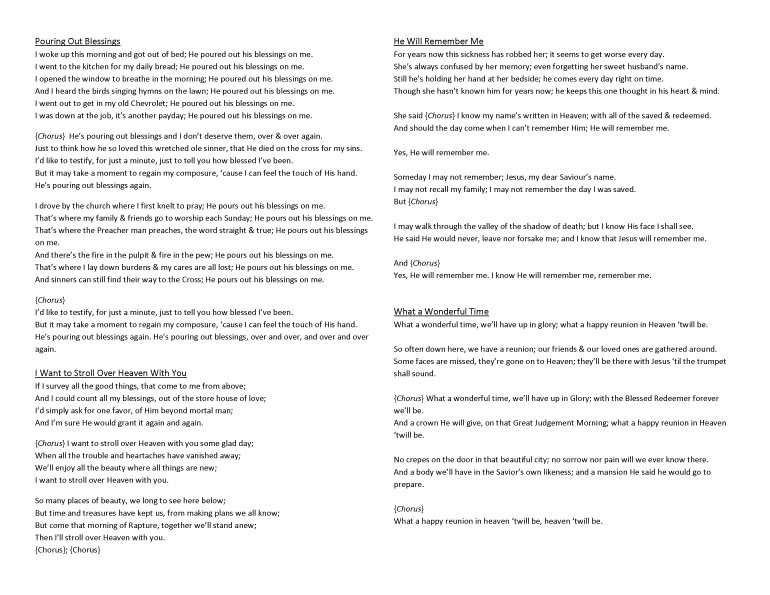
Thursday Random Song: Archie Watkins, “He Will Remember Me”


This song brought tears to my eyes when I heard it on XM Radio’s southern gospel station, Enlighten 34. Like many people, perhaps especially those whose passions and self-worth are bound up with intellectual pursuits, I dread the possibility of losing my mind with age. Archie Watkins’ ballad was a comforting reminder that the meaning and destiny of my life are in God’s hands, not mine.


Read the lyrics to this song and others on Watkins’ “Pouring Out Blessings” CD on his website . Watkins was a founding member of The Inspirations, whose Southern Gospel
Treasury collection is one of my very favorite CDs in any genre. Buy it
on Amazon here .

Wednesday Random Song: The Hooters, “All You Zombies”


It’s from the 1980s! And it’s about the Bible! And zombies! Awesomeness guaranteed.

Holy Moses met the Pharaoh
Yeah, he tried to set him straight
Looked him in the eye
“Let my people go”

Holy Moses on the mountain
High above the golden calf
Went to get the Ten Commandments
Yeah, he’s just gonna break them in half!

{Chorus}
All you zombies hide your faces
All you people in the street
All you sittin’ in high places
The pieces gonna fall on you

No one ever spoke to Noah
They all laughed at him instead
Working on his ark
Working all by himself

Only Noah saw it coming
Forty days and forty nights
Took his sons and daughters with him
Yeah, they were the Israelites

{Chorus}
The rain’s gonna fall on you

Holy Father, what’s the matter
Where have all your children gone
Sitting in the dark
Living all by themselves
You don’t have to hide any more

All you zombies show your faces…
…The pieces gonna fall on you

All you zombies show your faces
(I know you’re out there)
All you people in the street
(Let’s see you)
All you sittin’ in high places
It’s all gonna fall on you

(Lyrics courtesy of LyricsDownload.com)