Letter to an Evangelical Friend, Part 2: Obeying Jesus Without Knowing Him?


Last week I posted some of my email dialogue with my evangelical friend “Denise” about gay rights, the Bible, and how we choose our bedrock principles for discerning God’s will on such controversial issues. Her letter culminated in the following invitation to self-examination:

“…Speaking just for myself here, I have had to say to Jesus: ‘If it turns out those aspects of Calvinism which so trouble me are right, and that faithfulness to You means I have to accept their views, then I have to choose You.’…Might it be that one reason you don’t any longer want to read books/arguments contradicting your position is that deep down you wonder if you ever might be faced with that choice, and definitely don’t want to ‘go there’?…I just wonder which would come first, were it to come to that? Jesus, or your position on the gay issue?”

Denise and I are close friends, and our dialogues always take place in a spirit of love and humility, with respect for each other’s boundaries and for the limits of human knowledge of the divine. My next remarks, then, are not intended to apply to her.

I’m troubled by the power imbalance that can occur in debates between gay-affirming and traditionalist Christians when the latter make the rhetorical move of questioning their dialogue partner’s level of submission to God, Jesus, or the Bible. Suddenly the ground of argument has shifted from our intellectual disagreement to a personal defense of my core faith. This is not a conversation that anyone should be forced to have when friendship and trust have not already been established between the speakers.

Even where a personal context exists, an individual’s relationship with God belongs to the realm of sacred mystery where words fail. We should hesitate to speak of it or demand that others do so, lest we violate its intimacy or, by dragging it into conceptual space, make it too rigidly specific and idolatrous. It should not be put on display to prove a point. And if that point remains unproven, will not that core faith also be shaken? Would traditionalists rather see me agree that Christ is not my Lord, than remain a Christian who happens to support GLBT equality? Sometimes it seems that they would.

In reflecting on Jesus’ life and death, I had the thought that God’s life among us took this particular form to establish once and for all that we should not worship any power other than love. Love is the only power that God retained when he was born as a homeless, illegitimate, peasant baby, and died as a criminal whom the secular and religious authorities conspired to execute.

Therefore, when Christians invoke power-based concepts (God’s sovereignty, Biblical authority) to limit actions that compassion would otherwise recommend, one could say they are reverting to a worldly misunderstanding of what it means for Jesus to be Lord.

****

Here is what I wrote to Denise:

I can’t imagine Jesus would ask me to take a position that seems incredibly cruel and factually unsupported (to the very best of my cognitive abilities) as proof of my obedience to him, because then the concept of “Jesus” would be emptied of all content except inscrutable absolute power.

Certainly I can, as an intellectual exercise, entertain the possibility that God-in-Jesus could turn out to desire child sacrifice (to use an extreme example that nobody is arguing for, although one could say that Christian parents who cast out their gay children are enacting a present-day version of this story). Kierkegaard considered this very scenario in his commentary on the binding of Isaac, and if I remember my college philosophy class correctly, he came down on the side of the “teleological suspension of the ethical”—namely that God could command us to do something that seems totally evil and pointless according to our best judgment as human beings, but we should do it anyhow.

The problem with this position is that it takes away the main reason I believe Jesus is Lord—as opposed to Kali the Destroyer, Satan, Mother Nature, etc.—which is that Jesus is supremely loving, compassionate, nonviolent, humble, a defender of the radical equality of all people, and someone who privileges just outcomes over rule-following. I am a Christian because I want to believe God looks like Jesus, and because I am a better person when I try to look like him too.

It’s possible that the God who runs the universe is so alien to our ideas of kindness and goodness that we should just shut up and do whatever He says. But there is no workable way to implement this. There’s no unmediated, uninterpreted access to God’s will. When we suspend our own evidence-based judgment and suppress our compassionate instincts, we are only handing over our soul to some other human being who is all too happy to tell us “what God wants”.

When I take a stand on gay rights, I don’t see myself as relying on my personal feelings and “subjective ideological preferences” against Scripture and tradition. I’m speaking out of the collective experiences of all the gay people who have struggled, often at the price of their lives, to love God and their neighbors while honestly living the way God made them.

One could be more justified in saying that certain non-affirming Christians are privileging their personal preferences (about gender roles and human sexuality) over the evidence of science and psychology, not to mention the testimonies of their silenced gay brothers and sisters. We seem like isolated heretics and random individualists only because there are many more who are afraid to bear witness. Religious, familial, and civil discrimination collude in preventing gay and gay-affirming Christians from connecting with one another to create a new spiritual community and a new interpretive tradition.

It seems to me that on the issues that preoccupy us both—salvation for non-Christians in your case, or the permissibility of homosexual relationships in my case—we ourselves are personally not at risk. You are a Christian, and I am straight. Our anxiety springs from the yearning to have all others enjoy the same blessings that we have received. Based on the movement of the entire Biblical narrative toward an ever-widening membership in “God’s chosen”, it also seems to me that this motivation is greatly to be trusted, as a reason to choose one Biblical interpretation over another.

The two issues seem similar to me in another way. If God loves everyone and desires their well-being, whatever God commands must ultimately turn out to be for the benefit of every person. Eternal damnation, with no possibility of repentance and forgiveness, might be good news for some abstraction like “God’s sovereignty”, but it can’t possibly be of any benefit to the souls thus punished. Similarly, overwhelming evidence suggests that the results of suppressing a person’s sexual orientation are deeply traumatic for that person, which is why anti-gay rhetoric usually focuses on the benefits to “us” (society, the church, etc.) from getting rid of “them”. One simply can’t make the case that the closeted person himself is better off, spiritually, than one whose body and soul are integrated.

I honor the humility and sincerity of your struggle with obedience to Scripture. But to me it looks like a struggle between a natural inclination toward compassion, and a fear that this compassion is impermissible. That way of life doesn’t attract me.

Finally, to return to where you began, I absolutely agree with you that faith in the Person of Jesus requires some doctrinal container to shape it. That’s actually why this whole opposition between obedience and inclusiveness makes no sense to me. I follow Jesus because he stands for some very specific values, inclusiveness being among them. I don’t think he intended it to be very mysterious, either. In all the actions he took to manifest God’s nature working through him, he appealed not only to law and Scripture, but to logic, the poetic imagination, and the evidence of people’s senses. God’s idea of good and bad is different from ours, sure. But in every example where Jesus makes this point, he’s revealing God’s love for outcasts, never shooting down as “disobedient to Scripture” a person who crosses social and religious identity boundaries in the name of love.

That is why, even if I turn out to be mistaken on the gay issue when I stand before the throne of judgment, in the meantime I’d rather err on the side of inclusion.
My Interview on the Mass Cultural Council ArtSake Blog


Last year I was honored to receive a fellowship for poetry from the Massachusetts Cultural Council. Since then my gratitude has only increased, to see the publicity support that the MCC gives its fellows and finalists. In conjunction with our reading last week at Forbes Library in Northampton, the MCC’s Dan Blask interviewed me on their ArtSake blog. Here’s a sample:

ArtSake: Along with your poetry, you also write fiction and nonfiction. Do you approach writing prose differently from the way you approach poems?

Jendi: Yes, definitely! Poetry and fiction must be written by hand with a mechanical pencil in a 6×9 Mead Five Star notebook. Nonfiction, by which I mean my blog posts about gay rights and Christianity, is written on the computer. I don’t know how to shape a narrative in creative nonfiction. There are too many facts, and most of them were hard enough to live through once.

When I write poetry, I’m not thinking about an audience. What wants to be written, gets written. It’s like a computer’s self-diagnostic. I write to find out what I think. Naturally, my values and preoccupations are reflected in the poetry, so in that sense, it often contains a critique of society, but it’s driven by my own need to express my authentic inner experience, rather than to have a particular impact on others. (Though I wonder whether the two are really so separable – doesn’t every self-disclosure cherish a tiny hope of being recognized and responded to in kind, however much one tries to cultivate self-protective detachment?)

My novel-in-progress is about a young fashion photographer in 1990s NYC who struggles to reconcile his faith and his sexual orientation. With this project, I have more of a conscious intention to bring about social change, along with telling an entertaining story.

Writing a novel is harder than poetry because it’s impossible to be in the “flow” for that length of time. With a poem, by the time I figure out where my subconscious is taking me, the trip’s over. I don’t have much opportunity to get in my own way. Far more planning has to go into the novel, which means that there are many chances for self-consciousness and ideological agendas to seize control, instead of letting the work tell me, itself, what it needs to be. I counteract this problem by conceiving of the novel as a collaborative effort between myself and my characters. They’ve got to retain the freedom to surprise me. My job is to see enough of the big picture so that they don’t get lost and despondent, but not be so directive that they lose their independent life force. It is a constant, elaborate, frustrating, fascinating dance that calls on all my relationship skills, and maybe even improves them in the so-called real world.

I do my creative writing by hand because this slower, temporally linear method allows intuition to take the lead. Writing on the computer, it’s too easy to pull back and see the big picture, to let the analytical mind start rearranging and criticizing, and skip past that quiet inwardness where the soul of the poem or story gestates.

Read the rest here. Videos of myself and my talented co-readers Rosann Kozlowski, Nancy K. Pearson, Cynthia Morrison Phoel, and Jung Yun are available on the Winning Writers YouTube channel.


The Erotic Christ: Jesus in Love Blog Interviews Hunter Flournoy


This month on the Jesus in Love Blog, a resource for queer spirituality and the arts, Kittredge Cherry interviews Hunter Flournoy, a psychotherapist and shamanic healer who teaches “Erotic Body of Christ” workshops to help gay and bisexual men make a mystic, sensual connection with the divine. Here’s an excerpt. I was struck by the commonalities with Buddhism: the idea that the root of suffering is separation not only from God but from one another, and that we can attain transcendence by embracing the suffering of the world, not as self-punishment but as compassionate participation.

KC: Many LGBT people have been wounded by the false teaching that homosexuality is a sin. What message does the erotic Christ have for them?

HF: Our sexual energy is the most powerful tool we have to shatter the illusion of separation, which is what the original Christians meant by “sin.” The essential question we must ask ourselves is, am I using sex to bring myself alive, to overcome separation and incarnate the divine, or am I using it to medicate or avoid my own experience of being alive? This was the original understanding of chastity: it calls us to the highest possible relationship with our own sexual energy. All sexual experience can break down the boundaries and defenses we use to separate ourselves from each other and from God – we become one body, one being. Sex can also teach us how to give ourselves totally (kenosis) to each other, how to receive each other completely (plerosis), and how to surrender to the transfiguring power of our own erotic experience. As LGBT people, we also have an innate understanding that our erotic experience, our pleasure, desire, ecstasy, and union, can serve a purpose other than reproduction. Our erotic joy is a source of profound creativity, deep empathy, and a wild ecstasy that can take us out of who we are into a far greater sense of being.

KC: As you say, the idea of “suffering as Christ suffered” has been abused in legalistic religious systems. But gay bashing and other forms of “crucifixion” continue. How can the erotic Christ help in situations of real human suffering?

HF: There is nothing inherently spiritual or useful in suffering; it is useless to suffer as Jesus suffered. Nor did Jesus advocate cooperating with abuse and injustice. What he advocated and demonstrated – what really matters – is loving as he loved, embracing everything and everyone, including suffering, as Jesus embraced it. Instead of rejecting our suffering, trying to medicate, numb, get rid of it or distract ourselves from it, we learn how to embrace it, without indulging it or running from it. We let our suffering shatter our sense of self, our sense of control, and our need to make sense of the world. This is what the Christian mystics called katharsis. Second, our embrace transforms suffering into a searingly powerful erotic experience . . . it is like a fire that fills our whole being, a great trembling ache that breaks into the profound peace the mystics called theoria. Finally, we discover through this embrace that we are welcoming not only our own suffering, but the world’s suffering . . . we begin to experience ourselves as the world, as Christ’s body, and ultimately as God, in the mystery of theosis.


Read the whole interview here. Visit the Erotic Body of Christ website to learn more.

Murder Ballad Monday: Jimmie Rodgers, “Frankie and Johnny”


One of my favorite panels at this year’s AWP conference featured the novelist Wesley Stace , also known as singer-songwriter John Wesley Harding, talking about storytelling in music. Ballads and poems provide essential clues to the mystery in his excellent first novel, the comic melodrama Misfortune, and also feature in his just-released book, Charles Jessold, Considered as a Murderer.

Stace praised the ballad form as a deceptively simple yet profound form that gets right to the crisis point in a character’s history. Though retribution is usually swift and inevitable, there’s rarely any moralizing about the characters’ crimes, an open-endedness that allows us to choose how deeply we identify with the story.

I thought of his analysis when I heard these lines toward the end of the classic murder ballad “Frankie and Johnny,” performed here by Jimmie Rodgers: “This story has no moral, this story has no end, this story just goes to show that there ain’t no good in men.”


Literature Is a Lifeline, Prisoners Say


Readers of this blog have enjoyed the poetry and cultural commentary of my prison pen pal “Conway”, whose distinctive artwork graces my chapbook covers. Today I’d like to share an excerpt from my correspondence with another incarcerated writer, “Jon”, a young man who’s on death row in California for an alleged homicide during a robbery. Jon’s pencil drawings of angels, flowers and holiday scenes are good enough for a Hallmark card. He writes fantasy and sci-fi fiction and devotional poetry.

I’ve been trying to send him a copy of Freddy Fonseca’s anthology This Enduring Gift: A Flowering of Fairfield Poetry, which prison officials keep bouncing back because of some undisclosed postal violation. Meanwhile, Freddy emailed me this article from the Boston Globe: “Escape route: The surprising potential of a prison library“, by Avi Steinberg, author of Running the Books: The Adventures of an Accidental Prison Librarian. Steinberg attests to the power of the prison library as a community space where inmates learn to become citizens:

…The problem with the public discussion about libraries in prison is that it’s the wrong discussion. For over a century now, the debate has centered on reading — on which books should, or more often should not, be included on the prison library’s shelves; which books are “harmful” or “helpful”; whether reading is a privilege or a right. In 1867, Wines argued that a book like “Robinson Crusoe” — at the time, the only secular novel permitted in prison — served the cause of criminal rehabilitation. Others fervently disagreed.

But the issue of reading is only one dimension of the question, and not necessarily the salient one. The crucial point of a prison library may not be its book catalog: The point is that it is a library.

The library is a shared public space, a hub, where people spend significant portions of their time, often daily. It is a place inmates work and, in some important ways, live. It is more purposeful and educational than a recreational yard, less formal than a classroom. The prison library gives inmates an organic way to connect to the world, to each other, to themselves as citizens. It’s a small democratic institution set deep within a prison, one they can choose to join.

This is no small matter. The vast majority of prison inmates will eventually be released back into the free world, back into the community. What happens to them once they are out is the critical piece of the corrections puzzle. It doesn’t take an expert to know that a person who lands in prison, a person often already on the margins of society, will grow further isolated from the norms and routines of society while in prison. And yet, at the very same time, and in this very same building, many inmates — often for the first time in their lives — are also quietly becoming enmeshed in an important social institution….

…One of our regular visitors was a twentysomething woman whose 3-year-old daughter was living with a relative during her prison sentence. I’d first lured this inmate to the library by screening new release movie features. After a while, she was in the library at every opportunity, reading books and magazines and watching movies. She was, in other words, an average prison library visitor: a person who had stumbled in, almost by accident, but who ended up quietly but routinely making use of the library’s resources.

When her sentence was drawing to a close, she told me that she was going to miss using the prison library. I replied with the good news: Libraries also exist outside of prison! The idea seemed to surprise her (which surprised me). In her experience, a library, as an institution, was something one encountered in prison. She’d never set foot in a library in the free world.

She left prison, and the library, excited to give it a try. And, she said, she would do for her daughter what had never been done for her: She would bring the child to the public library every week. Just as a prison ID card, stamped with her mug shot, symbolized her civic isolation, I like to think of her public library card as a powerful token of membership back in society. After hundreds of hours logged in the prison’s library, the thought of using a public library now seemed not only plausible to her, but second nature. After her time in prison it was the thought of not using a library that troubled her.

People tend to see a prison as a monolithic institution, a place solely dedicated to locking criminals up. But many inmates experience prison in a more dynamic way, as a clash between institutions. And what I experienced every day was that, in the collision between the institution of prison and the institution-within-the-institution, the library, something constructive and potentially long-lasting was being formed.

Prison libraries aren’t miracle factories. The day-to-day was often far from inspiring. Glossy magazines and mindless movies were, for many, the main attraction. Pimp memoirs were among the most frequently requested books. And yet, even an inmate motivated by nothing more than a desire to watch “The Incredible Hulk” in the back room of the library was much more likely to come across something educational — a book, a program, a mentor — once he entered the library space. Just as important, this inmate was becoming a loyal patron of the library, something he could carry with him to the outside world, and perhaps pass on to his children.


I mailed Jon a printout of this article, and his reply in his Jan. 31 letter was so eloquent that I am sharing it below, unedited (spelling and all):

“Litrature of all sorts is probibly the most important thing an incarcerated person can get their hands upon. When a person is in a cell, they’ve plenty of time to think and to reflect. Reading does a number of things for people, for me, concidering all the various materials I’ve read, including classic novels, fiction, sci-fi, fantasy, psychology, numerology, spanish, history, and spiritual, although spiritual, the bible changes lives, my own included.

“The classic litrature is where my ‘self’ education begain in here. Reading these books gave room for self reflection, and also caused me to love reading. Reading can turn some of the most negative of people into patriots, and highly educated (self educated) members of society. I’ve seen it.

“I myself was a very terrible and lost soul when I came into jail. Yet over the years, and throughout books, such as Les Miserabes, A tale of two citys, Frankenstien, the call of the wild, white fang, the phantom of the opera, the three musketeers (and all Dumas’ other books), even Sherlock Holmes, to kill a mockingbird, just to name a few. Throughout books like these, I’ve learned of virtues, such as humor, honer, artistry, and even in many case what is right and what is wrong. Yet most of all I’ve learned of redemption.

“If books such as Hugo and Dickens wrote were readily available, I believe, no, I know that many criminals with reflection from reading would rehabilitate. For anyone to say that a prison library is of doubtful influence, I would say they are ignorant. The problem is a limited library. I truly know that if more state and county prison and jail finances were spent giving inmates access to literature, there would be less repeat offenders.”
****

Moved by Jon’s message? Donate to Books to Prisoners today.

Anti-Colonialism and Gay Rights in Uganda


Dr. Jillian T. Weiss, a regular contributor at the GLBT news blog The Bilerico Project , recently posted a thoughtful article, “Understanding Uganda”, in which she explores why gay-rights activism directed at African countries often provokes an anti-colonialist backlash. Since gay people have existed in all societies, and were actually treated better in some African cultures before the advent of Christian missionaries, how is it that gay rights have been successfully branded as a decadent Western import? Weiss suggests that the Christian imperialist roots of African homophobia are now so old that they’ve faded from public consciousness, while secular human rights language is more immediately identified with NGOs run by privileged foreigners. An excerpt:

…Similar charges [of elitism] are leveled against large LGBT rights organizations that are disparagingly referred to by some as “Gay Inc.”, implying that they are out of touch with ordinary LGBT people and seek to promote an elitist and oppressive agenda. Another analogy is imagining a strong force of groups across the United States, well-funded by countries we generally dislike, attempting to put messages in the media that we ought to embrace human rights by giving up American democracy and going with a One-World-Government plan. Of course, these analogies are vastly different from the Ugandan situation, and I don’t mean to compare their specific facts, but only the motivations that can stir dislike even of those espousing human rights.

I recently spoke to an African scholar regarding this issue. While his expertise is in Ethiopia, and in particular the issues of development and sustainability, his knowledge of Africa is useful in this context. I asked him why it is that human rights movements, including the African LGBT rights movement, are viewed as colonialist encroachment on African identity, whereas U.S.-imported evangelical Christian homophobia is viewed as compatible with African identity. To me, it seems a sad contradiction.

His answer made it clear to me that the subtext of the LGBT rights movement for many Africans is that of foreign imperialism, a “Western corruption” not native to Africa. Christianity, to the contrary, despite its origins in missionary activities designed to indoctrinate the “savages” into compliance with European dominance by means of a fatalist philosophy of acquiescence, was introduced so long ago to Africa that its imperialist subtext is completely obscured. Its handlers have deftly messaged it as supporting African autonomy, sovereignty and ownership. They truly believe it is African, despite the fact that, as discussed by Eugene Patron in his Harvard Gay and Lesbian Review article, “Heart of Lavender: In Search of Gay Africa,” Africans have lived without discord with LGBT identities in the past, despite the efforts of Christian missionaries.

The history of post-colonialism is a reaction against oppression of autochthonous rule, particularly the successful attempt to neuter those who might be independent-thinking local leaders. As Matthew Quest has noted, anything that appears to imply effeminacy is often rejected by Africans as smacking of imperialism.

Thus, it is impossible to understand the state-supported open homophobia imported from the U.S. that likely killed David Kato without understanding that rights advocates in Africa are seen as imperialist agents bent on the destruction of a pure and strong Uganda identity independent of the imperialist West. All this is confirmed by the condemnation of Western leaders, ensconcing the homophobic Ugandan leaders with the mantle of defiance against the imperialists.

None of this is meant to excuse or condone the homophobia of Ugandan leaders, or the complicity of U.S. evangelical Christians who stoke these fires while wearing the mask of African independence. But the solution is not going to come from condemnation. This issue is shot through with the same thorny problems raised by the homonationalist movement. Though speak out we must at the murder of a brave rights activist who was unwilling to let his LGBT brothers and sisters continue to suffer, despite the known danger to himself, let us not fool ourselves that heaping condemnation will solve this problem. It adds fuel to the fire….


“Swallow” Gets Downright Eucharistic on Logic’s Ass


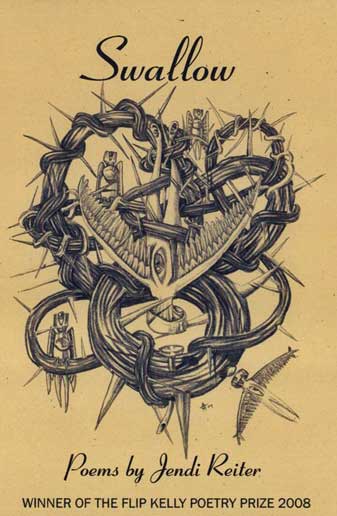
Martha Rzadkowolsky-Raoli has written a fantastic review of my chapbook Swallow (Amsterdam Press, 2009) for the Ampersand Books website. She’s reverse-engineered these rather difficult and prickly poems to make clear the theology behind them. The miracle of writing: when our readers mirror back to us more than we consciously realized we had said. I wrote Swallow by mad intuition, but an astute reader finds “method in it” after all. Some highlights:

Jendi Reiter created a tidy poetry book in which swallow means everything you can expect swallow to mean. She exhausts the word; its mashed remains a mix of cow meat, desire, intestines, bird. If you read the book, and you should, you’ll experience the beating of the word. Swallow. How else to learn something new ?(about the parameters of language) — – something only poetry can do, and these poems do it….

****

…By suggesting disparate contexts, these aphorisms maintain a collaged-world view. I like Reiter’s objection to a poetics bound by singular points of view. I like when word-artists comply with the rules of our new universe (a mess of sources coming at you from everywhere: billboards, email, the doorman). This kind of work feels real….

****

…Reiter’s rhetorical tricks can remind me of the riddle-ish catechism I was taught. The relationship between premises in these poems get downright eucharistic on logic’s ass. Mysterious pronouncements sound as zany as any church stories of body-magic: The body jesus lived in, the jesus body that is the eucharist, and the jesus body that you put into your body….


Read the whole review here.

You know you want it now:


Doubt Series, Part One: Insecurely Attached to God


In this season’s episodes of “Jendi discovers the obvious”, I want to look at some common secularist jibes at religion that I used to dismiss, but that are currently disrupting the faith I once knew:

“The Christian God is just a projection of believers’ relationship with their (real or ideal) parents.”

“I can’t believe in Christianity because Christians do bad things in the name of their faith.”

“The Bible’s moral, social, and/or scientific worldview is too primitive to be authoritative for us today.”

****

Today’s topic: If God is my parent, must I stay forever a child?

Tim Clinton, president of the American Association of Christian Counselors, and Joshua Straub, an adjunct professor at Liberty University (the late Jerry Falwell’s school), are the authors of God Attachment, a book that examines the psychological reasons why we do or don’t feel close to God. They summarized their research for CNN’s religion blog last month.

Attachment theory posits that the quality of our bond with our earliest caregivers influences our subsequent view of the world as a safe or unsafe place. Unreliable or abusive caregivers can foster a fearful, controlling attitude toward relationships later on. Instead of trusting that we are loved and our needs will be met by the person responsible for us, we may feel we have to compel their love through proper behavior or awaken their pity through self-harm.

Just as an insecurely attached child might believe that survival depends on manipulating their parent’s reactions, Christians with this kind of personal history might be especially drawn to legalism and superstition in their relationship with God the Father. Clinton and Straub write, “much of modern-day thinking about how to connect with God has been reduced to a theory of sin management — that what we do or don’t do in our daily lives is the gauge by which we measure why we are, or are not, close with him.” This reminded me of the unreasonable responsibility that abuse victims feel to “prevent” their abuse by predicting the will of a capricious spouse or parent.

Clinton and Straub go on to say:

If we don’t feel safe; if we are confused in our core beliefs about whether we’re worthy of love or whether others are capable of loving us or accessible when we need them, then we’ll transfer those beliefs onto God and struggle to believe he could really be there for us.

But if God serves the functions of an attachment relationship in our individual lives, it can be the difference between cognitively believing in God, as most do, and emotionally connecting, trusting, and walking with him every day, which is much less common.

If you came from a dysfunctional family and stopped reading now, you might be tempted to believe that it is impossible to have a genuine relationship with or healthy view of God. But the good news is that research supports the notion that those with insecure relationship styles can and do find a close, secure relationship with God as they turn to him and discover he is not like other attachment figures who have hurt them in life.

Perhaps it’s time to challenge our beliefs about God (if we’ve seen him as disinterested or unavailable) and re-evaluate our own identity (if we tend to see ourselves as hopeless or unlovable). Finding hope and meaning doesn’t happen overnight. There’s no magic prayer or verse that will heal the wounds we’ve experienced. We need to be honest with ourselves, grieve our losses, repent of our own wrongdoings, forgive those who have hurt us, and learn new relational skills.

Just like any other relationship, building intimacy with God requires vulnerability. Honesty. Time. Prayer. Focus. Listening. Journaling. Reading the Bible. Meditating.

Remember, the goal is to connect with God, and get to know him for who he really is. This often requires peeling off layers of false core relational beliefs.

When we understand our relationship with God in light of attachment research, we begin to realize how our unhealthy preoccupation with anxiety, fear, guilt, or self-punishment may actually be shutting out the love and healing we truly long for.

God is not like your mother, your father, your spouse, your ex, or any other human that failed, abused, or abandoned you.

In my life, the chief way that parents and mentors have messed with my attachment formation is by refusing me permission to grow up — the stage that Buddhist writer Philip Moffitt calls “initiation” in his profound essay Healing Your Mother (or Father) Wound:

It is through acts of initiation that you come to feel as though you are a valuable and welcome member of your family. As you develop, it is this function that provides the inner feeling that your life has meaning, and by the teenage years you understand that you have the right to become the full expression of your own unique life. It is also the initiation function that permits, accepts, and celebrates your leaving home to start your own life….

…When initiation occurs in a timely and clear manner, it is a beautiful process, though often painful for the parent. Most initiation takes place through symbols, rituals, and unspoken behavior. When it does not occur, there is a sense of guilt, of staying a youth, of not knowing or not feeling entitled to one’s place in life. For a mother to be effective in providing initiation, she must have somehow received or found her own. It is the most selfless of all the aspects, for she is encouraging a separation that leaves her without. This initiating power is associated with the shaman, the goddess, the magus, and the medicine woman.

In seeking initiation you may be attracted to teachers who claim superior understanding, who create an impression of having vast authority, thus signaling what is often a false claim that they can initiate. You may frantically want answers in your life, not understanding that initiatory power will come to you if you treat your questions as sacred. It is tempting to surrender your power to a teacher rather than seek a teacher who will initiate you so that you gain self-empowerment.

You may be caught in wanting to have energetic experiences on the cushion as a form of initiation. You may simply want something to happen in your life that signals your aliveness, meaning, and place. It is a call for initiation. It is much the same with teenagers who get tattoos, pierce their bodies, form cliques, posses, or gangs, and carelessly risk their lives and use drugs or fundamentalism of one sort or another to initiate themselves.

It is not realistic to expect a parent to provide all the initiation functions for a child. A parent only begins the process of initiation, which can be viewed as a series of lifelong developmental processes that are actualized through the use of rituals and sacred space by various spiritual and societal leaders.


Attachment to a parent figure is not a complete end in itself. It is also meant to give the child a safe base from which to explore the world, a goal noted by all the psychology texts I’ve read on this subject.

Unfortunately, it often seems that religious leaders want to cut off this exploration. Don’t entertain that idea. Don’t question that doctrine. Don’t allow history, science, personal experience, or your own moral intuitions to
inform and change your understanding of “what the Bible says”.

Attachment wounds happen for me in this way: Someone promises me love, community, righteousness, protection, and guidance, while instilling in me that I cannot survive without this support. I accept the support and grow strong enough to start using the gifts this mentor has given me to begin exploring on my own. At this point, the love is withdrawn and replaced by condemnation, the community is lost, and I find myself free but terrified, lonely, and angry that I was taught to be dependent in a world where there is no one to depend on.

Always before, in these situations, I would look to God, and re-learn the lesson that I’m justified by grace alone, not by pleasing human judges.

But swapping in God for my parents and teachers isn’t working anymore. I worry that looking for an attachment figure, even a perfect one like God, still keeps me in the mindset of a child who can’t survive without a caregiver. And let’s face it, eventually this will lead me back to looking for some human being to incarnate this relationship.

I’m a concrete thinker. That’s why I’m a Christian. I don’t trust abstractions that set themselves against and above experience. A spirituality of “just Jesus and me” is more likely to be a projection of my own ego, or a product of my active imagination as a writer. If I’m not seeing the face of Jesus in other people, I’m probably not seeing it at all.

So what would be a more mature way to envision my relationship with God the Father? Who does He want me to be when I grow up?

Truth is, I am mad at God for making me grow up because that’s always been the prelude to abandonment. How can I replace this learned response with a more trustworthy image of God from Scripture, tradition, and experience? Stay tuned.

What is a Covenantal Relationship?


Winning Writers subscriber Alvin T. Ethington is not only a published poet, but also the author of this eloquent argument for recognition of same-sex marriage in the Episcopal Church. (I’ll admit, he had me at “The Golden Girls”.) The article first appeared on FanStory.com, a good forum for emerging writers to receive feedback and enter members-only contests. He has kindly permitted me to reprint it below. Alvin tells me, “It proved to be very persuasive in the Diocese of Los Angeles, where same-sex blessings in many parishes now are a matter of course.”

What is a Covenantal Relationship?

by Alvin T. Ethington

On an episode of the television program “The Golden Girls,” Blanche, the woman who owns the house, discovers that she either has to make $10,000 worth of improvements or ask one of the three women who rent from her to move out. The house is not up to code for four people to occupy it. Whilst the women are in the process of discussing what to do, Dorothy comes up with the idea that Blanche can sell to her and the other women a portion of the equity in the house, thereby making the four co-owners. At first, Blanche is appalled by this idea—the house is one in which she lived with her husband, brought up her children, and spent most of her life. It is her family home. Later, when realizing she cannot ask any of her good friends to move out, she discovers her family has changed. Her husband is dead, her children are grown, and the people from whom she seeks support and with whom she lives in community are, indeed, the three other women who share the house. They are her family.

Our definition of family is changing. Adult children move back into the family home for economic reasons; sons and daughters choose to care for their elderly parents at home due to the high cost of medical care. Women have greater freedom in choosing societal roles; gay men and lesbians no longer have to keep the most important relationship of their lives secret. Children whose mother and father both work are often cared for by another relative or a friend; many families choose to adopt because of the large number of unwanted children in the world.

The nuclear family, which was engendered by the industrial revolution and which reached its apex in post-World War II white suburban America, is no longer the primary social unit it was once thought to be. For economic survival, women and men are choosing to live in groups of extended families and/or friends as they have in the past. Within these extended families and within societal communities, bonds of special relationships are being formed. Many people in these relationships of mutuality, love, and respect would like ecclesiastical recognition of what to them is of ultimate importance.

Some would argue that all this is the breakdown of Christian values in a societal context. I do not think so, for the message of Christianity is one of communal responsibility. The early Church provided for widows and orphans (Acts 6:1; cf. James 1:27). Whoever loves and serves Jesus of Nazareth by doing the will of God is his brother or his sister, a part of his family (Mark 3:35, Matthew 12:50).

Examples of covenantal relationships within the Christian community would be an older woman and man who have fallen deeply in love but whose financial situations preclude them marrying because of the concomitant loss of economic benefits that would bring, two lesbians or two gay men who have entered into a lifelong committed relationship, or adoptive parents who want to make a public pledge to bring up their children in the Church. (The Episcopal Church has started to recognize the last example in the 1979 Prayer Book rite “Thanksgiving for the Birth or the Adoption of a Child” which was previously limited to “The Thanksgiving of Women after Child-Birth.”)

Traditionally, the Church has recognized two kinds of covenantal relationships between persons — that of the promise the parents and godparents make to raise children in the faith and instruction of the Church at Baptism, and that of Holy Matrimony. These relationships are definitely sacramental. However, they have been developed and interpreted within the context of a Western society which has accepted the definition of Gratian for marriage — the union of a man and woman for procreation. Given the recognition that marriage has and can fulfill goals other than procreation and given the overpopulation of the world, it is expedient that we look to other definitions for marriage and for covenantal relationships.

The 1661/62 Anglican Prayer Book recognized that, although in its view, marriage is primarily for procreation, it is secondarily a remedy against sin, and tertiarily for mutual society, help, and comfort. Covenantal relationships which include a sexual component fulfill the goal of marriage to avoid fornication and all covenantal relationships fulfill the goal of mutual interdependence.

Is the Church in the process of affirming sexual sin in affirming covenantal relationships? These relationships only include a sexual component when the sex therein is other-concerned, respects the dignity of each person, and recognizes the partners as equals. Just as relationships of forced and non-consensual dominance and submission, of incest, and of rape break the covenant between parent and child or between wife and husband, so relationships which involve abuse of sexuality are not covenantal relationships. Covenantal relationships are inclusive of healthy sexual relationships, but not exclusive to them. Certainly the adoption of a child by a person does not include a sexual component.

Are these relationships sacramental? The Christian Church cannot agree on what exemplifies a Sacrament. If one accepts only the two Dominical Sacraments (Baptism and Holy Eucharist) as Sacraments, then these relationships are not Sacraments, but have a sacramental quality, as does marriage, for they are outward and visible signs of an inward and spiritual grace. If one accepts the seven historical sacraments as Sacraments, then these relationships do not have the Sacramental quality of marriage, but they do have the sacramental quality in which all of life is hallowed. A sacrament takes the simple things of life—water, wine, bread—and invests them with sacred meaning in the context of a person’s and a community’s relationship with God. Covenantal relationships are sacramental in that the two partners have made a commitment to themselves, to each other, to the Christian community, and to God to honor, love, and cherish each other. Because the sacramental quality of covenantal relationships involves two persons made in the image of God and the relationship between them, covenantal relationships are of a higher sacramental order than the blessing of an object. Covenantal relationships have a sacramental quality in that God is ever present in these relationships of love and faithfulness.

The Hebrews recognized this when they reflected on their relationship with God. They imaged their relationship with God in terms of covenantal relationships they knew and imaged their unfaithfulness to God in terms of covenant breaking they knew. God was the Father and Israel was His Son (Hosea 11:1). God was the Mother and Israel Her comforted child (Isaiah 66:13). When Israel was apostate, Israel “played the harlot” (Ezekiel 16:15, 16; cf.16:28); Israel was the unfaithful wife Gomer of the prophet Hosea (Hosea 1:2-3).

Jesus, as pictured in the Gospels, portrays his relationship to different groups in covenantal imagery. In the Q source material, he compares his relationship to the Jewish community of Jerusalem to that of a mother hen to her chicks (Matthew 23:37; Luke 13:34). The Johannine Jesus recognizes the deep bond of friendship between Jesus and his disciples (John 15:14-15).

The love poem Song of Songs has been interpreted to be exemplary of covenantal relationships. It illustrates the love of God for Israel and the love of Christ for the Church. What Jewish and Christian communities have done with this difficult text is to take the relationship between the two lovers and invest it with sacred meaning. God is ever present in the hallowing of special relationships.

Time moves on. The Church is required to be faithful to Scripture and tradition, but it is also open to the influence of reason and to the unfolding revelation of the Holy Spirit within the Church. We must stand in constant tension with and dialogue with society and affirm all persons on their spiritual journeys. We must not be afraid to speak out against sin, but we also must not be reluctant to recognize when God is present. Every good thing comes from God (cf. James 1:17). People are aching for spiritual recognition of their special relationships in a society in which the individual reigns supreme. We, as a Church, must comfort and succor those in this transitory life who daily face adversity. Where two people truly and authentically care about each other, where two people share joy and laughter, love and tears, sorrow and suffering, solace and comfort, life and death, there, indeed, is God.