John Koessler on Holy Emptiness


John Koessler, chair of pastoral studies at Moody Bible Institute, wrote an incredibly moving essay in Christianity Today about how emptiness is the precondition for blessing. Once again Jesus reverses our worldly values, such that the depth of our neediness becomes the measure of God’s opportunity to fill us with good gifts. Some excerpts follow:


My mother was hungry most of her life. She cooked daily for us, but rarely sat down to eat. Unable to stomach the food she’d prepared for the rest of us, she ate her own meals at odd hours, nourishing herself on a strange combination of the ordinary and the exotic. One day she might eat a baked bean sandwich smothered in ketchup; the next, broiled lobster.

Mother blamed her eating habits on a childhood of poverty. Born six years before the Great Depression, her earliest memories were of hunger. Her family was so poor they often went days without eating. When there was food, it was never enough. Sometimes all they had to share between them was a can of beans.

Mother looked hungry. As thin as a wraith much of her life, weighing an almost skeletal 90 pounds, her erratic diet eventually consumed her, shredding her bowels and leaving her emaciated. Unable to keep down food, she died in a hospital bed connected to tubes that provided nutrients for her weakened shell of a body.

My father, on the other hand, died of thirst. A large man with a hearty appetite, his experience was the polar opposite of my mother’s. He was raised in comfort. The son of a medical doctor, he observed the poverty of the Great Depression from a distance, never worrying about his next meal.

He started drinking in his teens, I suspect. By the time he reached adulthood, he was a full-fledged alcoholic. He couldn’t start the day without a shot of liquid napalm, which he purchased by the half gallon. Like my mother’s strange hunger, his thirst for alcohol was the end of him. He spent the last days of his life waiting to have his dry lips moistened with a damp swab, unable to drink water because of his alcohol-ravaged kidneys.

Their experiences are not lost on me when I read Jesus’ blessing in Matthew 5:6. Blessed are those who hunger? Hunger and thirst signal need. They are symptoms of emptiness and unfulfilled desire. How can they be a source of blessing?

The fact that Jesus says he is talking about hunger and thirst for righteousness clarifies little. He seems to have put the emphasis in the wrong place. Why not, “Blessed are the righteous?” Hunger implies a lack of righteousness. Jesus’ proposal is so radical, it turns our notions of God and righteousness and blessing on their heads. He blesses what most of us would curse.

According to Jesus, when we draw near to the kingdom, it is better to come empty than full. We are tempted to think that righteousness is the condition we must be in to be blessed. Jesus says the opposite. Righteousness is the blessing; hunger is the precondition….

****

Why is blessedness associated with hunger? Because those who bring their hunger to Christ will be filled with his righteousness. Thus, righteousness must be a gift before it can become a practice. The promise of righteousness is offered to those who are empty. It belongs to those who are aware of their lack.

We cannot labor for Christ’s righteousness. Even if we wanted to work for it, we could not expend enough effort to obtain it. If we wanted to buy it, we could not offer enough money. We can’t get it by loan. The only way to obtain righteousness is to receive it.

The language of filling in Christ’s beatitude underscores another important aspect of the blessing. Righteousness works from the inside out. We usually go about it the other way around; we try to work on it from the outside in, as if it were a matter of externals. If we worship in the right building, perform the right rituals, wear the right clothes, and are seen with the right people, we are righteous. If we read our Bibles and pray in the morning, give a tithe of our earnings on Sunday, control our tempers and restrain our passions the rest of the week, we are righteous.

But if we listen to Jesus, we begin to understand why he attracted the sort of people who came to listen to his preaching: hookers and thieves, trailer trash and lowlifes, people who dwelled on the outskirts, in places where decent citizens refused to travel. If we dare to hear Jesus rightly, we understand why respectable, law-abiding people such as ourselves wanted to silence him. It is because this word of Jesus has the power to strip us of all we think we’ve achieved. This beatitude robs us of what we thought we had acquired and leaves us naked, destitute, and empty. If we are to have righteousness as Jesus defines it, we must receive it like beggars, letting it transform us from the inside.

Above all, Jesus’ promise in this beatitude shows us that true righteousness leaves us craving more. We tend to think of righteousness as a standard. Like the little boy whose progress in growth has been marked inch by inch on the kitchen wall and compared to his father’s height, we hope that we, too, will measure up someday. Yet there is no limit to God’s righteousness, as if we could accumulate and eventually exhaust it. God has an infinite capacity for righteousness, and so do we. This is the secret to savoring the blessed hunger Jesus describes. Natural hunger is all about emptiness. The hunger Jesus blesses is about never being filled.

Such is our lot—and our blessing. As worshipers of an infinite God, we are always longing, always filled.

See also:
Book Notes: Jesus Mean and Wild
“The type of experience we’ll have with God for eternity: an endless falling in love, an endless fascination, an endless pursuing of the mystery of God — and the fact that we are never fully satisfied is precisely one reason we’ll find the kingdom of heaven such a joy.” –Mark Galli
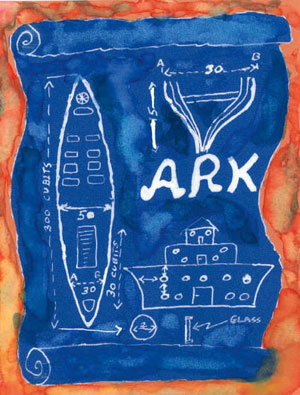
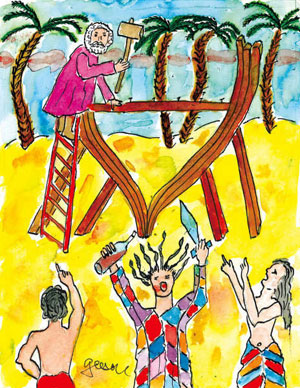
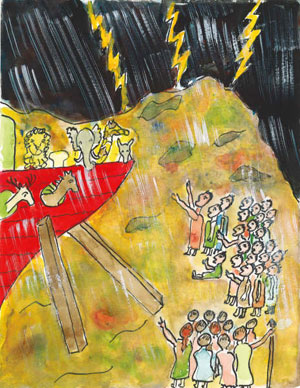
Judith & Gerson Goldhaber: “Noah and the Flood” (excerpt)

Award-winning poet Judith Goldhaber and her husband, the artist and physicist Gerson Goldhaber, have just released a sequel to their well-received collaboration, the illustrated poetry book Sonnets from Aesop. Their new collection, Sarah Laughed: Sonnets from Genesis, embellishes familiar Bible stories with humorous and mystical elements from midrash and folklore. Willis Barnstone writes, “Sarah Laughed is utterly charming, poem and icon…In the best tradition of imitation it illumines the Abrahamic religions.” The Goldhabers have kindly permitted me to reproduce the following excerpt from their “Noah and the Flood” sonnet sequence:

ii. The Time is Coming

God spoke to Noah when he became a man
and said, “The time is coming — build an Ark;
storm clouds are gathering; soon you will embark
upon the seas, as outlined in My plan.
Make the Ark as sturdy as you can —
line it with pitch, strip gopher trees of bark
to shape the hull, and lest it be too dark
cut windows, and a doorway.” Noah began
to do what God commanded, but worked slowly,
hoping in time the Lord might change His mind
regarding the destruction of mankind.
He begged the wicked to return to holy
customs, but they answered him with jeers.
And thus went by one hundred twenty years.


iii. The Laughing Stock

At last the Ark was finished, and it stood
three hundred cubits long, and fifty wide,
three stories — thirty cubits — high inside
constructed out of seasoned gopher wood,
the laughing stock of Noah’s neighborhood.
“A flood?” the people mocked, “I’m terrified!
Look! Over there! Is that a rising tide
I see? Boo-hoo, I promise to be good!!”
But then Methuselah died, and a malaise
descended on the people, for they knew
that God had stayed His hand until the few
good men still living reached their final days.
A dark cloud veiled the sun; the sky was bleak,
and Noah sniffed the wind and said, “A week.”


iv. Bird to Bird

Compared to getting humankind to heed
the urgent warnings, putting out the word
to animals was easy. Bird to bird
the news was spread at supersonic speed.
By nightfall all the beasts of earth had heard
the message, and they readily agreed
to group themselves according to their breed
(scaly, hairy, hard-shelled, feathered, furred)
and line up in a queue beside the Ark.
Birds sang and cattle mooed and lions roared
as Noah gently welcomed them aboard
and sealed the door against the growing dark.
At last, on bended knee, nose to the ground,
he gathered up the ants, lest they be drowned.


v. A Mighty Cry

The sun turned black, and lightning streaked the sky,
somewhere behind the clouds a strange light bloomed
and faded, and at last the thunder boomed,
bringing the first drops. Then a mighty cry
arose from those who’d chosen to defy
the warning signs, and callously resumed
their sinful ways. “Even now you are not doomed,”
despairing, Noah cried, “repent or die!”
On board the Ark, through unbelieving eyes
the animals beheld the death of man.
Sworn adversaries since the world began
wept freely as they said their last goodbyes.
Even man’s ancient enemy the snake
shed bitter tears that day for mankind’s sake.

Church of the Holy Cow


The artist Steve Emery, who blogs over at Color Sweet Tooth, put up a thoughtful post some months ago about taking some time away from the noise, conflict and complications of the church in order to reconnect with God. Commenting on the impending Episcopal schism, he wrote in March:


Why do we leave a church? Because we no longer consider the worship of the others to be true? Because we fear our own faith or the faith of our children may be damaged by hearing what we consider to be wrong ideas? Because we no longer believe the Spirit moves in the presider, and the Eucharist is thus somehow invalidated?

For now I find these questions beyond me, and not mine to answer. This may change.

In my case I did not leave a church in particular, though it was events in a particular church that precipitated my departure. I left organized church in general. I needed to leave, like a man who needs to clear his head at a concert or a party by going outside and breathing some cold fresh air. I was seeing the defects of organized church in a way that blocked seeing anything else. I’ve become some kind of a cow, I think. Recent visits to church left me feeling sleepy and benign, with dew from the fields still on my shaggy bovine hide. I was OK being there, enjoyed the company and worship, found God there as congenially as elsewhere, but I was happier to return outside. I know God will eventually turn me back into a man…but for now I’m learning by being cattle.

Six months later, Steve writes:


Sometimes, when I’m the most confused or hurt about something, my prayer takes the form of just standing beside Him and reaching up with my little hand to put it in His. I don’t see Him in these prayers, I just put my hand in and try to stand still. I have to do it over and over again, because I’m not good at standing still. But I don’t think about whether God is grossed out about all the mud on my legs, the way my clothes haven’t been changed and are full of grass stains, the way my little hand is wet and clammy, or the way the other hand’s thumb is probably in my mouth. He doesn’t care and I’m too busy just needing Him to give it much thought. That’s the best I can do much of the time.

Or, to shift to my current metaphor, I’m just munching grass over here in my shaggy coat, rain or shine, trying to take it all in and not fret so much. He doesn’t withhold the rain or the sunshine because I’m just a stupid cow or even if I’m a wicked cow. He’s just good and I just love being here with Him. And once in a while I hear a voice like yours and it makes me look up and pause in my chewing. It definitely seems to be where I belong at the moment.

I’ve gone on a very similar journey this summer, having forced myself to defer the question of which church to join (if any) until Labor Day. Steve’s attitude of childlike humility is the essential factor that keeps a church-vacation from backsliding into spiritual individualism and rejection of the body of Christ. I’ve tried to resist the temptation to codify what I am doing as something that everyone should be doing, or even as something that will always be right for me. I put my grubby little hand in my Father’s and say “I need a nap” and I trust that He will wake me up in time for supper.

“Talent”, Fatalism, and the Artist’s Fears


One of my favorite “books for writers” is Art and Fear by David Bayles and Ted Orland. Whether you need to sustain your faith in a long-term project or gather the courage to leap into a new one, this little book is an invaluable aid to identifying and overcoming the fear-based myths that prevent you from doing your work. One of those is “talent”:


Talent, in common parlance, is “what comes easily”. So sooner or later, inevitably, you reach a point where the work doesn’t come easily, and — Aha!, it’s just as you feared!

Wrong. By definition, whatever you have is exactly what you need to produce your best work. There is probably no clearer waste of psychic energy than worrying about how much talent you have — and probably no worry more common. This is true even among artists of considerable accomplishment.

Talent, if it is anything, is a gift, and nothing of the artist’s own making….Were talent a prerequisite, then the better the artwork, the easier it would have been to make. But alas, the fates are rarely so generous. For every artist who has developed a mature vision with grace and speed, countless others have laboriously nurtured their art through fertile periods and dry spells, through false starts and breakaway bursts, through successive and significant changes of direction, medium, and subject matter….

Even at best talent remains a constant, and those who rely upon that gift alone, without developing further, peak quickly and soon fade to obscurity. Examples of genius only accentuate that truth. Newspapers love to print stories about five-year-old musical prodigies giving solo recitals, but you rarely read about one going on to become a Mozart. The point here is that whatever his initial gift, Mozart was also an artist who learned to work on his work, and thereby improved. In that respect he shares common ground with the rest of us. (pp.26-28)

Another myth that is deadly to art-making is “magic”:


Imagine you’ve just attended an exhibition and seen work that’s powerful and coherent, work that has range and purpose….[T]hese works materialized exactly as the artist conceived them. The work is inevitable. But wait a minute — your work doesn’t feel inevitable (you think), and so you begin to wonder: maybe making art requires some special or even magic ingredient that you don’t have.

The belief that “real” art possesses some indefinable magic ingredient puts pressure on you to prove your work contains the same. Wrong, very wrong. Asking your work to prove anything only invites doom. Besides, if artists share any common view of magic, it is probably the fatalistic suspicion that when their own art turns out well, it’s a fluke — but when it turns out poorly, it’s an omen. Buying into magic leaves you feeling less capable each time another artist’s qualities are praised….

Admittedly, artmaking probably does require something special, but just what that something might be has remained remarkably elusive — elusive enough to suggest that it may be something particular to each artist, rather than universal to them all….But the important point here is not that you have — or don’t have — what other artists have, but rather that it doesn’t matter. Whatever they have is something needed to do their work — it wouldn’t help you in your work even if you had it. Their magic is theirs. You don’t lack it. You don’t need it. It has nothing to do with you. Period. (pp.33-34)

The Bible, understandably, takes a dim view of magic. Thus I found it particularly helpful to see my reigning writer’s-block myth tagged with this label. Magical thinking, for me, is what happens when I look to the success of my work to shore up my belief in God’s faithfulness, instead of taking that belief as bedrock and letting the work build on it. “I haven’t written a good chapter in two weeks — the mandate of heaven must have passed from me!” 

For no obvious reason, I grew up afraid that God was Tennessee Williams and I was Laura in The Glass Menagerie. I didn’t understand why so many people’s lives just stalled, trapped in meaninglessness and dysfunction, when they had started off like me, believing they could do anything. In literature, there was an author who set such characters up to fail, sacrificing them to the storyline. Perhaps someone already knew that my story would end as another tale of someone whose dreams outstripped their pathetic destiny. Could I spot the clues, and if so, what should I do about it — fight the tide, or reconcile myself to insignificance?

The Psalms and the Hebrew prophets tell a different story. God’s chastisement is always a prelude to restoration. Even the “vessels of wrath” passage in Romans 9 — the closest the Bible comes to supporting my fatalistic neurosis — is only a hypothetical.

In this context, what might it mean for the failure of some aspect of my writing to be “for my own good”? Salvation by grace breaks the chain binding works to self-worth. Therefore, when I’m blocked, my first assumption should not be that God wants to take me down a peg, but that I can learn something useful about what was wrong with my original agenda for the work. This depersonalizes the issue, and also gives me hope, because the failure itself is not the divinely desired outcome but only preparation for starting off again in a new direction.

I figured this out yesterday, and the writing went very well. But what about today? Keep on keepin’ on.

Divine Impassibility? A Jewish Perspective


No, not impossibility. For the non-theology-geeks among you, impassibility is the doctrine that God does not suffer or have emotions in the human sense. This assertion is disputed among Christians, and seems to appeal more to Calvinists and others who are anxious to preserve God’s absolute sovereignty. (If that sounds absurdly presumptuous, well, I phrased it that way for a reason.) I lean toward believing that it’s an unbiblical notion that crept in from Hellenistic culture, which understood perfection as changelessness. By contrast, the Bible tells us that God is faithful and eternal, but this need not mean that God is unaffected by events. Rather, it means that God’s loving nature and His promises are completely reliable. 

Writing in this week’s Jewish World Review, Rabbi Nathan Lopes Cardozo connects the de-personalization of God to a loss of moral significance for human emotions and actions:


…[T]he term G-d…often stands for completely opposing entities used by religious and quasi-religious ideologies. All of them agree that “G-d” affirms some Absolute Reality as the Ultimate. But, they fundamentally disagree as to what that reality is all about. For Benedictus Spinoza, the Dutch philosopher and Jewish apostate, and other pantheistic thinkers, He is really an “It,” a primal, impersonal force, identical with all nature — some ineffable, immutable, impassive, Divine substance that pervades the universe or is the universe. G-d is only immanent; He is permanently pervading the universe but not transcendent, a Divine spirit which has little practical meaning in man’s day-to-day life.

This is not so for Judaism and other monotheistic religions. For the Jewish tradition, G-d is not an idea or just a blind force but the Ribono shel Olam, the Master of the Universe, Who, besides being immanent is also transcendent, surpassing the universe which is His creation. He has the disturbing habit of being everywhere and anywhere, and He is known to interfere with anything and everything. He is a living G-d who is a dynamic power in the life and history of man, moving things around when He sees fit and smiling or getting annoyed with His creatures when they have blundered yet again. But, most importantly, while He does not fit into any category, He has, for the lack of a better word, “personality” and His own consciousness. His essence cannot be expressed, but He can definitely be addressed.

This radical difference in the conception of G-d makes for an equally profound divergence in attitudes about all life and the universe. While in pantheistic and other non-monotheistic philosophies, He has no moral input, nothing could be further from the Jewish concept of G-d. For in Judaism, He is the source “par excellence” of all moral criteria. According to pantheism and the like, the world is eternal, without a beginning. As such, it does not have a purpose since purpose is the conscious motivation of a creator to bring something into existence. It therefore follows that in the pantheistic view man cannot have any purpose either. He, like the universe, just “is” and, so, moral behavior may have some utilitarian purpose but no ultimate one. For pantheism it is not the goal of man to be moral but just a means to his survival. Would moral behavior no longer be needed as a means for man to survive, it could be dispensed with.

On a deeper level, the pantheistic world view sees the universe as an illusion — an unreal, shifting flux of sensory deception. As such, it needs to be escaped. Made from a purely Divine substance, it could not accommodate any physical reality and, therefore, could not have any real meaning. Neither could man. Once his physical existence is branded as an illusion, he can no longer exist as a man of flesh and blood. Nor are his deeds of any real value. Since it is the body, which gives man the opportunity to act, and man’s body is seen as part of the deception, it must follow that all man’s behavior belongs to the world of illusion as well. It is this view that Judaism protests. G-d is a conscious Being who created the world with a purpose. And this world is real and by no means a mirage. Man’s deeds are of great value, far from an illusion; they are the very goal of creation. Judaism objects to the pantheistic view of man since it depersonalizes him, which must finally lead to his demoralization. If man is part of an illusion, so are his feelings. So why be concerned with a fellow man’s emotional and physical welfare?

Paradoxically, this pantheism infiltrated western culture via the back door. When we are told by certain modern philosophers that man is only physical and his body a scientific mechanism in which emotions are just a chemical inconvenience, we are confronted with a kind of pantheism turned on its head. While pantheism denies the physical side of existence, this so-called scientific approach rejects the spiritual dimension of man. In both cases, emotions are seen as part of an illusion, and, therefore, they are to be ignored.

Judaism, on the other hand, declares that it is emotions that make man into man and that they are of crucial importance and real. In fact, emotions are central to man’s existence, since they are the foundation of moral behavior. While pantheism teaches that moral criteria belong to the veil of illusion, Judaism declares them to be crucial. It is for that reason that Judaism views G-d as an emotional Being. By giving G-d, metaphorically speaking, emotions, these emotions are raised to a supreme state. If G-d has emotions such as love, mercy, jealousy and anger, then they must be real and serious and not to be ignored when found in man. While some philosophers considered such anthropomorphism as scandalous, the Jewish tradition took the risk of granting G-d emotions so as to uphold morality on its highest level and guarantee it would not be tampered with. For the sake of man even G-d is prepared to compromise His wholly Otherness, albeit not to the point that He would be projected as a human being.

Read the whole article here. (JWR is reader-supported, so if you like it, consider making a donation.)

Rabbi Cardozo is describing an Incarnational worldview, one that Christians take a step further by claiming that God was in fact “projected as a human being” in Jesus. I’m always wary of philosophical moves that widen the gulf between God and humanity, in a way that obscures our ultimate reconciliation rather than merely whetting the appetite for it. Note that God’s sovereignty is not threatened because it was still His initiative to “compromise His wholly Otherness”. The one who “taking the very nature of a servant…humbled himself and became obedient to death” (Phil 2:7-8) does not need us to wipe away His humanity in order to restore His dignity.

“Pocket Full of Violet” and Other New Poems by “Conway”


My prison pen pal “Conway” continues to make great strides in his poetry and artwork. As I mentioned in last month’s post, conditions have improved at his new location, where he has a job in the library and access to colored pencils and a typewriter. I hope to reproduce some of his drawings here soon. He often picks up themes from the classics he has been reading and reworks them in a voice that’s all his own. He sent me these poems after reading T.S. Eliot’s “The Waste Land”. I heard some echoes of Eliot’s closing section (“What the thunder said”) in the first poem below.

In his July 17 letter, Conway writes,

“…The other day while going through work change (strip search) the lady (if you wanna call her that!) searched my lunch (state issue baloney, apple, bread & mustard) well I had put a scooter pie inside the bag, I had purchased from canteen — she said I was not allowed to have it, who knows what (security risk) this would present, ‘the great marshmallow pie war’ so I ate it, you know, destroyed the evidence, literally….

“OK now on to bad news, they shot me down Calif Supreme Court on my writ of Habeas Corpus. So now I must file in Federal court. The basis for the appeal is #1 violation of contract (plea agreement) being as there was no mention of 3 strikes law in original plea bargain in 1987 that if I was arrested for non serious crime I would receive life in prison. I have good federal case law that confirms my argument plus the due process doctrines. It’s hard to get anyone’s ear on this stuff, though. Everyone is so caught up in their own drama they could care less about all the people stuck in here on an illegal law, as long as they have their big screen TV and what-nots….”

From July 26:

“I’ve been going to work almost every day since I got assigned to Vocational Education Clerk. So not much to blabber about, except last Saturday we had a yard down incident (upper yard) I’m lower yard, but they make us all prone out on our belly when they answer an alarm. Any rage, it was 109 degrees and I had my shirt off yard shorts on and was walking the concrete track with a buddy, so we belly crawl off the blazin hot concrete (stayin low) over to the grass field in the center of yard and, were obviously lookin to see who got got, so to speak, and I noticed that the grass was itching real bad, and thinkin it had just been a long time since I laid in the grass, I commented to my buddy “man this grass itches” about that time he looks over at me and says “Dude you got Ants all over you” Sure as heck I’d laid myself smack dab on an ant hole, so we slow crawled sideways and I brushed the critters off me, feelin like the interloper. Crazy huh? I know an Ant can’t move a rubber tree plant, but they sure moved me 🙂  “


Pocket Full of Violet

What love can clutch me
will remain forever, sheltered inside
the refuge of this stone heart
among a lazy river of stars
rising to meet my eyes awake
searching this endless silence
waiting for a break, carefully.

Chances & chains connect our soul
with so many sighs undone, reflecting
glittering like glass marbles
framed in stone and drowned by tears
shuffled savagely by foul years.
Broken fingers of the wind
departed softly unheard, and wept
swept through a lost window
behind another dull evening moon
bringing the bright kite
with a pocket full of violet
waiting beyon this wall
heavy on my heart
promising a new start
in an empty chapel
built by the lean,
mean and broken, spider’ web.

I sat alone in the pew
behind myself, daring my heart
to turn the key and cope
pierce this fierce dark with hope…

********

Spider

A spider hurls his rope up high
into an invisible windless sky.
His silk flag floats down
spinning a sticky town.

He laced up a Butterfly begging to be free
he swallowed her, but won’t feast on me
I wave my middle finger, curse & mock
he smiles and points at his key to my lock.

Someday, he motions, but not just yet
I wonder, do spiders ever regret
forget the paralyzed pleas of their prey
cursing the web, his bite, this Day…

********

Little Brick 

This little brick went to prison
that little brick went home
that little brick went missin’
this little brick’s on his own
that little brick the cops hassle
put the little brick back in jail
built a little brick road & a castle
brick by brick straight to hell…

********

The Gavel

When the Gavel came down it glistened
   should’ve splintered from the sound
echoing in my mind, still shaking the ground
   no one else heard but I listened…

When the gavel came down I bled
   while my family mourns, I’m alive still cold
buried in concrete on steel shelf
   filed away, story untold

When the gavel came down
   we all shut the book on life, in this scene
a library of lost souls
   somewhere-n-nowhere
and everywhere in-between

Then the gavel spoke, deafened
   I started to choke, lost my mind
for all life to spend
   in this library of prison, when
the gavel gave its final decision…


Partners in Health: 20th Anniversary Appeal


For 20 years, Partners in Health has provided free medical services to the poorest communities around the world, while lobbying developed nations for more equitable access to medication and technology. Their website states, “Our mission is to provide a preferential option for the poor in health care.”

Millions of people are dying of treatable, preventable diseases such as malaria, AIDS and TB because medications are unaffordable or countries lack the infrastructure for traditional means of foreign-aid delivery to be effective. PIH’s innovative “community-based care” shows dramatic results where other programs have failed. Their aid workers make a hands-on, intensive personal commitment to their patients, helping them adhere to treatment regimens and addressing other non-medical problems that interfere with their care. For PIH, fighting disease in poor communities involves larger issues of social justice, including access to education, clean water, shelter, sanitation, and economic opportunities.

Some inspiring stories from their website:

Profile: Haitian AIDS patient delivers treatment and truth
More than 13 years ago, Denizard Wilson was diagnosed with AIDS. Soon he was too sick to continue working in Port-au-Prince, too poor to afford medical care, fearful that time was running out. Then he moved back to his hometown in the Central Plateau and went to PIH for treatment. “Since I have been with PIH, I have never been sick again,” he says today.

A doctor’s journal: bringing hope to patients in LesothoMathabo Posholi was too weak to sit up in bed when Dr. Jonas Rigodon first visited her. Eight months later, she is up and about and eager “to talk to people who have HIV and tell them that they have to take their medicine.”

To donate to their 20th anniversary appeal, click here.

I also recommend Tracy Kidder’s book about PIH founder Dr. Paul Farmer, Mountains Beyond Mountains.

Christian Mood Swings


When I became a novelist last year, I decided to start having emotions. Bad idea. My characters experience higher highs and lower lows than I’ve generally allowed myself in “real life”. I thought that because it wasn’t “really happening to me” I could enjoy the upside without the downside. Wrong again. 

Something that happened around the same time was that God answered my prayer (chuckling in His size-40 sleeve all the while) to remove my fear of being incinerated by contact with Him. Nowadays, when I read “Is not my word like fire, says the LORD, and like a hammer that breaks a rock in pieces?” (Jeremiah 23:29), my response is more “Awesome, dude!” than “Yikes – where do I hide?”

Since I opened the doors of my creativity and my prayer life to let the storms sweep through, amazing things have happened. My writing has taken on new degrees of honesty, depth and mission, and my zeal to know God has increased. BUT…a lot of the time I feel like the Holy Spirit’s chew toy. Shake shake shake, plop. Tossed in a corner. I suppose that changing my temperament from constant low-grade gloom to manic-depressive is an improvement in terms of productivity, but when the post-prophetic emptiness descends, I remember why I resisted our culture’s veneration of impulsive emotion for so long.

In short, I have become addicted to peak experiences. I’m writing because I need the high of creation, or to escape from the flatness of everyday life. I drift from church to church seeking the thrill of spiritual fervor, while knowing that I will never be in a real relationship with the people who are worshipping beside me, because I don’t feel safe with their church’s worldview.

Today’s thumbnail bio at The Daily Office was of Jeremy Taylor, a 17th-century Anglican bishop and chaplain to King Charles I, who wrote this extraordinary prayer for the visitation of the sick, as found in the Book of Common Prayer:


O God, whose days are without end, and whose mercies cannot be numbered; Make us, we beseech thee, deeply sensible of the shortness and uncertainty of human life; and let thy Holy Spirit lead us in holiness and righteousness all our days: that, when we shall have served thee in our generation, we may be gathered unto our fathers, having the testimony of a good conscience; in the communion of the Catholic Church; in the confidence of a certain faith; in the comfort of a reasonable, religious, and holy hope; in favour with thee our God, and in perfect charity with the world. All which we ask through Jesus Christ our Lord.

Wait a moment — we’re supposed to want to be aware of the emptiness of mortal life? This can be a blessing, not just a pathology? As my Buddhist husband has often told me, even negative emotions feel much better when you stop resisting them as a violation of your imaginary entitlement to constant happiness.

And so I ask myself: Do I really long to see and speak the truth because it is God’s truth, or only because it is cool and exciting? Some truths are not fun. They’re not even scary in an exciting way. Feelings of pointlessness and spiritual darkness are also part of the package, because life is indeed short and uncertain, and evil is real.

I have been revived by the emotional freedom of charismatic and evangelical services, and will probably always dip into that world for occasional spiritual rebooting. However, I’m also coming to appreciate the discipline provided by the traditional liturgy, how it makes space for the widest range of experiences through the Scriptures yet holds them in a framework that prevents a single passion from filling the entire field of vision. This striking juxtaposition from the August 10 Morning Prayer service is a perfect example:


1 O LORD, my God, my Savior, *
by day and night I cry to you.
2 Let my prayer enter into your presence; *
incline your ear to my lamentation.
3 For I am full of trouble; *
my life is at the brink of the grave.
4 I am counted among those who go down to the Pit; *
I have become like one who has no strength;
5 Lost among the dead, *
like the slain who lie in the grave,
6 Whom you remember no more, *
for they are cut off from your hand.
7 You have laid me in the depths of the Pit, *
in dark places, and in the abyss.
8 Your anger weighs upon me heavily, *
and all your great waves overwhelm me.
9 You have put my friends far from me;
you have made me to be abhorred by them; *
I am in prison and cannot get free.
10 My sight has failed me because of trouble; *
LORD, I have called upon you daily;
I have stretched out my hands to you.
11 Do you work wonders for the dead? *
will those who have died stand up and give you thanks?
12 Will your loving-kindness be declared in the grave? *
your faithfulness in the land of destruction?
13 Will your wonders be known in the dark? *
or your righteousness in the country where all is forgotten?
14 But as for me, O LORD, I cry to you for help; *
in the morning my prayer comes before you.
15 LORD, why have you rejected me? *
why have you hidden your face from me?
16 Ever since my youth, I have been wretched and at the point of death; *
I have borne your terrors with a troubled mind.
17 Your blazing anger has swept over me; *
your terrors have destroyed me;
18 They surround me all day long like a flood; *
they encompass me on every side.
19 My friend and my neighbor you have put away from me, *
and darkness is my only companion.

Glory to God the Creator,
and to the Christ,
and to the Holy Ghost;
as it was in the beginning,
is now, and ever shall be
world without end. Amen. Amen.


After all that, we are called to praise. Whether or not we feel like it. There is a sanity to that command that comforts when emotions fail.

Inmates’ Access to Religious Books Threatened


From the government that brought you Abu Ghraib and Guantanamo…Not content with violating the Eighth Amendment, our prison system is taking aim at freedom of religion, too. Chabad.org reports on new federal regulations that would remove thousands of religious books from prison libraries:


From behind bars, many prisoners turn to religion to fill the void in their lives. Frequently, prisoners’ pursuits dovetail with the prison system’s goal of rehabilitating the convicts in its care; at the end of their incarcerations, if prisoners leave with a better understanding of right and wrong, so the thinking goes, they’ll be less likely to return in the future.

But that logic has come under fire recently by a federal rule change implemented in May limiting prison libraries under the domain of the U.S. Bureau of Prisons from carrying no more than 150 titles dealing with any single religion.

The new policy, while rooted in a desire to prevent religiously-motivated militancy from taking hold in federal penitentiaries, has struck some – particularly Jewish prisoners and officials with the Chabad-Lubavitch Aleph Institute – as odd, considering that many traditional Jewish texts like Maimonides’ Mishneh Torah legal code are now off limits. The rule is being challenged by Jewish, Christian and Muslim prisoners in a class-action law suit.

“Inmates in prison are searching for a sense of spirituality; they are looking to adjust their lives,” said Ron, who spent the past two years and seven months as an inmate at the Federal Correctional Institution in Yazoo, Miss. As with all of the other prisoners and former prisoners interviewed for this story, Ron requested that his last name not be used.

“Inmates are looking to help themselves and search for ways to rehabilitate,” he added. “Most people on the outside do not hear the cries for help from inmates. Many have very little family contact, [and] there is an atmosphere of hopelessness.”

Surprisingly, according to Ron, who was the leader of his prison’s makeshift Jewish community, most prisons are not built with rehabilitation in mind. With the exception of the odd meager job, inmates could, if they so desired, sit around and do nothing all day. Some take the time to plot future crimes or harbor resentment at a system they blame for keeping them incarcerated, he asserted.

Prisoners’ constitutional rights are more limited than those of ordinary citizens, for security reasons, but even so, the regulation should not withstand a constitutional challenge, assuming that the judges obey precedent rather than politics. I would actually argue this as an Establishment Clause issue, not only a Free Exercise issue.

A good case can be made that the regulation fails the second and third prongs of the Supreme Court’s test for Establishment Clause violations in Lemon v. Kurtzman (1971): it is not neutral between religious and secular content (treating religious literature differently from other books that potentially contain extremist political ideas), and it creates excessive governmental entanglement with religion (determining what sect a book is assigned to — e.g. are you going to have 150 Protestant and 150 Catholic books, or just 150 Christian books? if the latter, how do you allocate that quota among 1,000+ denominations?).

I don’t discount the danger of radical Islam spreading in a disaffected prison population, but an overbroad crackdown on all forms of “religion” sacrifices one of the very freedoms that we are fighting for.

Meanwhile, readers, clean out your basements and donate your old books and literary journals to your local prison library. And I mean good books, not just drugstore paperbacks. Prisoners are looking for something of substance to fill their days. I might pick jihadism over Jackie Collins if those were the only two options on the shelf.

Suffering for the Wrong Reasons


The Christian life is not an easy one…but then, what life is?

“Life is real, life is earnest, and the grave is not its goal,” wrote Longfellow in “A Psalm of Life”. Prophets and preachers can be stung to harshness at the thought of people wasting that one precious life on trivia, when they could be growing in the knowledge and love of God. But I also see a lot of Grape-Nuts religion; woe to you who prefer Frosted Flakes to a bowl of unsweetened gravel, because you are still selfish enough to want God to make you happy. 

That is not the God I am encountering in the Gospels and the Psalms. God is always making promises to people, very concrete ones involving food, shelter, the birth of children, and livestock, as well as the ones we can reframe as acceptably “spiritual”, like justice and salvation. “I came that they might have life, and have it more abundantly.” (John 10:10)

The issue of homosexuality puts this kind of “No pain, no gain” religiosity on display.  Requiring gays to be celibate — the last-ditch response now that the existence of an unchosen, unchangeable gay orientation can no longer be denied — imposes a suffering far greater than lack of sex. It is about depriving a whole class of people, through no fault of their own, of even the hope of a loving family life. Not even single straight Christians, who are remaining chaste until marriage, face this certainty of a lonely future.

The typical response by celibacy advocates is to sidestep all appeals to compassion by saying that every Christian is called to suffer and sacrifice. This is my cross, this is yours, end of discussion. Chris at Betwixt and Between deconstructs this position admirably in his August 6 post; boldface emphasis mine (scroll down; the permalink feature is not working for me right now):


At heart, Christianity is NOT a sado-masochistic religion. It’s not about suffering for suffering sake. Or even “giving up” something. It’s about “responding unto”. It’s about response to the God who is love.

But some straight Christians and gay celibates can sure turn Christianity into that when discussing what is good for gay Christians in general. It often happens through an argument from the extreme case (celibacy) to every particular case….

All too often I run into posts across the internet about gay people and our needing to “give up something”, take up our cross, meaning that we’re automatically called to celibacy in toto. That a little more suffering is a good thing in and of itself even when nothing shows for it. But Christianity is not about suffering for suffering sake, or that a little more suffering will get you closer to God, after all, at heart, our faith makes clear that suffering can destroy and we can do nothing of ourselves to get us closer to God, rather God draweth nigh to us amidst the sundry realities of life, especially in our suffering….

Good and WISE spiritual discernment and direction knows that we have to be careful in determining another’s call or what from they are called to abstain, and even more careful in making carte blanche generalizations for an entire class of persons in this regard, and particularly so, it seems that while it is suspect to draw conclusions from gay individuals who claim celibacy is NOT their call and partner, it seems many heterosexuals are quick to glom on to those gay individuals who claim it is the call of every gay person simply because it’s working for those gay persons….

It’s my opinion that such efforts to make such determinations are ego-driven rather than driven by a concern to love the other as ourselves or to bring them the Good News of Christ Jesus and let the response be truly a working out of God in the gay person’s life. And this egoism can be hidden under all sorts of pious declarations and considerations.

In the case of gay people, I think the want to tell all gay people their calling is celibacy by virtue of being gay, is at heart, so that these people don’t have to deal with the uncomfortable reality of another orientation existing and making space for that orientation as ordinary even if abnormal statistically with appropriate means for the vast ordinary majority in that class to live as such with the possibility of growing in love and virtues. It’s about ego. Even when they see virtues arising from the vast majority of gays who will simply cut down the middle–just like them, in partnership. Give it up! Because the law says… It’s stifling to behold.

It’s like the bottom-line basis by which we discern is taken out from underneath us–fruits of the Spirit (virtues), and stamped on, simply because we’re told, the extreme (celibacy) would show that we truly loved God and would do us better because God requires more of us. And if we have to suffer a bit more. Oh, well! Quit that intimacy with your partner, and then we know you love God. But what if the relationship shatters and virtue slides away? I’ve seen this happen in ex-gay situations when one of the partners gets “saved”. No answer. Or some damn platitude, “Well God has a better plan…” Or another smarm about suffering. But that’s the whole point. Such argument from the extreme to the most of us who are ordinary and not gifted in celibacy can destroy. It’s bad spiritual direction and poor pastoral understanding.

Instead, what is good for us is ascertained by the extreme (celibacy)—well the Desert Elders did some claim for example so why can’t you gays, rather than recognizing most will likely find themselves, just like straights, needing a middle path….A path, partnership, that even many of those, who advocate that we are automatically called to the extreme, recognize leads to virtues. Many who say we should nonetheless take on an extra helping of suffering simply to suffer or to appease God because God calls us to give up the good (for what purpose in toto isn’t clear besides maintaining the rules) nonetheless admit that such partnerships show virtues. Perhaps that which is pleasing to God isn’t simply to increase suffering, but doing that which in a particular life leads to holiness?

…The danger in all of this is that gays will come to understand that the God of Jesus is a body-soul divider, opposes the Spirit to the flesh, a Manichaean God so often the image I get from straight people who make such suggestions but wouldn’t deign to turn that same suggestion on themselves (nor do they offer an equivalent to they’re generalized, “well heterosexuals suffer too” response when queried) or from the gay people who it seems have a vocation to celibacy so they universalize their vocation to all gay people (or the worst, apparently straight people called to celibacy who then have lots of suggestions for the gays while making snide comments about our parnterships)—not some tricky slide, well I give up x, y, z, so you need to give up partnership, but a humanizing, we’re more similar than different in this so most likely and reasonably speaking not all of you would be asked to give up partnership. It’s an argument from the extremes, that ironically, is at odds with monasticism in its healthiest forms and its focus on practice–that most practice will be in the middle not on the edges. To suggest that all gay people should be just like the Desert Elders or monastics is an extreme arguing into practice for the general population–of gays in this instance.

Instead, a blanket policy makes life easier—for the straights and the gay celibates who advocate this. And connecting that policy to the cross gets such people off the hook of examining what looks an awful lot like sado-masochism. Asking of an entire class of people what they wouldn’t ask for themselves, and being unable to think in terms of the particular in ways that would be unthinkable for straight people. The rules say, and so it goes… You will need to suffer a little more because…God needs appeasing. While we have tangible and good things in our lives, we’ll tell you about all of the non-existant ones you’ll inherit in the next. But instead in following Jesus, what we’re giving up is the story these people have told us about ourselves, and that puts us in some difficult jams. We get plenty of crosses coming our way by doing so everyday. The suggestion that we don’t already face crosses simply by living life is a form of blindness to what gay people face just for existing and living in ordinary ways.

I could understand this argument from the extreme if always and everywhere gay partnership failed to blossom in virtues or positively led to vice. But even many of these folks admit it doesn’t. Virtues arise. Which tends to tell us that the desire itself is not the problem, but rather what we choose to do with it, just like heterosexuality. And that those of either orientation given the GIFT of celibacy are not “giving up” but “responding unto” in the will God has for them rather than tending to put God and humans at odds, in competition.

In his 1974 tome On Being a Christian, renegade Catholic theologian Hans Kung helpfully distinguished between seeking suffering for its own sake (a misunderstanding of the cross) and bringing forth spiritual fruit from the suffering that inevitably comes our way:


Following the cross does not mean copying the suffering of Jesus, it is not the reconstruction of his cross. That would be presumption. But it certainly means enduring the suffering which befalls me in my inexchangeable situation — in conformity with the suffering of Christ. Anyone who wants to go with Jesus must deny himself and take on himself, not the cross of Jesus nor just any kind of cross, but his cross, his own cross; then he must follow Jesus. Seeking extraordinary suffering in monastic asceticism or in romantic heroism is not particularly Christian.

…It is likewise not a true following of the cross to adopt the Stoic ideal of apathy toward suffering, enduring our own suffering as unemotionally as possible and allowing the suffering of others to pass by while we remain aloof and refuse to be mentally involved. Jesus did not suppress his pain either at his own or at others’ suffering. He attacked these things as signs of the powers of evil, of sickness and death, in the still unredeemed world. The message of Jesus culminates in love of neighbor, unforgettably instilled in the parable of the good Samaritan and in the critical standard of the Last Judgment: involvement with the hungry, thirsty, naked, strangers, sick and imprisoned. (pp.576-77)

In my opinion, what makes universal gay celibacy a false cross is that the sacrifice benefits no one. Unlike chastity before marriage, it is not preparation for a relationship of mutual self-giving and fidelity. Unlike priestly or monastic celibacy, it is borne in solitude and shame, not in an honored role that provides alternative channels for that person’s loving generosity to express itself. It’s throwing away a resource rather than using it where it is most needed. It’s the cross for the sake of the cross, without salvation or resurrection. Jesus called people to sacrifice not so they could prove something to God with their unhappiness, but so that others could be happy as well. Sacrifices with no justification beyond formal obedience to reasonless commands should be looked upon with suspicion. “For my yoke is easy, and my burden is light.”