Miss Deeds Goes to Washington


We’re home from another inspiring, overwhelming AWP writers’ conference in Washington, DC, with the usual crate full of small press books and literary journals that we discovered at their bookfair. I’ll be reviewing some of our finds in future posts. Currently, I’m reading Nick Demske’s self-titled collection of deranged sonnets from Fence Books, and Dorothy Allred Solomon’s In My Father’s House: A Memoir of Polygamy, first released in the 1980s and republished by Texas Tech University Press.

After a 15-hour drive through Snowmageddon, we rewarded ourselves with a day of sightseeing Wednesday before the conference began. We were privileged to catch the groundbreaking GLBT portraiture exhibit “Hide/Seek ” at the National Portrait Gallery, closing this week. Even without the censored Wojnarowicz video, there was much to provoke a fresh look at American cultural history. Various pieces moved me to sadness and anger at the devastation of the AIDS crisis, and admiration for how creatively these artists deployed abstraction, coded symbolism, and experimental techniques to hide the truth of their lives in plain sight.

I was surprised by my feelings of connection with Felix Gonzales-Torres’ “Untitled (Portrait of Ross in L.A.)”, a pile of candies in multicolored wrappers. The placard said the installation starts out at a weight of 175 lbs., which was his late partner Ross Laycock’s weight before AIDS. Viewers are invited to take away a candy and consume it as an act of communion with Ross. Like the AIDS patient’s body, the pile gradually shrinks, but is then replenished, symbolizing the cycle of life and death. (You can see the image and read about it on the gallery’s website.)

What kind of art is this? Without the placard, it’s just a pile of candy. Perhaps it’s better understood as an interactive text, or a collaborative work of performance art, rather than our standard expectation of a visual art object that speaks for itself. The interactive nature of the work, I think, is the key to why I found it so moving. It challenges the whole notion of the uninvolved spectator as a proper or pure stance. We are complicit in this artwork. By taking the candy, we’re taking responsibility for our role as bystanders while people die of AIDS, but maybe we’re also receiving forgiveness and restored relationship through this bodily connection.

In other gay news, Adam and I took part in GetEqual’s protest of the National Prayer Breakfast on Thursday morning. It’s a little-known fact that this annual event, attended by the president and other top U.S. politicians, was created and sponsored by The Family, a secretive elite network of Christian conservatives bent on political takeover. (Yes, I know it sounds like a Dan Brown novel, but it’s all too real–just not as photogenic as Paul Bettany whipping himself.)

Members of The Family have been actively stirring up religious bigotry against gays in Africa, including the infamous Ugandan legislation that would impose the death penalty for homosexuality. Last month, David Kato, one of the most prominent gay activists in that country, was murdered in a probable hate crime. Our protest honored his memory. About 30 of us sang “We Shall Overcome” and handed out flyers detailing the link between the prayer breakfast, The Family, and genocide against gays.

Read coverage of the event at Metro Weekly and see a short video of the protest. Around 23 seconds into the film, you can see Adam holding the rainbow flag (he’s wearing the red ski jacket and black boots) and me next to him (black beret and coat).

Two Poems by Thelma T. Reyna


Poet and fiction writer Thelma T. Reyna’s new chapbook Breath & Bone is forthcoming from Finishing Line Press in April. I’ve already pre-ordered my copy; get yours from their New Releases page. (Books are listed alphabetically by author.) She kindly shares two poems from this collection below.

A childhood home marked by mental illness can sometimes be the crucible in which a writer is formed. Perhaps the need to make sense of the impossible hones one’s mental powers to find or invent extraordinary conceptual connections. There’s a fine line between the extreme coping strategy we call madness and the one we call art. That line, I think, is made of self-awareness and self-integration.

****

Quilts

Mother plugged up the coffee spout
  
with foil after dinner
to keep the cockroaches out
  and laid a pile
of patchwork quilts on the chilly floor
  
for us to sleep on and urinate.
She hung them on the doors
  
next morning,
colorful, stinky banners hanging
  
room through room
to dry—rearranging
  
them next night so the most pissed
would be on the bottom of the stack
  
and we could sleep without the stench
of too much wetness.

Her black
  
coffee sometimes had a baby cockroach
drowned in its bitters. Got through the foil, I guess,
  
damned little fool,
got through the plug to mess
  
her brew, as we messed her quilts—
growing kids lying shoulder to shoulder
  
on the floor,
growing older,
  
still peeing, still wrapped in each other’s arms
to keep warm.

****

How She Died

Who knew it would be like this?
Strong woman, monster lady, mover of monoliths,
she liked to say, not mountains, but monoliths.
Tough momma since thirteen: monster lady, she
called herself, woman who built our house,
   leather
hands cooking dinner for seven when the
   hammer stopped
pounding and the sky purpled. Tough cookie
   without
a man, welts hidden, legs scarred.

But in the end she moved molehills. Her brain
dumped her, one side crumpling, wetting, when
   the going got
too tough too long, the other side pumping her
   to be strong.
The wet one won.

With time, her visitors, airy visitors, came
in pairs, night or day, perched in corners,
   smirking in
the dusk. They took off their heads, she
   said, and
sat beneath her dining table. Her cloudy
eyes shooed them away, trembled when
   they moved
near her wooden knees. She cursed at them,
   tough
momma, made them know she wasn’t ready yet
   for death.

With time, others waited outside windows, came
softly in the brazen light of day, stood by her
   sheets, floated
by her stone hands from a far-off time beyond
recall. These she’d truly loved. Her brain burst one
day in a wetness of recognition. Who could’ve
known she’d die this way? Who could’ve
   guessed love
would take the monster?

Two Poems by Kenyan Writer Stephen Partington


Happy 2011! I thought I’d start off the new year with these poems by Kenyan writer Stephen Partington, containing a tale of new birth and a message of hope for a more peaceful world. They’re reprinted by permission from his collection How to Euthanise a Cactus (Cinnamon Press, 2010).

This collection was one of four books chosen by the influential magazine The Africa Report for their Best Books 2010 feature. (One of his fellow honorees was Nelson Mandela.) The editor’s review states: “The political crisis in Kenya triggered by the botched 2007 elections seems to have caught talented young writers off guard. As prose writers search for their voices, it has been the poets who have confronted the crisis and tried to find meaning through it. Partington’s new collection is a towering manifestation of poetry’s strident return to the literary mainstream. Using media accounts of the violence, Partington points a disturbing finger at the living who remained silent and took sides—and took sides in order to silence.”

Praise Poem

We praise the man who,
though he held the match between
his finger and his thumb,
beheld the terror of its tiny drop of phosphorus,
its brown and globoid smoothness
like a charred and tiny skull
and so returned it to its box.

So too, we hail the youth who,
though he took his panga on the march,
perceived it odd within his fist
when there was neither scrub
nor firewood to be felled,
so laid it down.

An acclamation for the man who,
though he saw the woman running, clothing torn,
and though he lusted,
saw his mother in her youth,
restrained his colleagues
and withdrew.

We pay our homage to the man who,
though his heart was like a stone
and though he took a stone to cast,
could feel its hardness in the softness of his palm
and grasped the brittleness of bone,
so let it drop.

We laud the man who,
though he snatched to scrutinise
the passenger’s I.D.,
saw not the name – instead, the face –
and slid it back
as any friend might slide his hand to shake a friend’s.

And to the rest of us,
a blessing:
may you never have to be that man,
but if you have to,
BE!

****

Present at the Keelhauling

Kenya, late December 2007
For Sophie Mwelu Partington

What could so tiny a sailor have done
to deserve such punishment?
Did you fall asleep on deck, steal lemons,
mutiny?
I stand here like some bleeding heart lieutenant,
at a loss until

the doctor pulls you sternly round your mother’s keel,
and here you come, full-bloodied,
slick as kelp, so much the doctor cannot hold you,
ribbed and gulping with the joyful joy of lungs.

Ten toes, ten fingers, you’re
statistically sublime.
Mum’s little stowaway for nine long months,
and just for now,
this instant as I swaddle you with all my hugs,
you’re mine.

Reiter’s Block Year in Review: 2010


“I do not intend to be inconsolable, but I do not intend to be deceived.” –Leon Wieseltier

Biggest Accomplishments

I now own over 75 Barbies.

It’s been a good year for the writing, too — 30 poems in 30 days, and several hundred pages of my novel and spun-off short stories. Thanks to everyone who has helped me take my career to the next level in 2010:

Massachusetts Cultural Council, 2010 Fellowship in Poetry
The Iowa Review Awards, 2nd Prize for Fiction
Stories published in the Bridport Prize Anthology and The Adirondack Review

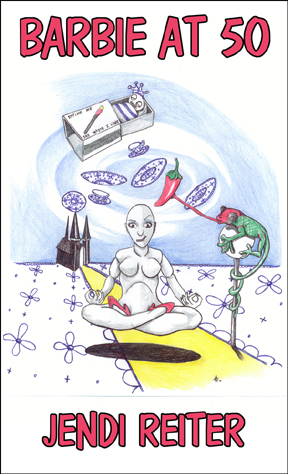
My new poetry chapbook Barbie at 50 was published by Cervena Barva Press:

Best Books Read in 2010:

*Charles W. Pratt, From the Box Marked Some Are Missing: New & Selected Poems (Hobblebush Books, 2010)

Fans of Richard Wilbur will love this beautiful and wise collection by a former English professor who farms an apple orchard in New Hampshire. Read a sample poem here.

*Wesley Stace, Misfortune

A comic melodrama in the Dickensian vein, this picturesque saga of 19th-century England concerns a foundling boy, raised as a girl by an eccentric lord, who must discover his true identity in order to save the family estate from greedy relatives.

*Wayne A. Meeks, Christ is the Question

Renowned New Testament scholar calls us to go beyond the liberals’ reductionist “historical Jesus” and the conservatives’ ahistorical literalism, to find out who Jesus is for us today. Christ’s identity, like ours, is dynamic and defined by relationship to others, not a fixed nugget of truth we must unearth from the past.

Big Gay News:

Federal trial courts rule that California’s same-sex marriage ban, Prop 8, and the federal Defense of Marriage Act are unconstitutional!

“Don’t Ask, Don’t Tell” ban on openly gay soldiers is repealed!

Favorite Blog Posts:

The Biblical Problem of the Prostitute
I used to believe that Christians could affirm monogamous same-sex relationships without rethinking our other theological commitments. It is possible, but now I question whether it’s such a desirable goal. That is to say, are we merely interested in bringing one more group into the circle of respectability? Or does Jesus want us to identify with others who are marginalized as our families once were, and settle for nothing less than a radical theology that includes everyone?

Campus Extracurricular Groups Claim “Religious Freedom” to Discriminate
Non-affirming conservative Christians may well be an oppressed minority on college campuses, but they are the oppressive majority in the rest of America. This is not to say that two wrongs make a right. It’s just important to remember the wider context. CLS presumably wants its members to use their legal skills to block full civil equality for GLBT people when they graduate. Their gathering is not just about personal self-expression.
(See follow-up post here, too.)

Straight Women, Gay Romance: Bridging the Gender Gap?
I feel a little sad that traditional male-female divisions persist even in queer culture. Some editors…suggest that the difference between gay male fiction and female-written M/M is that the latter is more romantic and sentimental. Men who want lasting love, who talk openly about their emotions with and for other men–are these still mainly a female fantasy, scorned by other men regardless of sexual orientation?

Marriage Equality Versus Fertility Cult
Gay couples are parents too. The only way to tell them apart is to elevate procreative ability to a spiritual ideal. Inadvertently perhaps, this attitude wounds and discourages potential adoptive parents, reinforcing our fear that infertility is a kind of failure, an exclusion from the highest level of sacred marital union.

Becky Dennison Sakellariou: “Stoning the Pool”


Becky Dennison Sakellariou is a poet who divides her time between New Hampshire and the village of Euboia in Greece. Her new collection, Earth Listening (Hobblebush Books, 2010), is a lyrical tribute to both landscapes and the fruit that springs from their stony soil. Among those fruits, metaphorically speaking, are the gifts of wisdom and acceptance of the passage of time. Somehow the heart stays open to love and beauty as mortality is faced. She kindly shares this poem below.

Stoning the Pool

I left all words
on the kitchen table
when they called my name.

I love words.
Words are the way
each idea comes to my tongue.

This idea needs no savoring.
Cancer tastes of fear
and fear will not

translate into echoes,
cadences, syllables.
The nurse said

all will be well
which is what I often tell
my friends who are in despair.

Her words sat
in the outer bowl of my ear,
rolling back and forth

like marbles in a dish.
All is well was gone,
disintegrated at a word.

Who will come?
Who will call my name?

Is this the Grove of No Shadows?

What shapes sleep
beneath the silky surface
of this body of bloody water?

Who will excavate my grave
littered with olive pits,
fig seeds and shattered potsherds?

Who will stand
for the final libation?

Lisa Suhair Majaj: “Practicing Loving Kindness”


This poem is reprinted by permission from Lisa Suhair Majaj’s Geographies of Light, which won the 2008 Del Sol Press Poetry Prize. These poems give a voice to the Palestinian people, bearing witness to brutal loss, as well as the joy.

The title is a phrase that’s familiar to me from Buddhist teachings. Nonviolence and compassion for enemies are central to Buddhism and Christianity. Both religions also share an emphasis on justice. Whether you call it natural law, or karma, moral and immoral actions have consequences on a cosmic scale. The psychological challenge is how to have compassion for the oppressor without whitewashing oppression. I like the way Majaj’s poem balances both of these imperatives, the naming of the world’s evils and the aspiration to look for reconciliation instead of revenge. Gentle humor is an important tool for the peacemaker.

Practicing Loving Kindness

Bless the maniac
barreling down the one-way street
the wrong way,
who shakes his fist when I honk.
May he live long enough
to take driving lessons.

Bless the postman
puffing under the no-smoking sign.
(When I complain, my mail
goes mysteriously missing
for months.) Bless all those
who debauch the air,
the mother wafting fumes
across her baby’s carriage,
the man whose glowing stub
accosts a pregnant woman’s face.
May they unlearn how to exhale.

Bless the politicians
who both give and receive
bribes and favors.
Bless the constituents
seeking personal gain,
the thieves, the liars, the sharks.
And bless the fools
who make corruption easy.
May they be spared
both wealth and penury.

Bless the soldiers guarding checkpoints
where women labor and give birth
in the dirt. Bless the settlers
swinging clubs into teenager’s faces,
the boys shooting boys with bullets
aimed to kill, the men driving bulldozers
that flatten lives to rubble.
May they wake from the dream of power,
drenched in the cold sweat
of understanding. May they learn
the body’s frailty, the immensity of the soul.

Bless the destroyers of Falluja,
the wreckers of Babylon,
the torturers of Abu Ghraib
and Guantanamo Bay.
May they understand desolation,
may they comprehend despair.

Bless the peace makers,
the teachers, the word-workers;
the wavers of flags
and the makers of fighter jets.
May they know the ends of their labor,
and the means. May they make
reparations. May they rebuild.

Bless this planet, so cudgeled,
so bounteous: the rain forests,
the tundra, the ozone layer.
May it persevere beyond
our human follies. May it bloom.

Bless cynicism. Bless hope.
Bless the fingers that type,
the computer that processes,
the printer that prints.
Bless email and snail mail.
Bless poetry books that cross oceans
in battered envelopes,
bearing small flames of words.

Two Poems by Paula Brancato


These poems are reprinted by permission from Paula Brancato’s newest poetry chapbook, For My Father (Finishing Line Press, 2010). Reviewing this collection in the Denver Examiner, Zack Kopp writes, “Her collection For My Father takes the intimate despair of an extra/ordinary familycentric reality tunnel and using the alchemty of creativity, tranfoms it to something profound and remarkable.”

The Plastics Man
(for my father)

I.

She wanted to say she loved him, as the hospital
   walls dissolved.
She wanted to tell him
about the boy she kissed once when he was
  in Korea,
but in a morphine haze
she slipped into that night of mermaids
  and moons.

Under the boardwalk, the sand cold, her
  feet bare.
It was my father she missed
but the boy with the clean shaven face was
  indisputably there,
the smell of citrus and his dark dank hair.
His hand brushed her cheek as their lips met.
  The sea

roared on and in the pain of my father’s absence,
my mother sat with the boy.
I could still be a ballerina, she wanted to cry.
  I could still
make babies. Most of all she wanted him,
  my father, inside, inside.
To fill this hollowness.

II.

“Everything is fine,” my father crooned
to soothe himself. She was fast asleep already.
  He looked down.
Something electric hit his heart and he dropped
  her hand.
The wedding ring was gone. This is not my
beautiful house… this is not my beautiful wife.

Then he remembered.
It was home in the jewelry box he’d bought
  her in Korea.
beside a small jar of cold cream, cover off,
capturing the last swish of her fingers.
“Everything is fine.”

He was holding her waist, so small, like the
  tiny dancing
girl inside the jewelry box, a ballerina, who
  twirled and twirled,
the tinny melody, the fullness of my mother’s
  hips under his hands,
the timbre of her voice, not low, not high,
in his dreams she always laughed,

my cries and the babbling of my brother,
  the tick-tock-tick
of the starburst clock in our hall, the dripping
  sink, dishes piled high, wet
clothes that flapped into the laundry bag.
  And footsteps.
The echoes of a family, no one there.
Every night, it was like that.

“Everything is fine.”
Every night she was here
in the sterile room.

III.

My father stood, dying for a cigarette.
He shifted his thoughts to his work,
because chemistry
was always easy, the titration he must make
  next morning.
The solution. How life was like a saturate,

a sudden crystallization from the falling of a
  final grain. Of the toughness,
the viability of petrochemical plastics. How capable
they were. My father was a “Plastics” man.
Using the handkerchief she ironed for him,
   he blew his nose,
wiped his eyes. She only saw his shadow then,

heard the faint hum of the machines, morphine
dripping into her veins. Drifting, she smelled the
  smell of him, her husband, traced his
lips in her dream. The salt of his skin, the starched
crispness of his collar, the heat of him
like an iron, the oily coils of his hair, faintly

mixed with the scent of tape and saline, the metallic
taste of the IV feed. The light was out: he’d
  turned it down.

IV.

Somewhere in the dark, a baby cried. It was her.
   She was the baby.
She was on someone’s knees, bouncing, an aunt’s,
   an uncle’s,
she was passed from hand to hand. There was
a bright beach ball, red, yellow, green, and laughter.
The ball, thrown with speed, flew toward her.
   Bigger and bigger.

She grew frightened, suddenly. It would fly
   in her face,
no one to stop it. It would obliterate
everything. “No, no, please, don’t go. Please!”
  she shouted.
Or thought she did. At the height of this eclipse,
  she tried
to sit up but her box of a body fell back.

V.

My father, hand on the doorknob, heard her moans.
“I’m here,” he said, and turned back.
But he wasn’t. He too was lost.
Thinking of the national athlete he once was,
   running the 440
around an asphalt track. The all-night lover
   he could have been,

given half the chance. The IBM
VP climbing into his Olds in Poughkeepsie.
   The Princeton scholar,
finishing his masters, my mother and brother
and I applauding, as photographers snapped
pictures and he alone explained how plastics

would save the world. The beautiful mistress Giselle
he might have had if he wasn’t a good Catholic
   and didn’t turn her down.
They would be in Peru or Fiji, stripped down
   in a bed, bathing
in the heat of one another. But at that moment,
there was only the honorable husband,

the benevolent father, the good son left to him,
the terror of raising me and my brother
   very possibly alone,
a piquant scent of hospital,
and the remembered touch of my mother’s sex
   the first time they’d made love,
her legs wrapped around him. He was gone,

though, of course, he turned
back and placed his arm under her shoulder.

****

Michael

They cannot go back. They can never go back. He is fifteen, fourteen, nine. She jumps him in checkers. He asks for her kiss. She gives him one black crown. He tosses his gum in, his baseball cards. For Mickey Mantle, Whitey Ford, she agrees. It is 1982. It is 1972. It is 1965. It is Coney Island. It is Rockaway Beach. It is Corona and the deli man. She tastes of coffee, cannoli, an octopus, sweet sausage and parmesan cheese. He tastes of ketchup, chocolate, salt and sand. Of boy, and not of man. It is Twiggy, the Pope, the Kennedy’s, lined up side-by-side. It is Elvis the Pelvis, Sid Ceaser, Cyd Charisse, Marilyn on Channel 5. The Last Supper hanging in the kitchen. A starburst clock in the hall. A Westinghouse refrigerator. Fathers spilling wine. It is prayer and haste and wait and waste. It is love and rosary beads. America kneels and beats the sheets. JFK has died. There are picnics and egg throws, barrel races, watermelon, pork chops, milk and Velveeta cheese. They compete as a three-legged team. He tucks his hand in her bathing suit bottom. When she punches his nose, it bleeds. There are mothers and fathers and brothers and sisters and nanas and uncles and aunts. A handkerchief appears. There are bottle caps in the asphalt. Malcolm X and Martin Luther. A black boy in Harlem with a two by four. A phone that coughs up dimes. Two years out, the Harvard Business School Class of 1959. They sit on the stoop. He shows her his knee. She greedily picks the scab. There are young men dying, air raids, jungles, grasses whipping wild. There are joy sticks, airlifts, agent orange bombings, napalm blasts and body bags. Under a desk, she swears she is not scared. While the air raid siren wails, he holds her hand. He is seven and a half. She is eight and a half. There is a quiet lake in Alley Pond. He claims ten pollywogs, possibly speared. There’s a crooked stick, some mud, a rock, one submerged branch, some lick-em-aid. She twists off her shoes to hasten the crossing. She grabs his wrists, he hugs her hips. They rock. They sway. They fall. She is a grade ahead of him. He is a head ahead of her. He is seven. There are railroad tracks. There are party shoes and school uniforms. He takes her on a dare. She is seven. He is six. She is five. He is four. He draws a big red house, a woman, a man. She sketches in trees and daffodils using her left hand. He gives her a crayon, muddy green. She paints in the leaves on his trees. She is three. He is two. She has him by the hand. He holds tight to her knees. There is a big white bunny. A soft blue blanket. A teddy bear. Yours. No, mine. They cannot go back. They can never go back. White, pure white. Oh mother. Oh father. It is September. It is November. It is the year that Michael died.
Two Poems by Temple Cone


A sacred quiet permeates Temple Cone’s debut poetry collection, No Loneliness, winner of the 2009 FutureCycle Poetry Book Prize. Abandoned barns are Cone’s churches; the steady rhythms of farm work, his liturgy. The birth of a daughter is both miracle and memento mori, a sweet paradox held together in an extended lyric poem that envisions poetry as a transmission of love across generations.

Temple has kindly given me permission to reprint these poems from his book. I had a hard time choosing just two favorites.

Mercy

Leaner than the gray French lops
I’d raised as a boy, the wild hare
I held in the August heat
was speckled yellow and brown
as old sandpaper, his pelt
worn to cussedness.
He lay twitching on asphalt
a minute after I swerved
and still hit him.
            I watched
his crazy dance to see
if he would rise, then gathered him,
trembling, into my arms,
one hand on his feather-quill ribs,
the other cupping soft neck.
Dumb luck, this. His eyes lolled
skyward, showed me
what to do. I whispered
some nonsense under my breath,
words to calm one of us.
The sparrow heart drummed in my palm.
I hadn’t forgotten how
to end life, could feel the old fracture
of knowledge in my bones.
So when he sprang free,
bounding to a roadside hedge,
I knelt down in the dust,
gaping at my torn shirt, marked skin,
stunned by how quickly
mercy could break from my hands.

****

  Bluesman

After his first descent to the underworld,
Orpheus didn’t die. The Maenads never tore him
apart like an offering of bread,
and the story of his head, singing
as the river bore it downstream to ocean,
is someone’s hopeful indulgence
in the persistence of song.
            What happened
to Orpheus happens to us all.
He wept. He cursed the animals who came
to comfort him, till the woods were silent.
In Thebes, he sold his lyre
and stayed drunk for days.
But the world doesn’t stop for myths,
so when the drachmas ran out, he found work
as a gardener. Kneeling hours in the dirt,
he’d talk to trellised morning-glories,
to the crocus and the daisies.
Of course, in time, he began to sing instead,
softly, and without knowing it.
The persistence of song. Then one day
he noticed the flowers following him
wherever he walked, and when he looked,
they didn’t turn away.

Peter Damian Bellis: “God’s Anvil”


While we were corresponding about a promotional campaign for his new novel, The Conjure Man, author Peter Damian Bellis shared some of his evocative, earthy poems with me. He’s kindly given me permission to reprint “God’s Anvil” below. I loved the idea that God might do His transforming work through something more grounded and physical, and less glamorous, than the “sweltering winds of my beliefs”.

God’s Anvil

Today I am spread thin across God’s anvil,
my soul withering in the bellows of his breath,
my body melting, merging, the dust of
my purpose mixing with the desert of
my hope until I am one of the many
obsidian-like shards half-buried, hiltless,
in the blood-dry carcass of this once fertile,
crescent earth, mirror to the shimmering,
sweltering winds of my beliefs, yet also the dark-
heaving ripple of the camels as they settle
into the sand, indifferent, unimpatient,
unwashed, impervious; and the stench of their
dung-heavy breath washes clean this mirror,
leaving now a cloudless, distant, sheltering sky.

River Boat Books, publisher of The Conjure Man, is offering a contest with good-sized cash prizes for essays responding to Bellis’ novel. Check it out here.

Eric Weinstein: “Persistence of Memory”


Eric Weinstein’s poetry chapbook Vivisection won the 2010 New Michigan Press/DIAGRAM Chapbook Contest. The sample poem below is reprinted by permission from Issue 10.5 of DIAGRAM, a quirky multimedia online journal that features poetry, flash prose, and cross-genre work along with peculiar diagrams found in obscure reference books. (The current issue, for example, features a selection from a handbook with the frighteningly optimistic title Anyone Can Intubate.) Read more of Weinstein’s work here.

Persistence of Memory

You bury a light bulb in the yard
& grow a blown glass tree.

It’s all your parents talk about
for hours after you’ve gone to sleep.

By morning the branches are hung
with tungsten leaves. The neighbors

complain because it attracts lightning,
even though it glows like an echo-

cardiogram for hours after each strike.
You are asleep when your father rakes

a chainsaw across the trunk, but the sound
carries & you wake, you run out, shouting

I’ll never forgive you, not ever. Of course you do,
hours later. A persistent cough carries you

to the emergency room, or rather, your father does.
They remove a filament from your tongue,

a spun glass feather from your trachea.
There were never any birds, your mother says.

The fiberoptic bronchoscope proves
otherwise: they find a miniature light

bulb, glass sapling, copper wire nest
& remove them from your lung.

Imagine that, the doctors say, voices
carrying through the anesthesia.

Imagine that, your mother says, so you do,
or rather, you remember your tree.

It’s all the surgical team talks about
for hours while you’re asleep.

It’s all the surgical team talks about
for hours after you’ve gone home.