The literary journal Image, a journal of the arts and religion, celebrates its 20th anniversary this year with an issue featuring various writers and artists addressing what it means to be fully human. I was moved by this essay by poet Robert Cording, “Love Calls Us to One World at a Time“, whose title is a riff on one of my favorite Richard Wilbur poems. Both poem and essay celebrate the inextricable union of finite and infinite, spirit and matter–a creative tension that the religious mind is so often tempted to resolve in favor of rejecting this world, not realizing that this disconnects us from direct experience of God and the people He has given us to love. Cording writes:
A few days before his death on May 6, 1862, Henry David Thoreau was asked by Parker Pillsbury, a former minister become abolitionist, that question so many would like to have answered. Noting that Thoreau was “near the brink of the dark river,” Pillsbury asked Thoreau how the “opposite shore” appeared to him. Thoreau, according to the biographer Richard D. Richardson, “summed up his life” with his answer: “One world at a time.” Thoreau’s reply, polite but firm, was in accord with the way he deliberately chose to live his life. Just months before his death, he was still collecting material for projects on the succession of forest trees and seed dispersal, newly taken with nature’s economy of abundance and its genius of vitality. Years earlier, in A Week on the Concord and Merrimack Rivers, Thoreau had come to a similar understanding: we need, he said, “not only to be spiritualized, but naturalized, on the soil of the earth…. We need to be earth-born as well as heaven-born.” Thoreau, who is too often mistakenly placed under the convenient label of pantheist, was not choosing to be “earth-born” over and against being “heaven-born.” He believed, rather, that both births depended on each other. To be “heaven-born” did not lie in redirecting attention from the natural to the supernatural, but in seeing more deeply into the sources of the natural. Those sources, like creation itself, were always a mystery.
In his famous poem, “Love Calls Us to the Things of This World,” Richard Wilbur enacts the way love calls us to extend ourselves toward a world which will always remain irreducible in its otherness and yet open to our understanding and recognition. In Wilbur’s poem, the soul cannot exist free of the body’s restrictions. Each day it must learn to keep a “difficult balance” in a world which asks us, as Wendell Berry has said, “to suffer it and rejoice in it as it is.” As Thoreau’s life had taught him, if we try to leave behind the earth, if we choose religion simply to quiet our fears and prop up our hopes rather than connect us with the sources of life, we ignore the call of love and heed only the usual summons of the self and its needs….
****
…Great art, according to Iris Murdoch, delights us “because we are not used to looking at the real world at all.” In her Metaphysics as a Guide to Morals, she uses Plato’s system of thought to give, ironically, a place to art and the artist that Plato did not envision in The Republic. Murdoch argues that the moral life in Plato is a “slow shift of attachments wherein looking (concentrating, attending, attentive discipline) is a source of divine (purified) energy…. The movement is not, by an occasional leap, into an external (empty) space of freedom, but patiently and continuously a change of one’s whole being in all its contingent detail, through a world of appearance toward a world of reality.” We know, of course, that the simple exposure to and even the study of great art may or may not lead to transformation, to care for the other. Art requires our consent, and in Murdoch’s view, our “morally disciplined attention” in order to enact the change from “a world of appearance toward a world of reality.” What we may learn from art is its closeness to morals, since for Murdoch the essence of both art and morals is love. And love, as Murdoch defines it in her essay “The Sublime and the Good,” “is the extremely difficult realization that something other than oneself is real”; it is the “discovery of reality.”
Great art is the enemy of fantasy; fantasy always leads to the creation of idols. Our weakness as human beings is our tendency to make idols of whatever is at hand, whatever makes the world easier, more understandable, and meets our most immediate needs. Poets have always argued that the imagination is the opposite of fantasy. Imagination is an exercise in overcoming one’s self, of extending oneself towards what is different from ourselves. And, in their loving respect for a reality other than oneself, imagination and art call us to attend, with devotion and care, to a world which will always remain a mystery, but a mystery in which love calls us to the things of this world where we may become most fully human.
Category Archives: Faith and Doubt
Rainer Maria Rilke: Excerpt from “The Book of Pilgrimage”
Poet Lois P. Jones, whose “Milonga for a Blind Man” I reprinted here earlier this month, was inspired by my “Mu!” post to send me this Rilke poem. In the spirit of hermeneutic indeterminacy that we pride ourselves on here at Reiter’s Block, I’m sharing both of the translations that she found. The first, which I like better, is courtesy of The Old Bill blog (I’ve queried him for its source), and the second is from the Anita Barrows and Joanna Macy translation of Rilke’s Book of Hours: Love Poems to God (Riverhead Books, New York).
from The Book of Pilgrimage
(version one)
All will come into its strength again;
the seas will rage, the field will be undivided,
the trees will tower and the walls will be small,
and in the valleys, nomads and farmers as strong and varied
as the land itself.
No churches to encircle God as though
he were a fugitive, and then bewail him
as if he were a captured, wounded creature.
Houses will welcome all who knock,
a sense of boundless sacrifice will prevail
in all actions, and in you and me.
No more waiting for the Beyond, no longing for it,
no belittling, even of death,
we shall long for what belongs to us,
learn the earth,
serve its ends,
and feel its hands about us like a friend’s.
****
from The Book of Pilgrimage
(version two)
All will come into its strength;
the fields undivided, the waters undammed,
the trees towering and the walls built low.
And in the valleys, people as strong
and varied as the land.
And no churches where God
is imprisoned and lamented
like a trapped and wounded animal.
The houses welcoming all who knock
a sense of boundless offering
in all relations, and in you and me.
No yearing for an afterlife, no looking beyond,
no belittling of death,
but only longing for what belongs to us,
and serving earth, lest we remain unused.
Mu!
At the start of our morning writing group, some friends and I were using a deck of Zen koan cards for writing prompts. I was pleasantly bewildered (a good Zen response) when the card I drew said, simply, “Mu!” Was this a message from the great feminist cow-goddess? The booklet explained that “mu” is a response meaning “not yes, not no” or “un-ask the question”. (See the Wikipedia entry.)
Lately I’ve been taking refuge in contemplating the non-conceptual, ineffable nature of God–prompted by dismay at how religious concepts so often harden into barriers between ourselves and others. As beings with finite minds, of course, we cannot avoid the specificity, and thus the deceptions, of conceptual thinking. Even to speak about “mu” is to risk turning it into another concept, an object among objects. If our worldview is a circle that contains some things and excludes others, “mu” is not so much an excluded thing as it is the general awareness that there is always something we’re not seeing.
Peter Rollins, coordinator of the experimental Christian collective Ikon, blogs frequently about this sort of negative theology, with a valuable emphasis on its radical ethical-political consequences. In a recent post, “Beyond the colour of each other’s eyes”, he writes:
The apostle Paul once famously remarked that in Christ Jesus there is neither Jew nor Greek, slave nor free, male nor female. He does not say that there are both Jews and Greeks, both slaves and free, both men and woman. Rather this new identity with Christ involves the laying down of such political, biological and cultural identities. This is not an expression of ‘both/and’ but rather ‘neither/nor’. Today this idea can seem almost offensive to our ears. In many churches we find flags proudly hanging in acknowledgment of our nationality and we seek to express our political and religious ideas as a vital and irreducible part of who we are. But what if the church is called to provide a space where, just for a moment, we encounter one another as neither Jew nor Greek, male nor female, slave nor free? And what if Paul didn’t just mean these three categories, as if all the others remained intact? What if he was implying that there is neither black nor white in Christ, neither rich nor poor, neither powerful nor powerless? What if we could go even further and say that the space Paul wrote of was one in which there would be neither republican nor democrat, liberal nor conservative, orthodox nor heretic?…
Search YouTube for Peter’s thought-provoking short videos, such as this parable from his forthcoming book The Orthodox Heretic. I can’t wholly agree with his opposition between action and contemplation, since we do need Christian philosophy to help define “right action”, and to give us a secure foundation for resisting worldly beliefs that induce pride or despair. An incarnational theology, for instance, is (in my opinion) more conducive to social equality than a gnostic-dualistic one. But I think his main point is that our priorities are often topsy-turvy. We value the external signs of Christian belief as if they were good in themselves, when their only value lies in whether they produce Christ-like behavior.
…While we cannot step out of historical time and enter the eschaton, while we cannot enact this radical negation today (for we cannot really forget our gender, our job, our sexual preferences, our political opinions, our nationality etc), some emerging collectives have developed a space in which we are able to symbolically enact this step. A place where we engage in a theatrical performance of Paul’s vision. It is the creation of what we may call ‘suspended space’….
…[T]here is a call for all who have gathered to engage in the symbolic enacting of God’s kenotic moment, the moment when God emptied God-self in the person of Christ Jesus. This Kenosis is described beautifully in Philippians when we read, ‘our attitude should be the same as that of Christ Jesus: Who, being in very nature God, did not consider equality with God something to be grasped, but made himself nothing’….
By forming a suspended space in which we theatrically divest ourselves of our various identities, we allow for the possibility of encountering others beyond the categories that usually define them. We encounter the other beyond the colour of their eyes, beyond the contours of their political and religious commitments…
Nationwide Protest Against the “Defense of Marriage Act” on Jan. 10
Activists nationwide will be gathering on Jan. 10 to protest the federal Defense of Marriage Act and gather petition signatures asking President-elect Obama to support its repeal. My husband and I will be at the Boston event, 1:30-4:30 PM in front of City Hall. To find the event in your city and print out the official petition form, visit Join the Impact.
DOMA, passed in 1996, defined marriage as between a man and a woman for purposes of all federal laws, and decreed that states did not have to recognize same-sex marriages performed in other states. Normally, the Constitution requires states to give “full faith and credit” to the laws of other states.
This means, for instance, that a woman covered by her domestic partner’s insurance must pay federal income tax on those benefits, where a heterosexual married couple would not. Same-sex couples can’t file joint tax returns or inherit as surviving spouses. A man might not be allowed to visit his partner in the hospital because the state where he fell sick treats them as legal strangers, even if they’re married in their home state. A straight person can get a green card for his or her immigrant spouse, but there’s no such mechanism for same-sex couples. These are just a few examples of the 1,100 rights and privileges that we heterosexual couples take for granted.
DOMA’s title is a misnomer because it confers no new protections on straight married couples, nor removes any threat to the legal privileges we already enjoy. It should have been called the “Deprivation of Marriage Act”.
Even Christians who oppose gay marriage should rethink whether this is a proper use of state power. Disadvantaging same-sex couples has no effect on how we live our lives. It only “defends” our specialness at the expense of a minority group. Isn’t marriage worthwhile in itself? Do we really need the incentive of feeling superior to others?
Jesus didn’t say anything about homosexuality, but he sure had a lot to say against people whose righteousness depended on invidious comparisons. I’m thinking especially of the parable of the laborers in the vineyard (Matt. 20:1-16), as well as the Pharisee and the tax collector (Luke 18:9-14).
So, DOMA defenders, what’s it really about? Are you hoping that if you make gay marriage difficult enough, they’ll give up and become straight?
I’ll let Jon Stewart have the last word on this one, in this Daily Show interview from December 2008 with former Arkansas governor and GOP presidential candidate Mike Huckabee. “Religion is far more of a choice than homosexuality…and the protections that we have for religion…talk about a lifestyle choice!” Stewart observes, adding, “It would be redefining a word, and it feels like semantics is cold comfort when it comes to humanity.”
Amen.
I Came Here for an Argument
This video will explain why I turned off the comments mechanism on this blog:
Great humor often contains insights into serious issues. What is the difference between an argument and mere contradiction or abuse? And what motivates us to respect some arguments, while blocking out the possibility that others might be legitimate?
We may resort to bare contradiction when it’s too frightening to face new interpretations of a text that once seemed clear to us. Refusal to engage with the argument can be a way of denying that there could be other possibilities. Sadly, it also bypasses an opportunity for self-knowledge.
As long as we pretend that there is only one possible viewpoint, we don’t have to examine the desires, fears, vanities, or misunderstandings that spur us to cling to that viewpoint. Nor do we confront the power imbalance between us and the questioners–the privilege that puts us in a position to interpret their lives in the first place, rather than the other way around.
Abuse takes this strategy a step farther. Because ours is the only possible interpretation, anyone who disagrees must be disobedient or perverted. Our own anger (or revulsion, or fear of losing something special to us) becomes objectified, masked by the authority of the text. It is not a personal feeling for which we must take responsibility, whereas the other side has only selfish personal feelings.
Before we as Christians can conduct a fruitful and faithful discussion about issues on which we disagree, we must be honest with ourselves and one another about the passions behind those issues, and consider which emotions are the most appropriate guides to choosing between one interpretation and another. Perfect love casts out fear.
State of the Block 2008
As a very inconvenient snowstorm descends on our little town’s attempts at First Night outdoor revelry, I am inspired to look back on the highlights of 2008 here at Reiter’s Block.
Books of the Year
Poetry:
Ariana Reines, The Cow
The Cow is like putting Western Literature through a sausage-making machine. The Cow is about being a girl and also a person. Is it possible? “Alimenting the world perpetuates it. Duh. Plus ‘the world’ is itself a food.” The integrated self equals sanity and civilization (whose machinery creates the slaughterhouse), yet the body is constantly disintegrating, eating and being eaten, being penetrated and giving birth. With manic humor and desperate honesty, Reines finds hope by facing the extremes of embodiment without judgment or disgust. Winner of the 2006 Alberta Prize from FENCE Books.
Fiction:
Donna Tartt, The Secret History
Precocious, decadent classics students at an isolated New England college kill someone during their attempt to recreate a Dionysian rite, then go mad covering it up. What I love about this book is that it works on so many levels. It’s a great thriller, but also a novel of ideas, and a modern-day Greek tragedy about hubris and tempting the gods. The protagonists experience the ultimate punishment of getting exactly what they asked for. Having chosen to live in their own superior, imaginary world (a campy mixture of the Roaring Twenties and ancient Greece), they are judged by that world’s merciless, fatalistic standards. Occasional intrusions of 1980s America into their reverie are sometimes comical, sometimes heartbreaking, a reminder that there is a real world where their games have consequences.
Nonfiction:
Byron Brown, Soul Without Shame: A Guide to Liberating Yourself from the Judge Within
An unparalleled practical guide to living in grace. Learn to be present with your true self and allow your spiritual growth to be directed by love, not fear. This book is written from an Eastern meditation perspective but is wholly compatible with a Christian worldview.
Magazines of the Year
The Open Face Sandwich
Brilliantly deranged literary journal of innovative prose and found texts. Highlights from the first issue include a short memoir by Ariana Reines, excerpts from the unpublished novels of Hortense Caruthers (an author so reclusive that she may not exist), and lovely photos of Atlanta roadkill.
Chroma: A Queer Literary and Arts Journal
This British literary journal publishes and promotes edgy, lyrical, and challenging prose, poetry and artwork by lesbian, gay, bi and trans writers and artists. They also offer an international queer writing competition.
Bloom
Queer fiction, art, poetry and more. Editorial board includes Charles Flowers and Dorothy Allison.
10 Magazine
Gorgeous British fashion mag with an attitude.
Photo
Monthly French magazine about artistic and commercial photography. Go track down their October issue celebrating Patrick Demarchelier. Delicious!
Personal Milestones
Best decision: Dyeing my hair red.
Proudest accomplishment: Being sane.
Second proudest accomplishment: Publishing several chapters of my novel-in-progress.
Biggest indulgence: Thrift-shop clothes and Barbie dolls.
Verses to Live By:
“Perfect love casts out fear.” (1 John 4:18)
“Who are you to judge someone else’s servant? To his own master he stands or falls. And he will stand, for the Lord is able to make him stand.” (Romans 14:4)
“I resolved to know nothing while I was with you except Jesus Christ and him crucified.” (1 Cor 2:2)
Good times:
Northampton Pride 2008:
Confirmation into the Episcopal Church: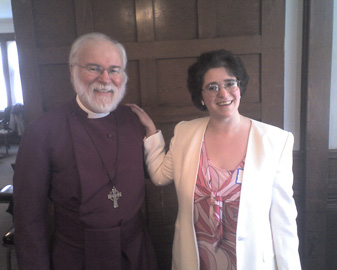
10th wedding anniversary:
What Children Hear in Church
Sara Pritchard’s first novel, Crackpots, won the prestigious Bakeless Prize from the Bread Loaf Writers’ Conference in 2002. I’ve put the book on my wish list after savoring this hilarious excerpt, “The Very Beautiful Sad Elegy for Bambi’s Dead Mother”, on her website. This is the story of a child who is doomed to become a writer, who relishes words with a physical delight, even (or especially) when she’s a little unclear on what they mean. My favorite part:
“I believe in the holey ghost, the holey Christian church, the communion of saints, the forgiveness of sins, the resurrection of the body, and the life everlasting, Hey men!” you say to yourself, bouncing a ball, walking Go-Jeff on a make-believe leash, jumping rope, hopping on one foot, skipping to school, whumping your slinky down the stairs. “The life everlasting, Hey men! The life everlasting, Hey Men! The holey Christian church. The holey Christian church. The holey-moley, roley-poley, holey Christian church.”
Now it’s Thanksgiving vespers, and after your favorite poem, the Apostles’ Creed, everyone is singing one of your favorite hymns, “Bringing in the Cheese,” their voices happy and cheerful, their faces kind in the yellow light. Mrs. Kline, at the pipe organ, is trying to keep up, her crow wings flapping, her feet going one direction, her hands the other.
Bringing in the cheese, bringing in the cheese,
We shall come rejoicing, bringing in the cheese.
You stand next to Albertine in the children’s choir and sing as loud as you can, sort of shouting. You sing with your top lip curled under and your top teeth sticking out like a mouse because this is a hymn written by church mice, and you are pretending to be one of them as you sing. Gus and Jock—from Cinderella—probably had a part in composing this wonderful hymn. They probably know it by heart. They are probably singing it right now at the top of their lungs in one of the dark, echoing alcoves of Riverview Lutheran Church, maybe over to your right there behind the baptismal pot, standing on a big hunk of Swiss cheese.
The hymn is over. The congregation claps shut their hymnals, but everyone remains standing as Mason, an acolyte, puts out the altar candles with the big candlesnuffer on a pole. Reverend Creech raises his arms like he, too, is about to fly. “Let us pray,” he says, and then the beautiful words wash over you, the words you will always remember all the long days of your life and whisper to yourself when you’re afraid, when you’re alone, when all the sadness of being human gathers itself around you:
May the piece of God, which passeth all understanding,
keep your hearts and minds in Christ Jesus, Amen.
For many, many years you ponder just exactly which piece of God Reverend Creech might be referring to, but for now, you forget about all that because the choir is filing out and everyone is singing your very most favorite song in the whole world, the one your mother plays for you on the piano at bedtime, and your father has taught you and Albertine to sing in two-part harmony:
Now the day is over, night is drawing nigh,
Shadows of the evening steal across the sky.
Now the darkness gathers, stars begin to peep,
Birds and beasts and flowers soon will be asleep.
Thru the long night watches may thine angels spread
Their white wings above me watching ’round my bed
Grant to little children visions bright of Thee
Guard the sailors tossing on the deep blue sea.
Comfort every sufferer watching late in pain
Those who plan some evil, from their sin restrain
Jesus, give the weary calm and sweet repose
With thy tenderest blessing may my eyelids close.
* * * * *
1958—With very little coaxing and carrying, and only minor scratches, a big orange cat follows you and Albertine home from school. A big orange cat with silky fur and a big round pumpkin head. An orange cat who walks around the house rubbing her head on the legs of everything, including you. She walks in and out your legs, in and out, and her tail goes up your dress and makes you giggle.
“Our cat must have a very beautiful name,” Albertine announces. “Princess!” she exclaims. “Here, Princess! Here pretty Princess Kitty!”
“Kyrie Eleison!” you call, after the beautiful and mysterious words of the kyrie sung in church. “Here, Kyrie,” you call, crawling across the carpet toward your cat. “Here Kyrie! Kyrie Eleison!”
“Daisy,” Albertine says resolutely. “DAISY BUTTERCUP.”
“Here Dona, Here Dona,” you persist, “Here Dona Nobis Pacem!” and Albertine rolls her eyes so far back into her head they disappear completely. Only the whites—like Orphan Annie’s—show.
“Panis Angelicus?” you pout and beg, “Adeste Fideles? Agnus Dei?”
For many hours that night, you lie awake, wandering through the enchanted forest of all the words you know, bumping into trunks and branches, tripping over roots and stumps, searching for the perfect name for your beautiful orange cat: mimosa, marmalade, gladiola, peony, poppycock, forsythia, taffeta, pinochle, piano forte, aspen, pumpkinseed, Leviticus Numbers, lickety-split, fiddlesticks, Worcestershire, nincompoop, whippoorwill, whippersnapper, Fridgedaire, DeSoto, squirrel, pollywollydoodle all the day . . . and on and on. And then . . . lying on its back, humming “Row, Row, Row Your Boat,” kicking its feet and doing the back stroke around your brain, you find it: the perfect name for your cat. So you can go to sleep now. But come morning, you wake up in a panic because the perfect name you’ve now forgotten! You should have written it down! Your heart is racing: mimosa, gladiola, peony, forsythia, taffeta, squirrel . . . Oh, praise the Lord, there it is! You run downstairs, but . . .
Your cat is gone.
“He wanted out,” Mason mumbles, dripping a big, sloppy servingspoonful of Wheaties up to his mouth and never looking up from the cereal box he’s reading.
Visit Sara Pritchard’s website here to find out about her new collection of linked stories, Lately.
“Nature” a Moving Target for Theologians
Austen Ivereigh, a columnist on the website of America: The National Catholic Weekly, made some insightful comments on the Church’s changing understanding of what is “natural” in his Christmas Eve column, “Gays, Galileo, and the Message of the Manger”. Excerpts:
The BBC has the correct headline on Pope Benedict’s curial speech story. “Pope attacks blurring of gender” is far more accurate than all those headlines claiming that “saving gay people is as important as saving the rainforests”…
The essential theological point in the Pope’s intriguing address is that going green while erasing God from Creation is a contradiction. Nature, he says is “the gift of the Creator, with certain intrinsic rules that offer us an orientation we must respect as administrators of creation.”
And he goes on: “That which is often expressed and understood by the term ‘gender’ in the end amounts to the self-emancipation of the human person from creation and from the Creator. Human beings want to do everything by themselves, and to control exclusively everything that regards them. But in this way, the human person lives against the truth, against the Creator Spirit.”
It’s worth placing this papal observation alongside the tribute Benedict XVI paid last Sunday to Galileo Galilei (1564-1642) on the 400th anniversary of the condemned astronomer’s telescope.
Galileo, you will recall, was declared a heretic by the seventeenth-century Church for supporting Nicholas Copernicus’ discovery that the Earth revolved around the sun (church teaching at the time placed the Earth at the centre of the universe). For centuries the Galileo condemnation has been used by secularists as a symbol of all that is incompatible between faith and science.
Last weekend, the Vatican sought to reverse that symbolism, building on Pope John Paul II’s 1992 apology and dusting off Galileo as a shining representative of faith and reason working together….
…I can’t help but spot an irony.
Galileo was condemned, at the time, because he was held to subvert the God-ordained nature of things. One can imagine Pope Urban VIII in 1633 using words similar to Pope Benedict’s to the Curia: that nature has “certain intrinsic rules that offer us an orientation we must respect as administrators of creation.”
But it wasn’t long before the “intrinsic rules” were overturned by the evidence. It turned out that putting the Earth at the centre of the universe was not God’s plan at all.
Mark Dowd, gay ex-Dominican and strategist for the Christian environmental group Operation Noah, is widely quoted in UK press reports as saying that in his curial speech Benedict XVI betrayed “a lack of openness to the complexity of creation” — in other words, that papal faith in the fixity of male-female gender roles may be misplaced.
At the moment, there seems little room in the Catholic Church’s “human ecology” for a possible divine purpose for homosexuality — just as in the seventeenth century there wasn’t much space for the idea that God has arranged the universe with the sun at its centre. It would be syllogistic to suggest that because the Church was wrong on the second it will turn out to be wrong on the first.
But it’s striking how the homosexual orientation appears in church teaching as “intrinsically disordered” — in other words, as contrary to the way God arranged the universe — in the same way as the Copernican view appeared in the seventeenth century.
And it isn’t a bad thought, at Christmas, to remember that the Creator of the Universe is capable of subverting its laws for the sake of His creatures.
Things are never so finally fixed that God can’t rearrange it all. The arrogance of scientists, of clergy, of the wise, our own arrogance — all get dethroned tonight by the Great Event: the manger-child, born of a refugee couple and the Holy Spirit, in a cave, in a place somewhere off the map, to where the centre of the Universe quietly relocates. Happy Christmas.
Book Notes: The Glass Violin
Australian poet P.S. Cottier truly does see the universe in a grain of sand–as well as in a tram ticket, a Caesarian scar, the names of Australian military operations, a shabby bear in the Soviet zoo, a wren visiting a dead friend’s garden, and myriad other small details of modern life that she turns into windows on the human condition, in verses both whimsical and profound. Her new collection The Glass Violin (Ginninderra Press, 2008) contains all this and more.
One of the pleasures of reading poetry is finding that someone else has experienced and expressed a precise emotion that you thought was peculiar to you. When Cottier writes, in a poem titled “Forlorn”, “The abandonment of teabags is absolute,” I feel less silly about my pangs of guilt for turning those neat, dry, nearly immortal little packets into wet lumps of trash. Elsewhere, in “Cutting on Laminex”, she reflects on how the scratches on a cutting board outlast the meals prepared there, which segues into awareness of the marks that time has left on her: “I can’t recall the accidents, the sharp slice/which scarified, but skin scratches speak/of that open cut, some day, grave of mine.” She has kindly given me permission to reprint a poem from this book below.
Rock
I didn’t want this, not at all.
The rock rolled back,
groaning, rasping,
birthing brightness.
It was meant to
make them free.
But a single breath,
in and out,
a teasing pause,
then they crucified others;
those who walked outside
their straitened view of me.
Labyrinthine irony,
to fill the sarcophagus
in my name.
Those chaotic echoes
darkening on deafness,
I hear them still.
I’d asked them to put down stones
and not to pound down sinners.
To understand, or at least,
not to irrevocably judge.
But when they built their church
on rock, of rock,
flesh was pushed aside,
Golgotha glorified.
A mortar and pestle,
hope ground against granite.
Sometimes when I watch, I wish
that boulder had not budged.
When my flesh was tortured
and my mother’s tears fell,
I believed
it would erode
the rocks in human minds.
But I hadn’t counted on their
thoughts like drowning pebbles,
sinking in a hard skull cave
just beneath the skin.
Love sealed within forever,
not knowing light.
The third day never comes.
AltXmas Art Envisions Holy Family of Color
Kittredge Cherry’s Jesus in Love blog is running a series of artworks that look at the imagery of the Christmas season through the lens of poverty, racial and gender justice. The beautiful and thought-provoking images are accompanied by Kitt’s daily Advent meditations. She’s kindly given me permission to reproduce today’s painting, “The Holy Family” by Janet McKenzie.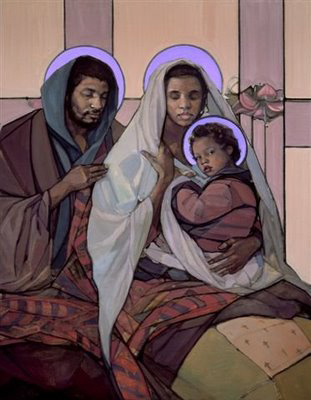
Copyright 2007 Janet McKenzie
Collection of Loyola School, New York, NY
About this painting, Kitt writes:
…Sometimes McKenzie’s art sparks controversy. Her androgynous African American “Jesus of the People” painting caused an international uproar after Sister Wendy of PBS chose it to represent Christ in the new millennium in 2000. However, McKenzie says that the responses to “The Holy Family” have been accepting and positive, perhaps because it was commissioned and wholeheartedly supported by the Loyola School in New York.
“As a school run by the Jesuits, it was important to them to have such an image, one that reflects their ethical and inclusive beliefs,” McKenzie explains. “ ‘The Holy Family’ celebrates Mary, Joseph and Jesus as a family of color. I feel as an artist that it is vital to put loving sacred art — art that includes rather than excludes — into the world, in order to remind that we are all created equally and beautifully in God’s likeness. Everyone, especially those traditionally marginalized, needs the comfort derived by finding one’s own image positively reflected back in iconic art. By honoring difference we are ultimately reminded of our inherent similarities.”
The Vermont-based artist had built a successful career painting women who looked like herself, fair and blonde, before her breakthrough with “Jesus of the People.” At that time she wanted to create a truly inclusive image that would touch her nephew, an African American teenager. “The Holy Family” continues the process of embracing everybody in one human family created in God’s image.
Read the full post here.