Over Easy Eggs
10/16/07; 3:46am EST
the castles in my femora
they have declared war on my circulation
red and blue flags
i have turned purple
my jaw
is falling off my head
and crushing the nerves in my neck
like a mother bird cooing to her chicklets’ bones
my blood
is turning to tea
a few of its leaves like driftwood in my heart
beating with me
as tumors
my liver won’t filter
my ears
must smell like the ocean
for my hair has turned to seaweed
humid, the brain
my nose
is in my neck, too
but it’s an infectious swamp
i want to pluck out all its black trees
and feel the satisfaction of stinging
let the mucus ski
the lines in my palms
are melting
on the carpet
and across the room
my stomach
is growing cacti
and i can feel the tumbleweeds rolling
rolling rolling
across the prairie
that is my membrane
my pelvis
has swallowed ice
it is sore from impact
from my lust for you
i lie down and feel only whale harpoons
my eyes
have forgotten my face
they feel like snorkeling goggles
they won’t be blue tomorrow
when i look at the sun
i feel small enough
to the point where i could rent the 28″ TV
and feel the leather in those cars
fall asleep to their trademark hip-hop
and drink tea with Geiko the Gecko
my wrists
are so cliché
and i’m so afraid
that if i bend them back at all, they’ll tear
slowly
violently
ember the bus girl
still has scars “where they all intertwine”
my latissimi dorsi
has forgotten its job as a tuxedo
for my
back
like an outlet, i am exposed
grotesque and naked
with plaque on my bones
my arms
are tired branches from my spine
i rip them open
to find a little oozing green
my calves
are fiercely running
no no no no please please please please
but they only run in their sleep
it tingles like fireworks
my knees
fell off when i threw up
in my chair
USS kneecaps
like Dixie’s paper plates
“I love you, but this is it.
This is what I think is best now.
This time I thought.
So, I think you should give it a try.
This time, I’m going to be here.”
god
gave me
these shoulders
but they were frisbees all along
now they’re trying to fly away from me
but they were never really mine
reprinted by permission from Poetry SuperHighway
Jessica Williams is a 15-year-old high school student in Lake Arrowhead, CA.
Category Archives: Great Poems Online
Mark Levine Interviewed at jubilat
Mark Levine’s second poetry collection, Enola Gay, is on the short list of books that expanded my understanding of what poetry could do. His post-apocalyptic, enigmatic images make sense the way a door creaking in a horror film makes sense. You don’t have to know what’s behind there to realize it’s something scary; in fact, it’s scarier because your rational mind can’t define it. Some excerpts from poems in the book:
from Counting the Forests
…He was counting the forests. That was his plan.
He carried a sack of dried fish
prepared by his servant and cured
in sea-salt. His servant was near; he could hear
the rasp of his servant’s breath.
His servant was making the vigil in a mountain
somewhere in the ice-country; and the ice-country
was vast
and blue and full of death-forms. So was the forest.
Here in the red forest: a forest of birds.
Birds and dark water and looming red leaves
brushed with murmuring voices.
They swept towards him, the voices, like
tensed wings.
And he ran from them; but the red
forest was glazed and the trees were vast
with ice-forms. And at the edge of the red
forest
he could see into the stone forest and
could see
the voices rinsing over the stone floor.
He had been there already and had taken count.
And he had counted the animal forest and the
smoldering forest and the weeping forest and
the forest
of the forgotten tropics and the God-forest.
What could he say to his accusers?
…
****
from Eclipse, Eclipse
…The law is coming, three battered islands hence;
the splash is coming, the radar is coming, the law
is coming wearing Mother’s private wig.
Comes a horseman, steady on the climb, a blade
against his thigh, a rumor on his spine.
Nearness is all. And the roots of the great tree
swayed in the heat, and the swollen seeds
struck the temple walls and left no stain.
Surely the great creeds could have warned us
to test the soil of nearby planets; our voices
plunged
like the voices of the gods’ outcast armies.
All of us wanted to take the steep walk back
into the memorial noise; feeling sick, not feverish.
A pencil in his glove and a shovel in his soul
and big plans for a secret farm: comes a horseman.
****
This year, Levine is back with a new collection, The Wilds. He was recently interviewed by Srikath Reddy in the literary journal jubilat, a piece that has been reprinted online at Poetry Daily. Some notable excerpts, below (boldface emphasis mine):
ML: It always surprises me (and sometimes worries me) to realize, long after the fact, how little aware I am—or how ill-informed I am—of what my preoccupations are when I’m writing, and how very partial is my understanding and command of what I’m saying….That last sentence is going to be my new motto as a novelist. Read the full interview here.
It troubles me a bit that, as poets, we seem to be required to pretend that everything we put in poems emerges from a very supportable rationale. Maybe we’ve been successfully cowed by those who are hostile to poetry, and have internalized their suspicion that the whole thing is a sham, an elitist attempt to confound and mock the guileless reader. And so we apologetically, or pompously, give in to this rather recent expectation that artists are supposed to talk a good game about what they do. I’ll tell you, I once spent a week interviewing the skateboarder Tony Hawk—a bit before he became a multinational industry—and here’s what I liked best about him: great skateboarder, not great interview subject. Every time he got on his board it was magic; every time he opened his mouth it was, well, pretty ordinary stuff. His intelligence was thoroughly absorbed in what he did, and to him, talking about it was not only irrelevant—it was almost a violation of the spirit of his sport. This seems appropriate.
By now, I’ve spent enough time around young people who are trying to write poems to recognize the common anxiety, even embarrassment, at simply being a poet, rather than pretending to be a poet and an eager A-student rolled up into a single reasonable package. But why, with all the hand-wringing poetry talk out there—our own, no doubt, included—are there some matters that, it seems, are very rarely aired, even in the supposedly brasstacks environment of the poetry workshop? Embarrassing questions, like: How much do you know what your poem is about when you’re writing it? Do you know who is speaking? Do you know what the situation is? Do you know what your themes are? When you get right down to it: Do you know what is happening—what is going on—in your poem when you are writing it? I don’t know about you, Chicu, but I’d often be lying if I answered most of these questions in the affirmative. I don’t even want to be able to say “yes.” If I could, I’d wonder why I was writing a poem.
****
SR: …[W]hat I want to focus on is what you described as “that cusp of consciousness that a child is perched on,” and how it shapes your sense of what poetry is. That cusp of consciousness seems a lot like the threshold between knowing and uncertainty that Keats described as negative capability. And I’d agree enthusiastically that this cusp or threshold is the most productive space for a poet to inhabit. But lately I’ve also been worried that uncertainty lets one off the ethical hook—it lets one, as it were, refuse to grow up.
I guess my vague feelings of guilt about not speaking up more about the political situation over recent years has something to do with this. In the lead-up to the war, for instance, I felt uncertain about whether or not there were weapons of mass destruction tucked away somewhere in Mesopotamia (among many other things), and my general reluctance to forcefully decide matters for myself mirrored, I think, a broader failure of liberals to dissent from what our nation is perpetrating abroad. That’s a detour, I know, but what I’m getting at is a sense that there is a danger to uncertainty. I’m definitely not advocating a more political poetry—Lord knows I find most overtly political verse to be fairly unliterary—but I’m wondering what you think about the ethics of uncertainty as a poet writing today.
ML: I know what you’re saying, but the thought of assuming a certain kind of ethical responsibility in poems makes me bristle a bit. Do you remember when you were younger and some snide kid told you to “grow up”? I think I can still hear that voice. I hated that kid. What he was really saying was: Don’t be yourself. Don’t have an imagination. Behave. I’m just not interested in growing up in those ways.
(On the other hand, I already find myself mourning a certain kind of bygone communal maturity—the days when people could disagree about poetics and politics in respectful and civil ways, without needing to assault each other from the safety of their dreary blogs.) I was once on a little panel about some forgettable issue or other and one of the other members was an ambitious and quite accomplished young critic, a guy then under thirty, who complained that poets in America had lost the value of being “judicious and authoritative” in poems. I was taken aback. He struck me as one of those people in college who wears a bow tie and carries a pocket watch—as someone who has gotten overinvested in a certain model of “maturity.”
There may be a lot of things wrong with poetry—now and always—but the reluctance to speak with authority doesn’t seem to me to be one of them. In my mind, one of the services poets perform, intuitively, is to hold up the authority of poetic and imaginative tradition against other claims to authority. My suspicion is that the recurrent charge that poets are not sufficiently engaged is typically a symptom of one of two things: the right-wing interest in trivializing poetry and misplaced left-wing guilt. I’m not proposing a Peter Pan model of the poet, but my guess is that “not growing up”—if it constitutes a willingness to remain, as you say, “in mysteries, doubts, and uncertainties”—is much preferable—poetically, ethically, politically—to being prematurely pickled.
SR: So it’s this cusp of uncertainty that you somehow find to be both fundamentally poetic and fundamentally ethical?
ML: That cusp—I don’t know, I think the desire to be there must in part be temperamental. I like basketball games that go into overtime; overtime drives some people crazy. I don’t really care about how books or movies end. I like the unresolved. I’ve always been drawn to the moment “before”—the moment when you have a heightened awareness that you’re in the presence of something real, something meaningful, but when the meaning hasn’t yet been captured. To me, that’s the “intensest rendezvous.” In Bob Dylan’s terms, it’s the refrain of “Ballad of a Thin Man”: “Because something is happening here, but you don’t know what it is, do you, Mr. Jones?” That’s one reason that, for me, striving to write precise, deftly rendered imagery—material that conveys much more, through the senses, than can be expressed in other terms—is vital.
But I understand your uncertainty about uncertainty. (Your meta-uncertainty?) It’s something that the uncertain ones among us must grapple with. Doesn’t it come down to a question of the authenticity of our uncertainty? If uncertainty is a posture—something we adopt in an effort to make cool poems—it would, indeed, be frivolous. But true uncertainty is a beautiful thing. And my guess is that those (like Mister Bow Tie) who adopt the posture of certainty are far more dangerous, morally and politically—and of course artistically—than those who have fewer answers, less of an agenda to promote, and who try to use their work as a way of shedding a little light on the darkness.
My glib, reflexive take on this problem would be that of an aesthete: that the ethical task of a poet is to write as well as he can, as accurately, forthrightly, and courageously—to be as uncompromising as he can in relation to poetic truth. But that is a tall order, an ideal against which one always falls short. Also, of course, excellence is not value neutral: is the ethical task of a nuclear bomb maker to make the best bomb he can? Um, no. But in that case the problem is that the medium itself—nuclear bomb making—is morally corrupted from the start. Whereas I have cast my lot with those who believe that the poetic tradition is, at its height and in its impulse, noble, resistent, and self-scrutinizing. So, yeah, I think the world woul
d be a much better place if we all listened to each other the way poems listen to us.
****
ML: …Of course I’m aware that poems, like everything else made by human beings, are artificial, but I don’t believe that excludes poems from approaching authenticity, and partaking of it—as far as I’m concerned, poems routinely do that, and that’s a big reason that we read them. One thing that’s so moving about poems is that we know they are artificial, but still we invest them, and their materials, with the force of the real. We need to do this, because we need to feel the reality of our lives. When I write the word tree, I don’t just see a word or construct—I see a physical tree. And if I’m not being particularly lazy as a writer, I’m going to do more to specify the reality, the tree-ness, of that tree—not only as a way of writing a “nice” poem, but of specifying, and thereby sharing in, the reality of reality.
SR: So “no ideas but in things”?
ML: It’s easy to talk in abstract terms, which always makes me uncomfortable, because I’m drawn to the physical experience of poems, not their ideas. You asked whether, in reading poems, we can begin to distinguish between the appearance of authenticity and something that smacks of the real deal. Don’t you think we rely on being able to make that distinction, however provisionally? I have to believe it can be done. The poem makes a claim—”My heart aches, and a drowsy numbness pains my sense,” for instance—and, after submerging ourselves in the poem, we can ask, “Do I feel the truth of the claim in the poem, or does it just seem like a convenient or clever thing to say? Does the poem, in its rhythms, syntax, imagery, and so forth, grapple with drowsiness, numbness, and pain, or not? Does the claim feel abstract or, as you say, ’embodied’?”
And how does one embody the experience of one’s poem? There must be as many ways as there are authentic poems (i.e., not that many). First off, I suppose, one believes in the reality of one’s own imaginative event. One orients oneself to a position inside the poem—one lives in and through the poem, rather than hovering above it, using it as a way to say something that makes one seem clever, or as a vehicle for producing nice poetic effects, which, once you’ve read enough poems, are not as rare or interesting as they might first appear. I’ve found, myself, that focusing, in particular, on imagery, has helped me to “feel” the poem by employing my (generally underused) senses, rather than trying to direct the poem with my often enfeebled brain.
****
ML: [On the painter Francis Bacon] … I love the way he deploys traditional values—of form, structure, line, color, modeling, and subject matter—to explore what he calls his “nervous system.” He also talks, in his interviews with David Sylvester, of using traditional techniques and materials of painting to capture, even trap, the real. Reality is the outcome of his process, not a known quantity that he enters his process wishing to depict.
Judy Kronenfeld: “Spaghetti Straps”
On my campus walk a spring effusion
of spaghetti straps, and—Madonna’s
legacy—the inside outed, too delicate
for the name of straps, tender, silky
bra linguine, tomato-red, celery-green,
slipping off creamy shoulders, or
tangling fetchingly with those spaghetti
straps my daughter informs me, I,
as an older woman, can not wear.
Once, unwittingly,
I draped my navy blazer on
the chairback in my class; two
pale pink shoulder pads plopped
up like obscene pincushions
from the costumer’s shop, abruptly
spotlit. The student they tickled
apologized, but couldn’t stop laughing
each time he looked. Now
I pull my jacket
around me, though it’s hot,
thinking suddenly
of Madame Goldfarb’s Foundation,
Lingerie and Prosthesis Shoppe,
where my mother bought her ordinary
bras, and how the saleswoman—
discussing shoulder
welts, back strain—lifted
her breast into the cup the way
the technician lifts mine onto the plate
for my mammogram, or the butcher
cups the roast he’s about to weigh,
thinking of how
my mother’s hidden back and breasts
even into her ninth decade—
compared with her wizened arms
and face—were shockingly alluring,
olive smooth, unblemished, as I helped her
into the hospital gown.
Originally published in The Evansville Review, this poem was included in Judy Kronenfeld’s chapbook Ghost Nurseries (Finishing Line Press, 2005) and will appear in her full-length collection Light Lowering in Diminished Sevenths, which won the 2007 Litchfield Review Annual Book Contest and will be published next year.
“The Approach” and Other New Poems by “Conway”
My correspondent “Conway” has been very prolific this summer, writing poetry inspired by the books and printouts I’ve sent him: T.S. Eliot, Alexandre Dumas, Stephen Dobyns, and even yours truly. Conway is the pen name of a resident in a maximum-security prison in California, where he’s serving 25-to-life for receiving stolen goods under the state’s draconian three-strikes law. Here’s a selection from his recent work:
The Approach
The Sky offers empty promises
smiling with toothy clouds
blades hiding in the invisible wind
pushing forward an orgasmic rain
wide open mouth, stuttering-n-drooling
over the gloriously ravaged land
polished and preened for the dance
electric frustration crackling
instinctive thunder cackling
destructively loud vibrations cuss
at all of mother nature’s fuss
primping for her approaching sun
another beautiful day begun…
****
Pretender
Smell the dust circulating
rumble of gears, chattering wind
pushing past shadows of patience again
pressed faces on clear glass, melted sand
trapped & strapped as time flails
crouching in concrete jails
tumbling hearts in a coin-op dryer
hoping tears will gratify
those moments that pass them by
seasons march with unseen smoke
dawn breaks down upon the broke
strung up tight in spider spun cords
sung all night by distraught mothers
and those muddy misplaced others
pretending to be alive…
One of their pastimes in prison is the “poetry war”, challenging one another to come up with poems or raps on specific topics, often in response to a previous poem by the challenger. I had sent him this ballade I wrote in college, which was inspired by Richard Wilbur’s Ballade for the Duke of Orleans:
Ballade of the Fogg Art Museum
by Jendi Reiter (1990)
The squat museum’s walls decline in plaster;
black iron gates like screens before it rise,
given by graduates now turned to dust or
some more profitable enterprise.
Inside the vaulted halls, the street noise dies
the way the light too fades, as filtered through
too many windows, till the sight of skies
uncovered seems forever out of view.
Upon the wall the carving of some master
hangs as it did over centuries of cries
seeking the aid of this tired saint whose lost or
disputed name was once a healing prize;
saint of the mute, saint of the paralyzed,
of cures some true and some believed as true,
all that their less than truth and more than lies
uncovered seems forever out of view.
Lone stained-glass windows stand, as if the vaster
church fell away and in the rubble lies,
disordered jewels, displayed as if they last were
no necklace, broken when the wearer dies.
Behind them a lit wall the hue of ice,
unchanging light that cannot prove them true,
the sun’s capricious grace that stupefies
now covered and forever out of view.
These corridors wish also to sequester
the wanderer in halls as dim and dry as
the echoes of dead theologians’ bluster
of strict dichotomies that like a vise
close round the listener, until he tries
to follow their imagined bird’s-eye view
of black lines, like this map, where all that eyes
uncover is forever out of view.
Like some grim doctor of the church, the plaster
bust of the founder means to supervise,
mute guardian of a world he tries to master
by over-studying what he is not wise
enough to love; a searching hand that pries
out each thread separately to find the true,
happiest when the tapestry they comprise
is covered and forever out of view.
Above this roof, a bird descends no faster
than snow through shining air, like some demise
so graceful that it isn’t a disaster;
to be a fallen angel would be prize
enough if one could but fall through such skies,
past autumn bursts of leaves’ bright mortal hue
which no recording hand can seize, which lies
uncovered now, then ever out of view.
A wasted hand preserves and petrifies
the gilded tree, flat heaven’s lapis blue.
The leaf must fall, the leaf must improvise,
uncovered now, then ever out of view.
****
In response, Conway wrote the poem below. It plays more loosely with the form but has an immediacy and passion that my old poem lacks. Round #1 to him!
Ballade of Arms Justice
by Conway
This prison squall defines disaster
how many doors of life must waste
Through corridors paint, white alabaster
statues risen — fall wine they taste;
dear ground bones have, fed budgets bill.
Minds’-eye blue sky, though still it lingers
upon thy heart and always will
it pays long arms, not sticky fingers…
Now here in thought, recoiled much faster
and left our freedom more in haste
These green suit goons design my master
keys that unlock, chains round my waist
and slop I cannot stomach still
we must digest this smell that lingers
until we’re sure we’ve had our fill
for long arms pay, not sticky fingers…
Those white house pillars, fake alabaster
have kept injustice-jackboots laced
we fear the blue steel beanbag blaster
upon the skin burned sentence placed;
It was against forefathers will
to plant, the prosecutions ringers
on the side that fights to steal
laws long arm pays, not sticky fingers…
Law keep your lies, you’re not my master
I cannot be easily replaced
My family reels from this disaster
your long arms pay not, our sticky fingers…
keys that unlock, chains round my waist
and slop I cannot stomach still
we must digest this smell that lingers
until we’re sure we’ve had our fill
for long arms pay, not sticky fingers…
Those white house pillars, fake alabaster
have kept injustice-jackboots laced
we fear the blue steel beanbag blaster
upon the skin burned sentence placed;
It was against forefathers will
to plant, the prosecutions ringers
on the side that fights to steal
laws long arm pays, not sticky fingers…
Law keep your lies, you’re not my master
I cannot be easily replaced
My family reels from this disaster
your long arms pay not, our sticky fingers…
Ned Condini: “In the Farmer’s Hut”
(after Federico Garcia Lorca)
When I feel lonely
your ten years still remain with me,
the three blind horses,
your countless expressions and the little
frozen fevers under maize leaves.
At midnight cancer strode out into the halls
and spoke with the empty shells of
documents,
live cancer full of clouds and thermometers,
with its chaste desire of an apple
to be pecked by nightingales.
In the house where there’s no cancer
white walls break in the frenzy of
astronomy
and in the smallest stables, in the crosses
of woods,
for many years the fulgor
of the burnings glows.
My sorrow bled in the evenings
when your eyes were two stones,
when your hands were two townships
and my body the whisper of grass.
My agony was looking for its dress.
It was dusty, bitten by bugs,
and you followed it without trembling
to the threshold of dark water.
Silly and handsome
among the gentle creatures,
with your mother fractured by the village
blacksmiths,
with one brother under the arches
and another eaten by anthills,
and cancer beating at the doors!
Some nannies give children
milk of nastiness, and it’s true
that some people will throw doves into
a sewer.
Your ignorance is a river of lions.
The day malaria clobbered you
and spat you in the dorm
where the guests of the epidemic died,
you looked for my agony in the grass,
my agony with flowers of terror,
while the voiceless fierce cancer
that wants to sleep with you
pulverized red landscapes in the sheets
of bitterness
and put inside hearses
tiny frozen trees of boric acid.
With your jew’s harps,
go to the wood to learn antennae words
that sleep in tree trunks, in clouds,
in turtles,
in the wind, in lilies, in deep waters,
so that your learn what your country
forgets.
When the roar of war begins
I will leave a juicy bone for your dog
at the factory. Your ten years will be
the leaves that fly in the clothes of
the dead,
ten roses of frail sulfur
on the shoulder of the dawn.
Forgotten, your wilted face
pressed to my mouth, my son,
I will be alone and enter,
screaming, the green statues of cancer.
This poem is reprinted by permission from Wordgathering, an online journal of disability poetry. Ned Condini is a translator and a poetry and fiction writer. Chelsea Editions will soon publish his translation of Carlo Betocchi’s selected works, Awakenings. Among his other awards, he won first prize in the inaugural Winning Writers War Poetry Contest in 2002. His publications include The Earth’s Wall: Selected Poems by Giorgio Caproni, available from Chelsea Editions, P.O. Box 773, Cooper Station, NYC, NY 10276.
Poems for September 11
Today is the sixth anniversary of the September 11, 2001 terrorist attacks on the World Trade Center and the Pentagon. Rather than add my own words to a subject that is nearly beyond words, I share below a winning poem from the Winning Writers War Poetry Contest that I judge every year.
SUMMER RAIN
by Atar Hadari
This is the season people die here,
she said, Death comes for them now.
Sometime between the end of winter
and the rains, the rains of summer.
And the funerals followed that summer
like social engagements, a ball, then another ball
one by one, like debutantes
uncles and cousins were presented to the great hall
and bowed and went up to tender
their family credentials to the monarch
who smiled and opened the great doors
and threw their engraved invitations onto the ice
and dancing they threw their grey cufflinks
across each others’ shoulders, they crossed the floor
and circles on circles of Horas
filled the sky silently with clouds, that chilled the flowers.
And funeral trains got much shorter
and people chose to which they went
and into the earth the flowers
went and no one remembered their names
only that they died that summer
when rains came late and the streets emptied
and flags flying on car roof tops
waved like women welcoming the army
into a small, abandoned city.
This poem won an Honorable Mention in our 2003 contest. I also invite you to read these poems that won awards in past years:
Melody Davis, The View from the Tower (2005 HM)
Stacey Fruits, The Choreography of Four Hands Descending (2003 HM)
Raphael Dagold, In Manhattan, After (2002 HM)
Robert Bly Interviewed on PBS
Last week the venerable poet Robert Bly was interviewed on Bill Moyers’ Journal on PBS. Some highlights from their witty, uplifting conversation are below. I recommend watching the video online rather than simply reading the transcript, as Bly’s joie de vivre is an essential part of the experience.
BILL MOYERS: You know, when I first met you, you were just barely 50. And you read this little poem. You remember this one?
ROBERT BLY: “I lived my life enjoying orbits. Which move out over the things of the world. I have wandered into space for hours, passing through dark fires. And I have gone to the deserts of the hottest places, to the landscape of zeroes. And I can’t tell if this joy is from the body or the soul or a third place.”
Well, that’s very good you find that because when you say, “What is the divine,” it’s much simpler to say there is the body, then there’s the soul and then there’s a third place.
BILL MOYERS: Have you figured out what that third place is 30 years later?
ROBERT BLY: It’s a place where all of the geniuses and lovely people and the brilliant women in the– they all go there. And they watch over us a little bit. Once in awhile, they’ll say, “Drop that line. It’s no good.”
Sometimes when you do poetry, especially if you do translate people like Hafez and Rumi, you go almost immediately to this third world. But we don’t go there very often.
BILL MOYERS: Why?
ROBERT BLY: Well I suppose it’s because we think too much about our houses and our places. Maybe I should read a Kabir poem here.
BILL MOYERS: And Kabir?
ROBERT BLY: Kabir is a poet from India. Fourteenth century.
“Friend, hope for the guest while you are alive.
Jump into experience while you’re alive. Think… and think… while you’re alive.
What you call salvation, belongs to the time before death.
If you don’t break your ropes while you’re alive,
you think that ghosts will do it after?
The idea that the soul will join with the ecstatic
just because the body’s rotten–
that’s all fantasy.
What is found now is found then.
And if you find nothing now,
you will simply end up with an apartment in the City of Death.”
I was going through Chicago one time with a young poet and we were rewriting this. And he said, “If you find nothing now, you will seemly end up with a suite in the Ramada Inn of death.” That’s very interesting to see how that thing really comes alive when you bring in terms of your own country. You’ll end up with a suite in the Ramada Inn of death. If you make love with the divine now, in the next life, you will have the face of satisfied desire.
So plunge into the truth, find out who the teacher is, believe in the great sound. Kabir says this, when the guest is being searched for – see they don’t use the word “God”. Capital G, “Guest”. When the Guest is being searched for, it’s the intensity of the longing for the Guest that does all the work. Then he says, “Look at me and you’ll see a slave of that intensity.”
********
BILL MOYERS: You’ve been talking and writing a lot lately about the greedy soul.
ROBERT BLY: I’m glad you caught that. Read this.
ROBERT BLY: “More and more I’ve learned to respect the power of the phrase, the greedy soul. We all understand what is hinted after that phrase. It’s the purpose of the United Nations is to check the greedy soul in nations. It’s the purpose of police to check the greedy soul in people. We know our soul has enormous abilities in worship, in intuition, coming to us from a very ancient past. But the greedy part of the soul, what the Muslims call the “nafs,” also receives its energy from a very ancient past. The “nafs” is the covetous, desirous, shameless energy that steals food from neighboring tribes, wants what it wants and is willing to destroy to anyone who receives more good things than itself. In the writer, it wants praise.”
I wrote these three lines. “I live very close to my greedy soul. When I see a book published 2000 years ago, I check to see if my name is mentioned.” This is really true. I’ve really done that. Yes, I’ve said that. So, in writers, the “nafs” often enter in the issue of how much– do people love me? How much people are reading my books? Do people write about me? Do you understand that? It probably affects you too in that way.
BILL MOYERS: Us journalists? Never.
ROBERT BLY: Never. Okay. “If the covetous soul feels that its national sphere of influence is being threatened by another country, it will kill recklessly and brutally, impoverish millions, order thousands of young men in its own country to be killed only to find out 30 years later that the whole thing was a mistake. In politics the fog of war could be called the fog of the greedy soul.”
********
BILL MOYERS: Are you happy at 80?
ROBERT BLY: Yeah, I’m happy. I’m happy at 80. And– I can’t stand so much happiness as I used to.
BILL MOYERS: You’re Lutheran.
“Art That Dares” to Comfort and Discomfort
Images of Jesus are such common currency in our popular culture that we scarcely notice them, save to afford them a sentimental smile or an eye-roll of aesthetic disdain. From rappers in crucifixion poses on their album covers, to kitsch statues for your little softball player, Jesus is like Mrs. Dash, tossed in to spice up the processed images served up to our jaded palates.

On the one hand, the Incarnation means that Jesus really is standing behind us in the batter’s box (though he didn’t help the Red Sox much this week). We mustn’t get so churchy that we wall off certain areas of life as too mundane for his attention. He still knows when we’re stealing from the cookie jar.
On the other hand, casual handling of Jesus’ image domesticates it, robbing it of its power, as least as often as Jesus-ification elevates the subject matter in question. For me, kitsch images of Jesus can clutter up my mind and block my ability to visualize him as a real, individual, living person.
Kittredge Cherry at Jesusinlove.org has compiled a book of contemporary GLBT and feminist Christian art entitled Art That Dares: Gay Jesus, Woman Christ and More. Samples can be viewed on the gallery page.
I wanted to recommend this project wholeheartedly, but my reaction to the sample works was more complicated. The artworks are presumably meant to be affirming to one group of viewers, and disturbing to others. Jesus, I think, should be experienced as both affirming and disturbing to everyone. Mainstream sentimental Christian art is hampered by its clear-cut message, a trait that this project doesn’t fully escape.
Should the goal of this work be conceived as political rather than devotional, it’s easier for me to overlook the lack of nuance in some of the pieces I saw. It was similarly scandalous to some white Western Christians when people of color tossed out the blonde, blue-eyed image of Jesus in favor of a more African appearance. In Christ there is neither Jew nor Greek, male nor female. Most people today would add “black nor white”, but “gay nor straight” (though arguably contained in “male nor female”) is a tougher sell. Paintings like Becki Jayne Harrelson’s The Crucifixion of Christ deliver a shock that can’t be ignored.
My favorite among the sample pictures was Elisabeth Ohlson Wallin’s posed photo Sermon on the Mount. There’s a humor, absurdity and tenderness in the image of leather daddies hugging Christ’s knees, which lends a complexity not found in a lot of popular Christian art, gay or straight. This picture was also great because the men, though clearly sexual beings, were not relating to Christ or one another in merely a sexual way. Images of love between men always delight me, but the angel’s hand on Christ’s butt in F. Douglas Blanchard’s Jesus Returns to God was a bit much. Love, even between sexual partners (and they do make a cute couple), isn’t always expressed by groping, especially at a moment like this. Was the artist afraid we wouldn’t see them as gay otherwise? It’s a reductive visual trope that erases the non-sexual dimensions of a gay person’s life.
Christians who think Cherry’s project is scandalous should go back and read some classic Christian poems, with their ideological blinders off. Start with St. John of the Cross:
On a dark night,
Kindled in love with yearnings
–oh, happy chance!–
I went forth without being observed,
My house being now at rest.
In darkness and secure,
By the secret ladder, disguised
–oh, happy chance!–
In darkness and in concealment,
My house being now at rest.
In the happy night,
In secret, when none saw me,
Nor I beheld aught,
Without light or guide,
save that which burned in my heart.
This light guided me
More surely than the light of noonday
To the place where he
(well I knew who!) was awaiting me
— A place where none appeared.
Oh, night that guided me,
Oh, night more lovely than the dawn,
Oh, night that joined
Beloved with lover,
Lover transformed in the Beloved!
Upon my flowery breast,
Kept wholly for himself alone,
There he stayed sleeping,
and I caressed him,
And the fanning of the cedars made a breeze.
The breeze blew from the turret
As I parted his locks;
With his gentle hand
He wounded my neck
And caused all my senses to be suspended.
I remained, lost in oblivion;
My face I reclined on the Beloved.
All ceased and I abandoned myself,
Leaving my cares
forgotten among the lilies.
(translation courtesy of this website)
And how about this poem by the 17th-century metaphysical poet George Herbert:
Love bade me welcome, yet my soul drew back,
Guilty of dust and sin.
But quick-ey’d Love, observing me grow slack
From my first entrance in,
Drew nearer to me, sweetly questioning
If I lack’d anything.
“A guest,” I answer’d, “worthy to be here”;
Love said, “You shall be he.”
“I, the unkind, the ungrateful? ah my dear,
I cannot look on thee.”
Love took my hand and smiling did reply,
“Who made the eyes but I?”
“Truth, Lord, but I have marr’d them; let my shame
Go where it doth deserve.”
“And know you not,” says Love, “who bore the blame?”
“My dear, then I will serve.”
“You must sit down,” says Love, “and taste my meat.”
So I did sit and eat.
“Love”, in this poem, is another name for Christ. Who is male. From the first stanza, we can see that the speaker is obviously male too. Something to think about.
Christians who think Cherry’s project is scandalous should go back and read some classic Christian poems, with their ideological blinders off. Start with St. John of the Cross:
On a dark night,
Kindled in love with yearnings
–oh, happy chance!–
I went forth without being observed,
My house being now at rest.
In darkness and secure,
By the secret ladder, disguised
–oh, happy chance!–
In darkness and in concealment,
My house being now at rest.
In the happy night,
In secret, when none saw me,
Nor I beheld aught,
Without light or guide,
save that which burned in my heart.
This light guided me
More surely than the light of noonday
To the place where he
(well I knew who!) was awaiting me
— A place where none appeared.
Oh, night that guided me,
Oh, night more lovely than the dawn,
Oh, night that joined
Beloved with lover,
Lover transformed in the Beloved!
Upon my flowery breast,
Kept wholly for himself alone,
There he stayed sleeping,
and I caressed him,
And the fanning of the cedars made a breeze.
The breeze blew from the turret
As I parted his locks;
With his gentle hand
He wounded my neck
And caused all my senses to be suspended.
I remained, lost in oblivion;
My face I reclined on the Beloved.
All ceased and I abandoned myself,
Leaving my cares
forgotten among the lilies.
(translation courtesy of this website)
And how about this poem by the 17th-century metaphysical poet George Herbert:
Love bade me welcome, yet my soul drew back,
Guilty of dust and sin.
But quick-ey’d Love, observing me grow slack
From my first entrance in,
Drew nearer to me, sweetly questioning
If I lack’d anything.
“A guest,” I answer’d, “worthy to be here”;
Love said, “You shall be he.”
“I, the unkind, the ungrateful? ah my dear,
I cannot look on thee.”
Love took my hand and smiling did reply,
“Who made the eyes but I?”
“Truth, Lord, but I have marr’d them; let my shame
Go where it doth deserve.”
“And know you not,” says Love, “who bore the blame?”
“My dear, then I will serve.”
“You must sit down,” says Love, “and taste my meat.”
So I did sit and eat.
“Love”, in this poem, is another name for Christ. Who is male. From the first stanza, we can see that the speaker is obviously male too. Something to think about.
Judith & Gerson Goldhaber: “Noah and the Flood” (excerpt)
Award-winning poet Judith Goldhaber and her husband, the artist and physicist Gerson Goldhaber, have just released a sequel to their well-received collaboration, the illustrated poetry book Sonnets from Aesop. Their new collection, Sarah Laughed: Sonnets from Genesis, embellishes familiar Bible stories with humorous and mystical elements from midrash and folklore. Willis Barnstone writes, “Sarah Laughed is utterly charming, poem and icon…In the best tradition of imitation it illumines the Abrahamic religions.” The Goldhabers have kindly permitted me to reproduce the following excerpt from their “Noah and the Flood” sonnet sequence:
ii. The Time is Coming
God spoke to Noah when he became a man
and said, “The time is coming — build an Ark;
storm clouds are gathering; soon you will embark
upon the seas, as outlined in My plan.
Make the Ark as sturdy as you can —
line it with pitch, strip gopher trees of bark
to shape the hull, and lest it be too dark
cut windows, and a doorway.” Noah began
to do what God commanded, but worked slowly,
hoping in time the Lord might change His mind
regarding the destruction of mankind.
He begged the wicked to return to holy
customs, but they answered him with jeers.
And thus went by one hundred twenty years. 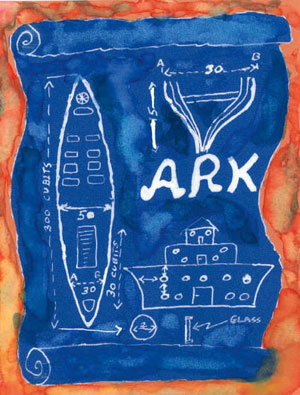
iii. The Laughing Stock
At last the Ark was finished, and it stood
three hundred cubits long, and fifty wide,
three stories — thirty cubits — high inside
constructed out of seasoned gopher wood,
the laughing stock of Noah’s neighborhood.
“A flood?” the people mocked, “I’m terrified!
Look! Over there! Is that a rising tide
I see? Boo-hoo, I promise to be good!!”
But then Methuselah died, and a malaise
descended on the people, for they knew
that God had stayed His hand until the few
good men still living reached their final days.
A dark cloud veiled the sun; the sky was bleak,
and Noah sniffed the wind and said, “A week.”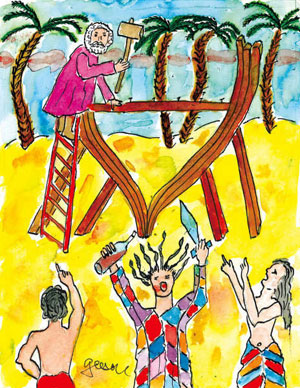
iv. Bird to Bird
Compared to getting humankind to heed
the urgent warnings, putting out the word
to animals was easy. Bird to bird
the news was spread at supersonic speed.
By nightfall all the beasts of earth had heard
the message, and they readily agreed
to group themselves according to their breed
(scaly, hairy, hard-shelled, feathered, furred)
and line up in a queue beside the Ark.
Birds sang and cattle mooed and lions roared
as Noah gently welcomed them aboard
and sealed the door against the growing dark.
At last, on bended knee, nose to the ground,
he gathered up the ants, lest they be drowned. 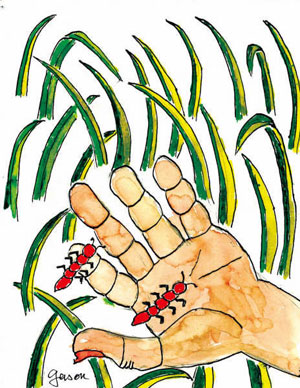
v. A Mighty Cry
The sun turned black, and lightning streaked the sky,
somewhere behind the clouds a strange light bloomed
and faded, and at last the thunder boomed,
bringing the first drops. Then a mighty cry
arose from those who’d chosen to defy
the warning signs, and callously resumed
their sinful ways. “Even now you are not doomed,”
despairing, Noah cried, “repent or die!”
On board the Ark, through unbelieving eyes
the animals beheld the death of man.
Sworn adversaries since the world began
wept freely as they said their last goodbyes.
Even man’s ancient enemy the snake
shed bitter tears that day for mankind’s sake.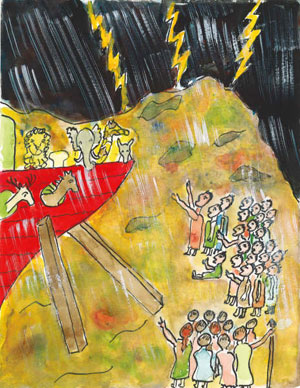
“Pocket Full of Violet” and Other New Poems by “Conway”
My prison pen pal “Conway” continues to make great strides in his poetry and artwork. As I mentioned in last month’s post, conditions have improved at his new location, where he has a job in the library and access to colored pencils and a typewriter. I hope to reproduce some of his drawings here soon. He often picks up themes from the classics he has been reading and reworks them in a voice that’s all his own. He sent me these poems after reading T.S. Eliot’s “The Waste Land”. I heard some echoes of Eliot’s closing section (“What the thunder said”) in the first poem below.
In his July 17 letter, Conway writes,
“…The other day while going through work change (strip search) the lady (if you wanna call her that!) searched my lunch (state issue baloney, apple, bread & mustard) well I had put a scooter pie inside the bag, I had purchased from canteen — she said I was not allowed to have it, who knows what (security risk) this would present, ‘the great marshmallow pie war’ so I ate it, you know, destroyed the evidence, literally….
“OK now on to bad news, they shot me down Calif Supreme Court on my writ of Habeas Corpus. So now I must file in Federal court. The basis for the appeal is #1 violation of contract (plea agreement) being as there was no mention of 3 strikes law in original plea bargain in 1987 that if I was arrested for non serious crime I would receive life in prison. I have good federal case law that confirms my argument plus the due process doctrines. It’s hard to get anyone’s ear on this stuff, though. Everyone is so caught up in their own drama they could care less about all the people stuck in here on an illegal law, as long as they have their big screen TV and what-nots….”
From July 26:
“I’ve been going to work almost every day since I got assigned to Vocational Education Clerk. So not much to blabber about, except last Saturday we had a yard down incident (upper yard) I’m lower yard, but they make us all prone out on our belly when they answer an alarm. Any rage, it was 109 degrees and I had my shirt off yard shorts on and was walking the concrete track with a buddy, so we belly crawl off the blazin hot concrete (stayin low) over to the grass field in the center of yard and, were obviously lookin to see who got got, so to speak, and I noticed that the grass was itching real bad, and thinkin it had just been a long time since I laid in the grass, I commented to my buddy “man this grass itches” about that time he looks over at me and says “Dude you got Ants all over you” Sure as heck I’d laid myself smack dab on an ant hole, so we slow crawled sideways and I brushed the critters off me, feelin like the interloper. Crazy huh? I know an Ant can’t move a rubber tree plant, but they sure moved me 🙂 “
Pocket Full of Violet
What love can clutch me
will remain forever, sheltered inside
the refuge of this stone heart
among a lazy river of stars
rising to meet my eyes awake
searching this endless silence
waiting for a break, carefully.
Chances & chains connect our soul
with so many sighs undone, reflecting
glittering like glass marbles
framed in stone and drowned by tears
shuffled savagely by foul years.
Broken fingers of the wind
departed softly unheard, and wept
swept through a lost window
behind another dull evening moon
bringing the bright kite
with a pocket full of violet
waiting beyon this wall
heavy on my heart
promising a new start
in an empty chapel
built by the lean,
mean and broken, spider’ web.
I sat alone in the pew
behind myself, daring my heart
to turn the key and cope
pierce this fierce dark with hope…
********
Spider
A spider hurls his rope up high
into an invisible windless sky.
His silk flag floats down
spinning a sticky town.
He laced up a Butterfly begging to be free
he swallowed her, but won’t feast on me
I wave my middle finger, curse & mock
he smiles and points at his key to my lock.
Someday, he motions, but not just yet
I wonder, do spiders ever regret
forget the paralyzed pleas of their prey
cursing the web, his bite, this Day…
********
Little Brick
This little brick went to prison
that little brick went home
that little brick went missin’
this little brick’s on his own
that little brick the cops hassle
put the little brick back in jail
built a little brick road & a castle
brick by brick straight to hell…
********
The Gavel
When the Gavel came down it glistened
should’ve splintered from the sound
echoing in my mind, still shaking the ground
no one else heard but I listened…
When the gavel came down I bled
while my family mourns, I’m alive still cold
buried in concrete on steel shelf
filed away, story untold
When the gavel came down
we all shut the book on life, in this scene
a library of lost souls
somewhere-n-nowhere
and everywhere in-between
Then the gavel spoke, deafened
I started to choke, lost my mind
for all life to spend
in this library of prison, when
the gavel gave its final decision…
In his July 17 letter, Conway writes,
“…The other day while going through work change (strip search) the lady (if you wanna call her that!) searched my lunch (state issue baloney, apple, bread & mustard) well I had put a scooter pie inside the bag, I had purchased from canteen — she said I was not allowed to have it, who knows what (security risk) this would present, ‘the great marshmallow pie war’ so I ate it, you know, destroyed the evidence, literally….
“OK now on to bad news, they shot me down Calif Supreme Court on my writ of Habeas Corpus. So now I must file in Federal court. The basis for the appeal is #1 violation of contract (plea agreement) being as there was no mention of 3 strikes law in original plea bargain in 1987 that if I was arrested for non serious crime I would receive life in prison. I have good federal case law that confirms my argument plus the due process doctrines. It’s hard to get anyone’s ear on this stuff, though. Everyone is so caught up in their own drama they could care less about all the people stuck in here on an illegal law, as long as they have their big screen TV and what-nots….”
From July 26:
“I’ve been going to work almost every day since I got assigned to Vocational Education Clerk. So not much to blabber about, except last Saturday we had a yard down incident (upper yard) I’m lower yard, but they make us all prone out on our belly when they answer an alarm. Any rage, it was 109 degrees and I had my shirt off yard shorts on and was walking the concrete track with a buddy, so we belly crawl off the blazin hot concrete (stayin low) over to the grass field in the center of yard and, were obviously lookin to see who got got, so to speak, and I noticed that the grass was itching real bad, and thinkin it had just been a long time since I laid in the grass, I commented to my buddy “man this grass itches” about that time he looks over at me and says “Dude you got Ants all over you” Sure as heck I’d laid myself smack dab on an ant hole, so we slow crawled sideways and I brushed the critters off me, feelin like the interloper. Crazy huh? I know an Ant can’t move a rubber tree plant, but they sure moved me 🙂 “
Pocket Full of Violet
What love can clutch me
will remain forever, sheltered inside
the refuge of this stone heart
among a lazy river of stars
rising to meet my eyes awake
searching this endless silence
waiting for a break, carefully.
Chances & chains connect our soul
with so many sighs undone, reflecting
glittering like glass marbles
framed in stone and drowned by tears
shuffled savagely by foul years.
Broken fingers of the wind
departed softly unheard, and wept
swept through a lost window
behind another dull evening moon
bringing the bright kite
with a pocket full of violet
waiting beyon this wall
heavy on my heart
promising a new start
in an empty chapel
built by the lean,
mean and broken, spider’ web.
I sat alone in the pew
behind myself, daring my heart
to turn the key and cope
pierce this fierce dark with hope…
********
Spider
A spider hurls his rope up high
into an invisible windless sky.
His silk flag floats down
spinning a sticky town.
He laced up a Butterfly begging to be free
he swallowed her, but won’t feast on me
I wave my middle finger, curse & mock
he smiles and points at his key to my lock.
Someday, he motions, but not just yet
I wonder, do spiders ever regret
forget the paralyzed pleas of their prey
cursing the web, his bite, this Day…
********
Little Brick
This little brick went to prison
that little brick went home
that little brick went missin’
this little brick’s on his own
that little brick the cops hassle
put the little brick back in jail
built a little brick road & a castle
brick by brick straight to hell…
********
The Gavel
When the Gavel came down it glistened
should’ve splintered from the sound
echoing in my mind, still shaking the ground
no one else heard but I listened…
When the gavel came down I bled
while my family mourns, I’m alive still cold
buried in concrete on steel shelf
filed away, story untold
When the gavel came down
we all shut the book on life, in this scene
a library of lost souls
somewhere-n-nowhere
and everywhere in-between
Then the gavel spoke, deafened
I started to choke, lost my mind
for all life to spend
in this library of prison, when
the gavel gave its final decision…