Alexander McQueen, R.I.P.


Acclaimed British fashion designer Alexander McQueen was found dead in his home on Feb. 11, CNN reported. Later news stories confirmed that the 40-year-old designer had committed suicide by hanging.

I was deeply saddened by this news. It goes without saying that premature death is always terrible, especially by suicide, and especially when it seems to outsiders that the person had so much to live for–genius, success, and an appreciative community.

But McQueen was special to me in particular because his aesthetic matched my ideals as a writer. Through fashion, a medium that many dismiss as frivolous, he achieved that marriage of beauty, sensuality, horror, and the uncanny that philosophers of art have called the sublime.

The Associated Press writes:

…Known for his dramatic statement pieces and impeccable tailoring, McQueen dressed celebrities from Cameron Diaz to Lady Gaga and influenced a generation of designers.

The son of a cab driver, McQueen grew up on a public housing estate in London’s East End, left school at 16 and entered the fashion world the old-fashioned way, as a teenage apprentice to a Saville Row tailor. He later studied at Central St. Martin’s art college in London and was discovered by fashion guru Isabella Blow, who bought his entire graduation collection. She became a friend and mentor; her suicide three years ago shook the designer, who wept openly at her funeral.

McQueen was a private man who avoided the limelight, but his Twitter postings show emotional turmoil after his mother’s death on Feb. 2. McQueen had posted messages four days before his death about his “awful week,” and said he had to “somehow pull myself together and finish.”

His mother’s funeral was held the day after McQueen died.

Friends also said he might have felt under pressure to outdo himself at the unveiling of his spring collection in Paris next month.

“I don’t think success was easy for him,” friend Plum Sykes wrote in the Sunday Telegraph this week. “He told me he was driven by his insecurities, and he believed that all successful people were.”

McQueen became chief designer at the Givenchy house in 1996, but was best known for his own label, in which Gucci bought a majority stake in 2001. McQueen retained creative control, and became famous for his dramatic and often uncategorizable creations: sculptural cocktail dresses in psychedelic patterns; headwear made of trash; 10-inch (25 centimeter) heels shaped like lobster claws.


The GLBTQ website, an online encyclopedia of queer culture, includes a good description of McQueen’s unique and controversial aesthetic:

McQueen always attracted (if not courted) controversy. His theatrical fashion shows gained him as much of a reputation as his stylish clothes. Some fashion experts deplore his “shock tactics” and publicity seeking, while others defend his exploration of radical ideas. The latter see his shows as questioning accepted notions of fashion and beauty.

For his March 1995 “Highland Rape” show, McQueen sent his models down the catwalk in ripped lace dresses and skirts with what appeared to be tampon strings attached. The 1996 “Hunger” show featured clothing and jewelry that evoked bondage and decay, while the “Untitled” show of 1998 (originally named “The Golden Shower” but changed because the sponsor, American Express, felt it was too risqué) highlighted a model with what looked like a bit between her teeth, walking through water lit with yellow light.

The outrageousness of McQueen’s shows has led to accusations of misogyny (an accusation often leveled at gay designers for the supposed fantasy women they try to create) and exploitation, but the “bad boy of fashion” is quick to counter these accusations. “Highland Rape,” he explained, was about the “rape” of Scotland by the British, a subject that had a personal resonance as his family is of Scottish descent.

Moreover, he insisted that his attitude towards women is informed by his having witnessed as a child scenes of violence involving his sister: “Everything I’ve done since then was for the purpose of making women look stronger, not naïve,” he was quoted in The Independent Fashion Magazine in 2000, “models are there to showcase what I’m about, nothing else. It’s nothing to do with misogyny.”

One of McQueen’s most controversial shows grew from his art direction of an issue of the alternative fashion magazine Dazed & Confused about models with severe physical disabilities. The subsequent catwalk show inspired by the issue featured model Aimee Mullins, whose legs had been amputated from the knees down, walking down the catwalk on hand carved wooden legs. The show was presented in a spirit of empowerment and inclusivity.


McQueen’s family has temporarily taken down all videos and photos from the designer’s website as a gesture of mourning. Readers interested in seeing images of his signature collections, with critical analysis, should pick up a copy of Caroline Evans’ excellent book Fashion at the Edge: Spectacle, Modernity and Deathliness (Yale University Press, 2003).

Evans suggests that a fascination with the body’s abjection, its traumas, disfigurements and decay, is the shadow side of our culture’s bodily hedonism and individualism, and of fashion’s impossibly narrow standards of physical beauty. Stories of violence and political instability fill our news media, juxtaposed with ever-more-luxurious images of products for sale. The genius of designers like McQueen is to express these tensions and paradoxes in costume, creating a modern self that we can wear.

Since Evans references the 19th-century poet Charles Baudelaire in one of her chapters on McQueen, I’ll close with this poem from his collection Les Fleurs du Mal, which to me expresses the McQueen signature themes of shock, eroticism, and the grotesque. This website includes several English translations; I’ve chosen the one that I like best because the free-verse rendition sounds more natural to my modern ear. With a poem like this, one runs dangerously close to the edge of the ridiculous, which English rhyme seems to accentuate.

Rest in peace, Lee McQueen.

Une Charogne

Rappelez-vous l’objet que nous vîmes, mon âme,
Ce beau matin d’été si doux:
Au détour d’un sentier une charogne infâme
Sur un lit semé de cailloux,

Les jambes en l’air, comme une femme lubrique,
Brûlante et suant les poisons,
Ouvrait d’une façon nonchalante et cynique
Son ventre plein d’exhalaisons.

Le soleil rayonnait sur cette pourriture,
Comme afin de la cuire à point,
Et de rendre au centuple à la grande Nature
Tout ce qu’ensemble elle avait joint;

Et le ciel regardait la carcasse superbe
Comme une fleur s’épanouir.
La puanteur était si forte, que sur l’herbe
Vous crûtes vous évanouir.

Les mouches bourdonnaient sur ce ventre putride,
D’où sortaient de noirs bataillons
De larves, qui coulaient comme un épais liquide
Le long de ces vivants haillons.

Tout cela descendait, montait comme une vague
Ou s’élançait en pétillant;
On eût dit que le corps, enflé d’un souffle vague,
Vivait en se multipliant.

Et ce mo
nde rendait une étrange musique,
Comme l’eau courante et le vent,
Ou le grain qu’un vanneur d’un mouvement rythmique
Agite et tourne dans son van.

Les formes s’effaçaient et n’étaient plus qu’un rêve,
Une ébauche lente à venir
Sur la toile oubliée, et que l’artiste achève
Seulement par le souvenir.

Derrière les rochers une chienne inquiète
Nous regardait d’un oeil fâché,
Epiant le moment de reprendre au squelette
Le morceau qu’elle avait lâché.

— Et pourtant vous serez semblable à cette ordure,
À cette horrible infection,
Etoile de mes yeux, soleil de ma nature,
Vous, mon ange et ma passion!

Oui! telle vous serez, ô la reine des grâces,
Apres les derniers sacrements,
Quand vous irez, sous l’herbe et les floraisons grasses,
Moisir parmi les ossements.

Alors, ô ma beauté! dites à la vermine
Qui vous mangera de baisers,
Que j’ai gardé la forme et l’essence divine
De mes amours décomposés!

A Carcass

My love, do you recall the object which we saw,
That fair, sweet, summer morn!
At a turn in the path a foul carcass
On a gravel strewn bed,

Its legs raised in the air, like a lustful woman,
Burning and dripping with poisons,
Displayed in a shameless, nonchalant way
Its belly, swollen with gases.

The sun shone down upon that putrescence,
As if to roast it to a turn,
And to give back a hundredfold to great Nature
The elements she had combined;

And the sky was watching that superb cadaver
Blossom like a flower.
So frightful was the stench that you believed
You’d faint away upon the grass.

The blow-flies were buzzing round that putrid belly,
From which came forth black battalions
Of maggots, which oozed out like a heavy liquid
All along those living tatters.

All this was descending and rising like a wave,
Or poured out with a crackling sound;
One would have said the body, swollen with a vague breath,
Lived by multiplication.

And this world gave forth singular music,
Like running water or the wind,
Or the grain that winnowers with a rhythmic motion
Shake in their winnowing baskets.

The forms disappeared and were no more than a dream,
A sketch that slowly falls
Upon the forgotten canvas, that the artist
Completes from memory alone.

Crouched behind the boulders, an anxious dog
Watched us with angry eye,
Waiting for the moment to take back from the carcass
The morsel he had left.

— And yet you will be like this corruption,
Like this horrible infection,
Star of my eyes, sunlight of my being,
You, my angel and my passion!

Yes! thus will you be, queen of the Graces,
After the last sacraments,
When you go beneath grass and luxuriant flowers,
To molder among the bones of the dead.

Then, O my beauty! say to the worms who will
Devour you with kisses,
That I have kept the form and the divine essence
Of my decomposed love!

— Translated by William Aggeler
Videos from My Green Street Cafe Poetry Reading, Plus Upcoming Readings News


Saturday, Feb. 20, 7:00-8:30 PM: I’ll be reading with poets Karen Johnston and Ellen LaFleche at Thirsty Mind Coffee and Wine Bar, 23 College Street, South Hadley, MA. For more information, call 413-538-9309.

Karen G. Johnston is a social worker by vocation, a poet by avocation, a socialist by inclination, a UU-Buddhist by faith, and mother by choice. Her writing has been published in Silkworm, Equinox, Concise Delight, WordCatalyst, and Women. Period. An Anthology of Writings on Menstruation.

Ellen LaFleche has a special interest in poems about working class people, and issues of health and healing. She has published in numerous journals, including Many Mountains Moving, Alehouse, Alligator Juniper, the Ledge, New Millennium Writings, and Naugatuck River Review.

And speaking of Naugatuck River Review

Saturday, Feb. 27, 2:00-4:00 PM: Launch party for the Winter 2010 issue, which includes winners of the 2009 narrative poetry contest, at Forbes Library, 20 West Street, Northampton. I’ll be reading with several of my fellow authors in this issue.

Readers include: Thomas R. Moore (1st place winner), Kathryn Neel (3rd place winner), Pat Hale, Gineen Lee Cooper, Jendi Reiter, Allegra Mira, Lynne Francis, Wendy Green Simpson, Don Lowe, Laura Rodley, David Giannini, Barbara Benoit, Christina Svane, Sharon Charde, Andrea Cousins, Paula Sayword, Jeff Friedman and Tim Mayo. Also reading are our poetry editors Oonagh Doherty, Ellen LaFleche and Sally Bellerose. Leslea Newman, our esteemed contest judge, will also read! Hosted by Publisher Lori Desrosiers.

****
Last month, I had the pleasure of reading with Charlie Bondhus, author of How the Boy Might See It (Pecan Grove Press, 2010) at the Green Street Cafe in Northampton. Thanks to my husband, Adam Cohen, and his ever-present Flip camera, our performances can now be viewed on Blip TV here (me) and here (Charlie). Each segment is about 25 minutes. We introduced each other, which is why Charlie’s segment starts with me and vice versa.

If you prefer to take me in small doses, as many people do, please enjoy these YouTube videos from the reading.

“Wedded” first appeared in The Broome Review. Regular readers of this blog may notice a familiar theme.

Buy Swallow!! I mean it.

And now for something completely inappropriate.

A Talent for Sadness (Turning Point Books, 2003) can also be yours.

“Waiting for the Train to Fort Devens” Now Online at The Rose & Thorn


My flash fiction piece “Waiting for the Train to Fort Devens, June 17, 1943”, is now online in the Winter 2010 issue of The Rose & Thorn, a quarterly journal of literature and art. This story was inspired by an archival photo of young men from Western Massachusetts going off to World War II, republished in the Florence Savings Bank calendar. The photo’s owner, Sharon Matrishon, whose father is featured in the image, kindly allowed us to reprint it on The Rose & Thorn page. Here’s the opener:

This photograph was taken right before forty boys turned into soldiers. In fairy tales, transformations are sudden, painless. Seven brothers lift up their white arms in unison and become swans. Forty comical thieves peek out of fat-bellied oil jars. But these forty men waiting for the train to Fort Devens will have a long way to go before they all become the same.

They line up, as if for a yearbook portrait, beneath the slatted wooden balcony of the old Bay State Hotel, which must have been a cheap hotel because its front porch is only a dozen feet from the railroad tracks. A place for salesmen and card sharps, or girls who thought they needed to make a quick getaway from their parents’ sleepy fireside. Some of these boys might have taken a girl to the Bay State Hotel after a night of confused carousing, hooked up by an elder brother who offered a knowing wink that both annoyed and excited them. Some of these boys have never had the opportunity, and are distracting themselves from thoughts of German bullets by imagining the grateful softness of French girls in a farmhouse where a single candle burns in a wine bottle. These boys kissed Mary Sue or Ethel in the back seat at the drive-in and promised to wait for her, and she might have unhooked her bra even though she knew waiting was powerless against male hormones and the U.S. government.

In other writing news, my prose-poem “Possession” won the 2009 Robert J. DeMott Short Prose Prize from the journal Quarter After Eight. My poem “What Dora Said to Agnes” (a feminist response to David Copperfield) tied for third place in the 2009 Caesura Poetry Contest. Caesura is the literary journal of the Poetry Center San José.

Charlie Bondhus: “His Sunday Morning Blues”; Plus, Upcoming Reading Jan. 14


Charlie Bondhus and I will be giving a poetry reading at 7:30 PM on Thursday, Jan. 14, at the Green Street Cafe, located at 64 Green Street (no surprise there) in Northampton, MA. This cozy neighborhood bistro cooks with home-grown herbs and vegetables; I recommend the Sri Lankan vegetable stew.

I’ll be reading some of my newer poems and selections from Swallow and A Talent for Sadness. Copies of these books will be on sale, along with my freshman effort, Miller Reiter Robbins: Three New Poets (Hanging Loose, 1990), which features a lovely picture of fierce 17-year-old me.

Charlie’s first full-length collection, How the Boy Might See It, was released last month by Pecan Grove Press. He kindly shares this poem from the book below. It exemplifies the combination of sensuality and spiritual depth that I appreciate in Charlie’s work.

His Sunday Morning Blues

Then the Lord God formed man out of the dust of the ground and breathed into his nostrils the breath of life, and man became a living being [and] the man knew Eve his wife.
-Genesis 2:7, 4:1


Woke up this
morning cold
kicked the
blankets last night
saw her gone
must’ve stolen out
with the boys
another gathering
lesson, though this time
didn’t wake me up
with a kiss and
touch on the head
like usual.

Don’t feel like checking the fields,
guess I’ll spend the day
in our camel hair bed
and hash this whole thing out.

Funny how
everything I remember before the
sand and the crag looks the way a deer
does, vague behind the gloss
of fog.
I do remember monkeys and mountain goats who
spoke in a voice
similar to our own;
toucans and thrushes that
screeched and warbled in
what must’ve been friendship;
a sense
that everything existed
indefinitely.

As for the woman, she
sometimes talks about tinctured
fruit, every color of a
blush, and uncured leaves–
of peppermint, thyme, rosemary–
something sharper, maybe wiser
that used to float
in the flavor of papayas and kiwis.

Also something more for her
in the sound of the river–
the entire streambed maybe
covered with flutes and shells,
rather than mud and papyrus.

These days though,
everything sounds and tastes
blurry as the dog looked
when we found him
at the bottom of the oasis,
as if we touch and eat
only the colored shadows
of grape, apple, grain–

as if life were lived
forever in twilight.

And still other things,
called to mind by
the branches of a tree–
something in the twist or
the pull, the sober tinge of
bark–

the slope of a leaf–
wondering whether the color is really
green or something that’s not quite
green and if
the edges are really as
pointed or smooth as they
appear.

The gravid clouds that shuffle,
dazed and vapid,
like the feet of an aging God,
across a monotonous sky,
wondering whether or not one could tear
their flimsy substance
between hands or teeth.

Always too, those objects that we
cannot see but still perceive more
readily than rocks and sand,
many of which
I haven’t gotten around
to naming.

Sometimes the woman
cries and throws
herself on the bed
refuses to talk and
I know she’s in pain because
of the blood but we’ve both
cut ourselves before, like once
I tore open my shin on a rock while
climbing after a
goat, and she ripped open
the palms of her hands when she
lost her grip, attempting to pull up
a stubborn vegetable in the garden,
but both of us were still able to speak then
so I know that when she bleeds unbidden,
she must be
stuffed full of
one of those crazy compound things
that we fear
for their power, persistence, and
lack of a name, and that’s
what really hurts.

My greatest fears
stand taller than wheat
when the ground isn’t fertile,
the animals go into hiding, and we
take Cain and Abel,
move to a different place,
and the woman and I find
in each empty, unbreathing land,
no matter how distant,
that the unspoken
is a little more real.

I tremble at these times
when the truth looks the way
that apple grape and grain taste–
should we fall the way some
animals have, stricken by neither
stone nor spear, and the sand were to cover
the crops and the caves crumble to
soil, as they have in the lands we have left,
with no creature capable of maintaining things
as we have, would we be judged unworthy
to return to the place of
sharp taste, musical river, and speaking beast?

Reiter’s Block Year in Review: 2009


My imaginary friends and I have had an eventful year. Some friendships were strained, many others proved more of a blessing than I’d ever imagined. Novel chapters got written, some published, and poetry did even better. My husband and I visited Chicago (AWP), New York City (friends, family and shopping), West Palm Beach (gay rights conference), and three agricultural fairs (we like cheese). My politics moved further to the left, dragging my theology along. Or was it the other way around?

Thanks for visiting Reiter’s Block. I look forward to continuing our conversation in 2010.  And now, the clips episode.

Biggest Accomplishment

SWALLOW. SWALLOW SWALLOW SWALLOW. Buy it now and the scary birdies won’t getcha.

Biggest Disappointment

You know who you are.

Guilty Pleasure

Facebook. Okay, so that’s tangentially related to my writing career. But…

Even Guiltier Pleasure

Farmville on Facebook. This game has no productive value whatsoever. The most I can say is that it’s easier on my wrist than computer solitaire.

Best Books Read in 2009

*Alex Haley, Roots

I thought I understood the story of slavery in this country, but I didn’t feel it in my heart till I read this saga of seven generations of an African-American family, beginning with Haley’s Gambian ancestor who was kidnapped and sold into slavery in the 18th century. Haley’s fictionalized re-creation of their lives is rich with drama, humor, tragedy, political outrage, and love that defies the odds.

*Cheryl Diamond, Model

There’s more to this teen memoir than meets the eye. Beautiful, blonde Cheryl has a wise old head on her shoulders, which helps her survive encounters with all sorts of human predators as she tenaciously builds a career as a fashion model in New York City. She’s also a sharp, funny writer. Now, when I feel defeated by life’s setbacks, I often ask myself, “What would Cheryl do?”

*Adrian Desmond & James R. Moore, Darwin’s Sacred Cause

Two leading Darwin scholars wrote this thorough and engaging history of how Charles Darwin’s hatred of slavery impelled him to seek a common origin for the races. The book has a strong narrative line and a detailed analysis of how politics, religion, and science have been entwined at every step in the development of evolutionary theory.

*David G. Myers & Letha Dawson Scanzoni, What God Has Joined Together: The Christian Case for Gay Marriage

A journalist and a sociologist make a concise and persuasive case that marriage is good for everyone; gays are born that way; and the Bible doesn’t have to be interpreted to condemn homosexuality. While their arguments won’t be news to followers of progressive and queer theology, this is the book I recommend first to anti-gay Christians because it’s written by two straight evangelicals.

*Sarah Schulman, Ties That Bind: Familial Homophobia and Its Consequences

Original, hard-hitting new book from longtime AIDS activist and lesbian playwright casts a critical eye on the family dynamics of shunning and devaluing gay members, and how this becomes the template for the same behaviors in the wider society, as well as domestic abuse in gay relationships. Amazon reviewer C. Bard Cole writes, “…a tight and focused master work. Her approach to talking about the painful family dynamics in her own life is unlike anyone else’s, so unlike the calculated confessional approach of memoir and transgressive fiction that I hardly know how to describe it. It’s cool, intellectual, self-controlled — but perhaps like Perseus looking at the Gorgon only as a reflection in his shield.”

Favorite Blog Posts

“Blogging for Truth” Week: Writing the Truths of GLBT Lives

As Pontius Pilate famously asked, “What is truth?” Who gets to tell it, and about whom? The debate between affirming and non-affirming Christians is fundamentally about the relationship of truth to power. For that reason, it should concern all Christians, whether or not they have a personal stake in GLBT rights.

Liberal Autonomy or Christian Liberty

Original sin distinguishes the Christian picture of human nature from the liberal one. Privileging personal experience over text and tradition, a liberal might say “The truth is inside you.” I wouldn’t go that far. As a good postmodernist, I would say “You are inside you.” The right to stay grounded in our own experience should not be conditioned on the impossible burden of always “getting it right”. That’s another form of legalism.

I’m a Barbie Girl, in a Fallen World

When I’m with my Barbies, I can simply enjoy being a girl. I can pretend that I’m working on narrative structure by inventing elaborate storylines for them — TV show producer Barbie, transgender fashion designer Barbie, 12-step rehab Barbie, closeted evangelical gay teen Barbie, Korean radical feminist ex-stripper Barbie, and the rest. But the truth is, I just love clothes.

Happy 2010 from me and my muse…

Report from the Soulforce Anti-Heterosexism Conference, Part One


Last weekend, my husband and I attended the Soulforce Anti-Heterosexism Conference in West Palm Beach. I think the experience is best summed up by the words of the old hymn: “There’s a sweet, sweet spirit in this place, And I know that it’s the spirit of the Lord.” Many of the participants had survived terrible abuse at the hands of straight Christian leaders and family members, yet the mood they created was one of kindness and openness to the perspectives of everyone in the group, gay or straight, religious or secular. I was even more inspired by the fact that many of them had not given up on their faith. Despite the efforts of those who would split their bodies from their souls, they were determined to claim their place as God’s children, through nonviolent resistance, truth-telling and love.

So what is heterosexism? In brief, it’s the presumption that straight is better than gay. It manifests itself not only in our personal feelings about gay people, but in structural inequalities in our society that disadvantage gay relationships or make them culturally invisible.

Just as white privilege is different from racism, heterosexism is different from homophobia. You need not have personal animus against a group to participate in its oppression, simply by assuming that your flavor is the only one in the shop. For instance, the butt-plug and rape-anxiety jokes employed to code male bonding as “not gay” in the new film “Planet 51” are an example of homophobia; the complete absence of same-sex couples in this and all other mainstream children’s cartoons is heterosexism.

To use a more serious example, homophobia is Fred Phelps; heterosexism is the presumption that straights are naturally the correct interpreters of the Bible, and gays have to “justify” their inclusion according to the standards of the straight majority. Open and affirming–that’s nice, but why do you own the church doors?

We were one of two straight couples among the 50+ attendees, the other being a twentysomething woman and her partner who were doing research for an academic project. I was excited to meet some of my favorite bloggers:

Candace Chellew-Hodge, founder of Whosoever, the first online magazine for GLBT Christians, and frequent contributor to Religion Dispatches.

Carol Boltz, who stood by her husband, contemporary Christian music star Ray Boltz, when he came out of the closet and instantly became persona non grata among his former fans. Instead of joining the chorus of blame, she decided to speak out against the real culprits, the homophobic religious leaders who had forced their family into living a lie. Carol blogs at My Heart Goes Out.

Anthony Venn-Brown, who came to us all the way from Australia. This Pentecostal mega-church preacher struggled against his sexual orientation for 22 years before risking it all to be true to himself. His book and blog are titled A Life of Unlearning. Anthony’s upbeat, extroverted personality added a good feeling to our discussions. He was hopeful about the progress of gay rights in Australia.

Jim Burroway of Box Turtle Bulletin, one of the leading websites that monitors the “ex-gay movement” and other organized forms of homophobia. Jim was always ready to ask the tough questions that moved our discussions forward.

Darlene Bogle, a former director of an ex-gay ministry affiliated with Exodus International, who issued a groundbreaking apology at the 2007 Beyond Ex-Gay conference. Darlene’s book A Christian Lesbian Journey talks about how she began her current work of promoting reconciliation between faith and sexual orientation.

You can read a summary of the weekend’s events on the Soulforce website. In the next installments, I’ll share my notes on the presentations that particularly made an impression on me.

Poem: “What You Need to Know Is”


The New England Trans United pride march will be held in Northampton this Saturday, Oct. 3, from 11 AM-5 PM. I would love to march again this year, but my husband and I will be in New York City on family business for most of October. Please send me your photos and videos to post on this blog.

In honor of Trans Pride, I’d like to share this poem from my new chapbook, Swallow, which is now available from Amsterdam Press:

What You Need to Know Is

Not in my urinal or my soprano,
white rubber corset or tobacco whiskers.
Not in the gun or the red bloom
on the tumbled gown. Not prone and not aiming.
I could presume to say that you dream
of Lazarus and if it is anywhere,
it is there, in the nights your dry tongue
burns for wasted water but more so
in the mirror dream where your hand spills it away.
Sometimes I, too, soften it like the twilight
and then I am that lightbulb questioner
who slaps you awake with a hose.
I in my nursing smock, I in my meat-stained apron,
how I wish I did not know this
much as you wish I were not beside you
(O my mustache, O my silver-tipped fingers)
sweating through the Gloria.

Hometown Favorite Lorelei Erisis Crowned Miss Trans Northampton


Local activist, journalist and Pride emcee Lorelei Erisis won the Miss Trans Northampton 2009 pageant at the Center for the Arts this past weekend. The eight contestants represented, to my eyes, an interesting variety of ways for someone born biologically male to perform femininity.

Those with a more petite build, like second runner-up Lily Rin, convincingly resembled young glamorous women, with high voices to match. Meanwhile, Lorelei and first runner-up Leslie-Anne Rios were tall and striking figures with deeper, rougher voices and a commanding stage presence. Their self-presentation occupied some third space between the conventions of male and female appearance. Leslie-Anne, for instance, looked sassy in an evening gown and sang a heartfelt song of her own composition about finding peace within–female?–but flexed her biceps with a wink at the end–male? Lorelei’s talent-show entry was a performance piece about her transition, starting out in a man’s suit and ending up in a bra and panties.

Transgender, I’m discovering, is about more than “dressing up”. The transgender rights bill remains stalled in the Massachusetts legislature, perhaps because a man’s “right” to wear a dress to work somehow still appears more frivolous than the right to marry the man he loves. On the other hand, would people feel more comfortable if they really understood what trans was about–not the right to perform existing gender roles so much as the acknowledgment of their inadequacy?

A transwoman who doesn’t convincingly pass for female makes us cis-women cringe, sometimes, because she’s what we’re afraid of seeing in the mirror: someone too tall, or too awkward, or too loud, or too strong to fit the feminine ideal. Beauty standards are a test that some of us fail. Some of us slept right through the damn thing.

I had my own “trans” moment last month when a guy at my gym kept greeting me as “It’s Pat!” He’s a big scruffy street musician, good-natured in a sort of spacey way, and he assured me he meant no harm in comparing me to the unattractive and gender-ambiguous Saturday Night Live character: “Pat is funny!” he said. I guess a weight-lifting girl translates into intersex in his mind. Still, it took all my genderqueer political consciousness not to feel mortified that I did, indeed, slightly resemble Pat, who is too graceless to be female and too soft to be male. (My gym buddy, by the way, has now learned my real name but misremembers it as “Glenda“…shades of Ed Wood!)

But let’s go to the videotape… Here are some highlights of Saturday’s competition. Thank you, Miss Trans Northampton, for challenging us to see that beauty comes in all shapes and sizes.

Lorelei Erisis performs “my entire life and transition in under five minutes”:

Leslie-Anne Rios performs her song “Teach Me Peace”:

Tammy Twotone lip-syncs and dances to “Something’s Gotta Give”:

The evening gown competition:


“Swallow” Poetry Chapbook by Jendi Reiter Now Available from Amsterdam Press


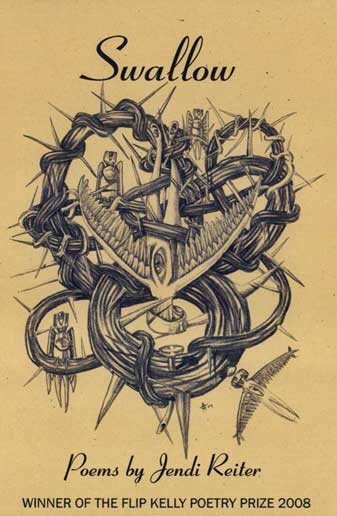
My poetry chapbook Swallow won the 2008 Flip Kelly Poetry Prize from Amsterdam Press and is now available for purchase online. Thanks are due to my awesome editor, Cindy Kelly; poet Ellen LaFleche, who helped me organize the collection and suggested the title; and my prison pen pal “Conway” who drew the amazing cover art.


“Jendi Reiter’s poems are arrows that plunge dead center into the hearts of feminism, religion, death, the interior of mental health and psychotherapy. Her humor and satire here are as sharply honed as are her indignation. All are delivered in highly imaginative and metaphoric imagery. This is an intelligent and powerful read that will leave issues bleeding in the minds of readers for a while before they heal.”

—Ellaraine Lockie, award-winning poet, nonfiction author, educator

“There’s plenty of poetry I wouldn’t give a fig for, but I’d give strawberries for the poems in Jendi Reiter’s SWALLOW. When I started in Poetry in 1962, I felt poems were only poems if the top of my head was taken off, to use Emily Dickinson’s words. Jendi Reiter, who is also a bold experimenter, writes that way—solid images, worthwhile themes, and sentences that stick in the mind like raisins in rice pudding. I find much of today’s poetry too arcane, which may be why it’s ignored by so many. That’s not true of Jendi Reiter’s work. It’s challenging, beautiful, and clear. Read it, and again in Dickinson’s words, taste a liquor never brewed.”

—William Childress, Pulitzer-nominated Korean War poet and journalist

Enjoy a sample poem from Swallow:

Wolf Whistles

We’re all trying not to think about sex or cake.
That bitter word hurled from a car.
A moment ago you felt pretty.
Trying not to hammer the nail
into anything but the board.
Hard hat men sucking on coffee,
women with their hands down their throats
like a magician pulling a ten-foot rope out of a bottle.
It seems to go on forever,
monotonous intestine.
We’re trying cold baths and grapefruits,
another route around the tar
someone’s grateful to be laying down.
Saying throw me in the briar patch,
come on, do.
What a great distraction brambles are.
Rubbing and rubbing the saw against the wood.
What wound is he favoring
as his whistle strips you like paint?
We’re smashing pies into our faces,
we’re cutting open our skins. The better to eat.

Stay Tuned for Miss Trans Northampton Pageant, Sept. 5


The first-ever Miss Trans Northampton Pageant is scheduled for next Saturday, Sept. 5, at the Northampton Center for the Arts. This is one of only a few such events nationwide. Eight Massachusetts transwomen will compete in the categories of glamour, poise, evening gown and talent. “Transgender” is a broad term that includes transsexuals, transvestites, and those who choose not to identify as either male or female.

The Springfield Republican newspaper ran a story on the event yesterday. Pageant organizer Christa L. Hilfers’ gender odyssey is interesting in itself:

Hilfers, 33, moved to Massachusetts three years ago from South Dakota. Born a biological male, Hilfers was raised by her mother as a girl. She went into foster care at age 9, but was allowed to continue living as a female.

“I didn’t try to live as a boy until I was 18,” she said.

Hilfers had a child with a woman, but the relationship failed, and she has not seen her daughter, now 15, for years. “After that I realized I could never be a boy,” she said.

Part American Indian, Hilfers spent some of her life on a reservation in South Dakota. Although her fellow Indians were accepting of her, she found South Dakota a difficult place to be transgender. She and her husband, a heterosexual male, moved here so they could get married. His family still doesn’t know Hilfers is transgender, she said. She considers herself a straight female.

Hilfers has competed in pageants for most of her life and won the title “Miss Gay Rochester, Minnesota” in 2003. Once she moved to Hampshire County, she identified Northampton as a good place for a transgender pageant.

“It’s really safe,” she said, “and not just for transgender people.”

That’s the kind of statement that makes me proud of our town. In other news, Northampton will host the second annual New England Transgender March and Rally on Oct. 3. See my coverage of last year’s event here.