Ten Years After 9/11: Poetry and Some Thoughts


This weekend marks the tenth anniversary of the September 11 terrorist attacks on the World Trade Center and the Pentagon.

Back then, our family was still living on the Lower East Side of Manhattan. At 9 AM, I came upstairs to my office at a publishing company in the West 30s to find everyone peering out the window at smoke billowing from the WTC. We could only see the top floors in the distance so we were not sure what had happened. We saw the flash that was the second plane hitting, but only found out later what had caused it. After that, the grey cloud of smoke and ash was all we could see. Shortly thereafter we learned from the radio that the towers had collapsed and another plane hit the Pentagon. It was then that I became really scared: this was not an accident, it was an attack, and anything could happen now. I don’t remember how we evacuated from the 21st floor, but I assume we must have taken the stairs. Fortunately my husband worked in midtown too and I could email him to come meet me, since the phones were not working.

We walked about three miles downtown to our apartment, part of a stunned crowd. The funereal silence and slowness of these typically high-adrenalin New Yorkers really brought home to us that our world had changed. (I am so proud of the residents of my birth city for not panicking and responding with such courage.) My moms lived across the street from us so we went up to their place to let them know we were all right. One of them was there and the other was making her way downtown from West 96th St., driving her co-workers home, as far as the emergency personnel would allow cars to go. Like everyone that day, we obsessively watched the televised footage of the disaster, hoping for information that would make sense of it all, although it was clear that only speculation and tragedy were on offer.

We were spared the pain that thousands of our fellow New Yorkers endured, in that we did not know anyone who was in those buildings. Our upstairs neighbor lost his brother, Robert Foti, a firefighter. We went to his funeral a few weeks later. Rest in peace, Robert. I will never forget his mother’s words when we paid her a condolence call. “They’ll never find their bodies,” she said, wiping her hand along the table. “See this dust? We’re breathing them in right now.”

What I remember most from those early days was the fear of what might be demanded of us. What sacrifices would we have to make? Would it be like World War II, when the homefront was part of the battle? I was worried that Adam would feel a sense of duty to enlist. Though I am the least bureaucratic person in the world and had just escaped from my legal career, I sent away for a pamphlet about joining the Judge Advocate General’s Corps.

Our preoccupations of the week before were tinged with tragic irony. Walking home from dinner, in a rush to watch the U.S. Open, Adam and I got sidetracked into an argument about his wish for children. Newly independent of my parents, I was afraid I wouldn’t get to experience life and make progress in my writing career before being submerged in someone else’s needs. After 9/11, I felt keenly the truth that “no one knows the day nor the hour”. Plans are uncertain; family matters most in a crisis. (Double irony since we still haven’t been able to make this happen…)

There was something beautiful about the mindfulness and tenderness with which New Yorkers went about their business in the following weeks. On a crowded midtown bus at rush hour, truly one of the more unpleasant aspects of New York life, I noticed that people gave way to one another instead of jostling and taking offense. We were suddenly grateful that each person next to us was still alive.

And simultaneously there was the crassness of the “Fight Back New York: Go Shopping!” campaign, the alarming speed with which the sidewalk vendors cranked out death-to-Osama T-shirts and flag-festooned junk. The mutual contempt of the pro- and anti-war camps, everyone desperate for a simple narrative, as if death always came to people with a reason and a forewarning, visible if we looked hard enough.

It was supposed to be the end of irony. Even if that had been true, I don’t think it would be a good idea. We need all possible interpretive tools to make our way in a world where 9/11’s happen. What it was, instead, was a collective moment of appreciation that life is precious and mysterious, and that no one is really a stranger. That consciousness was too painful, though, and too unprofitable, to keep up for long. “Go, go, go, said the bird; humankind/Cannot bear very much reality.”

But for that little while, we cried at baseball games, we wore our flag lapel pins and bootleg NYPD and FDNY caps, we prayed over the names in the newspaper and asked forgiveness for being unable to read one more obituary, and we wrote poetry about crashing planes and falling towers and heroes.

Adam and I had just started Winning Writers that summer, and we were putting together the rules for our first annual contest. Distressed by the simplistic verses being written by both the blame-America liberals and the kill-the-Muslims conservatives, we decided that our contest should solicit high-quality and nuanced poetry about war. (2011 will be this topic’s tenth and final year, to be replaced by the Sports Poetry Contest.)

These poems from Israeli author Atar Hadari, honorable mention winner in our 2003 contest, best express how New York felt to me in the aftermath. The “two lights” are the memorial Tribute in Light that represented the lost towers with spotlight beams.

Read more 9/11 reminiscences at the WNET-Channel 13 public television website.
****

SUMMER RAIN

by Atar Hadari

This is the season people die here,
she said, Death comes for them now.
Sometime between the end of winter
and the rains, the rains of summer.

And the funerals followed that summer
like social engagements, a ball, then another ball
one by one, like debutantes
uncles and cousins were presented to the great hall

and bowed and went up to tender
their family credentials to the monarch
who smiled and opened the great doors
and threw their engraved invitations onto the ice

and dancing they threw their grey cufflinks
across each others’ shoulders, they crossed the floor
and circles on circles of Horas
filled the sky silently with clouds, that chilled the flowers.

And funeral trains got much shorter
and people chose to which they went
and into the earth the flowers
went and no one remembered their names

only that they died that summer
when rains came late and the streets emptied
and flags flying on car roof tops
waved like women welcoming the army
into a small, abandoned city.

TWO LIGHTS
by Atar Hadari

Two lights were fixed over the town
high up, higher than any star had business being
and yet they shone, not like helicopter beams,
like flames, like something burning and not being consumed.

I stepped two steps toward the fence
to see, to try to see, the fire –
they stayed two gold balls in the sky
and I trod on some stones and smelled dog piles.

Whenever I tried to hear roar
of propellers’ wings, the milk trucks
would careen by in their floats
and commuters late home whizzed by in droves
like ice cream vendors.

Eventually one went out
then the other and suddenly
way above them both
another lit, preternaturally still,
an emptying cinema’s white bulb.

A jogger came out of the dark
my side of the fence
I waved, “Do you know what that is?”
“It’s light to find the terrorists,” he said

and ran and I walked away
looking thru at darkness
and left one bulb in the middle
of the empty cinema

like traces of a flame
after you’ve closed your hand
and clenched your lids
and walked out of the shot

and lights still burn in that sky
and I translate the word of God
out of Hebrew. And wanderers in that dark
mistake those lights for guides through the ruins.
My Poems “Inheriting a House Fire” and “touching story” in Solstice Literary Magazine


Solstice Literary Magazine, an online quarterly, selected two of my poems as the “Editor’s Pick” from their contest submissions this year. “Inheriting a House Fire” and “touching story” appear in their Summer 2011 issue. Launched in 2009, Solstice has published such authors as Kathleen Aguero, DeWitt Henry, Leslea Newman, and Dzvinia Orlowsky. Enjoy (if that’s the right word?) “touching story” below.

touching story

not the turn to gold but touch he
wanted most, no object that
flesh of his
supper gelled to shining
ore lumps when he bit, that sepals
stiffened on the rose
like nipples bared to frost. not
the lark that lasted but the scar
its moneyed weight peeled
down the tree. not the trophy
hound, that sudden andiron
dropped from his lap,
but the fox, stinking, invisible,
unchased.
                
myth to asses’ ears,
no nodding velveted clefts
named his errata, not a page
or armed barber kissed the riverbed
to scandalize the reeds
into singing true. and when his
   daughter,
as he’d tell it, sprang
into his transmuting arms, and after,
there was no god to take the
   hardening gift away.

Sponsor Me for the Soulforce Virtual Equality Ride


One of my favorite GLBT activist groups, Soulforce, counters religion-based homophobia through nonviolent activism in the tradition of Gandhi and Dr. Martin Luther King Jr. Their annual Equality Ride takes GLBT youth and straight allies on a bus tour of U.S. colleges whose official policies include discrimination against non-heterosexuals. The Riders initiate dialogue with school administrators and offer support to sexual minorities on campus. Since the first ride in 2006, several Christian schools (including Mormon heavy-hitter Brigham Young U.) have softened their anti-gay policies, and Gay-Straight Alliances have formed on a number of campuses.

Soulforce, a nonprofit, pays for all the expenses of the Equality Riders. Besides food, lodging, and transportation, the program includes training in nonviolent activism, so that the young people can remain peaceful and spiritually safe when confronted with hate speech during their silent vigils and sit-ins. The Riders raise money for their work through sponsorship pages on the Soulforce website.

This year, those of us who are too old to get on the bus can still be part of this courageous campaign as a Virtual Equality Rider. The sponsorship idea is the same, and the money goes to the general expenses of the ride.

Please visit my page and make a contribution! If I raise $1,000 by March 2012, they’ll put my name on the bus.

Advice to Myself, Across 20 Years


“I once believed in causes too, I had my pointless point of view…”Billy Joel

I turned 39 this week, and I intend to stay that way for quite some time. (And if you get that reference, you’re older than me, haha.)

Twenty years ago, I was named one of Glamour Magazine’s Top Ten College Women, either despite or because of the fact that my hair was the size of a small hedge and I had no idea how to apply eyeshadow. Yes, I was a diversity hire: the crazy poet quota. The magazine treated us to a lovely weekend in NYC, including a Revlon gift bag and a visit to the MTV studios, and published our pictures in an issue with Cindy Crawford on the cover.

Earlier this summer, a Glamour staff member sent us alumnae this intriguing question:

We would like to know what you would tell your Top 10 College Woman self. If you could go back in time and give yourself some advice at the moment that Glamour honored you, what sage nugget of wisdom would you like to impart? We’re considering sharing some of your advice with our upcoming winners in the magazine.

With that in mind, here’s what I wish I could have told Jendi-in-1992:

Don’t be afraid to embarrass yourself in the service of the truth.

You have a right to believe that you are beautiful.

There are as many ways to perform femininity as there are female-identified people.

Get therapy and a decent haircut.

Someday, you will have good sex.

You don’t have to wait for someone else’s permission to grow up.

Style knows no dress size.

Don’t go to law school.

You’ve got to be your own mommy.

Walk away from any relationship that threatens your safety or your integrity. No exceptions. There’s always another way to reach your goal.

Every five years, you will completely change your mind about something important, so don’t be a butthole to people who disagree with you now.

Marriage Equality Comes to New York!


Yesterday, the New York State legislature passed and Gov. Andrew Cuomo signed legislation that will give same-sex couples the right to marry! According to the Vermont Freedom to Marry press release: “Joining Connecticut, Iowa, Massachusetts, New Hampshire, Vermont, and Washington, D.C., New York becomes the most populated state to achieve marriage equality, and more than doubles the number of both same-sex couples and of Americans living in a state with marriage equality.”

Other organizations that deserve your thanks and financial support for their hard work on this legislation include the Human Rights Campaign, GetEqual, Courage Campaign, Freedom to Marry, and Other Sheep. If you live in Buffalo, give a shout-out (and your vote) to Sen. Mark Grisanti, a Catholic Republican who cast one of the swing votes for the bill in the Senate last night.

The full text of the legislation is here. An excerpt:

Marriage is a fundamental human right. Same
sex couples should have the same access as others to the protections,
responsibilities, rights, obligations, and benefits of civil marriage.
Stable family relationships help build a stronger society. For the
welfare of the community and in fairness to all New Yorkers, this act
formally recognizes otherwise-valid marriages without regard to whether
the parties are of the same or different sex.

It is the intent of the legislature that the marriages of same-sex and
different-sex couples be treated equally in all respects under the law.
The omission from this act of changes to other provisions of law shall
not be construed as a legislative intent to preserve any legal
distinction between same-sex couples and different-sex couples with
respect to marriage….

***
…A MARRIAGE THAT IS OTHERWISE VALID
SHALL BE VALID REGARDLESS OF WHETHER THE PARTIES TO THE MARRIAGE ARE OF
THE SAME OR DIFFERENT SEX.
2. NO GOVERNMENT TREATMENT OR LEGAL STATUS, EFFECT, RIGHT, BENEFIT,
PRIVILEGE, PROTECTION OR RESPONSIBILITY RELATING TO MARRIAGE, WHETHER
DERIVING FROM STATUTE, ADMINISTRATIVE OR COURT RULE, PUBLIC POLICY,
COMMON LAW OR ANY OTHER SOURCE OF LAW, SHALL DIFFER BASED ON THE PARTIES
TO THE MARRIAGE BEING OR HAVING BEEN OF THE SAME SEX RATHER THAN A
DIFFERENT SEX. WHEN NECESSARY TO IMPLEMENT THE RIGHTS AND RESPONSIBIL
ITIES OF SPOUSES UNDER THE LAW, ALL GENDER-SPECIFIC LANGUAGE OR TERMS
SHALL BE CONSTRUED IN A GENDER-NEUTRAL MANNER IN ALL SUCH SOURCES OF
LAW.

It remains to be seen how broadly the religious exemptions will be construed. The relevant text reads:

A CORPORATION INCORPORATED UNDER THE BENEVOLENT ORDERS
LAW OR DESCRIBED IN THE BENEVOLENT ORDERS LAW BUT FORMED UNDER ANY OTHER
LAW OF THIS STATE OR A RELIGIOUS CORPORATION INCORPORATED UNDER THE
EDUCATION LAW OR THE RELIGIOUS CORPORATIONS LAWS SHALL BE DEEMED TO BE
IN ITS NATURE DISTINCTLY PRIVATE AND THEREFORE, SHALL NOT BE REQUIRED TO
PROVIDE ACCOMMODATIONS, ADVANTAGES, FACILITIES OR PRIVILEGES RELATED TO
THE SOLEMNIZATION OR CELEBRATION OF A MARRIAGE.

Few would argue that clergy should be forced to perform marriages that don’t meet their denomination’s doctrinal requirements, or to use church property for the same. I would imagine that even without this provision, a First Amendment claim would be resolved in the church’s favor. But what other “privileges” or “accommodations” might they try to withhold? Could a religious hospital block a gay spouse from visiting and making medical decisions for an incapacitated partner? Hopefully, courts will construe this clause narrowly as only applying to the actual ceremony (“solemnization or celebration”), not to the legal status (“a marriage”) that follows from it.

All in all, a great day for justice and freedom! Hooray New York!

Northampton Pride 2011: Party or Politics


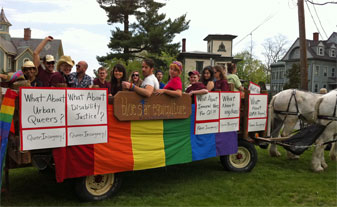
Last Saturday, Northampton hosted its 30th annual GLBT Pride march. Political diversity and even dissent were noticeable themes this year, in my opinion a good sign that our GLBT community feels safe enough to forgo a united front–and even to prioritize other issues besides their own rights.

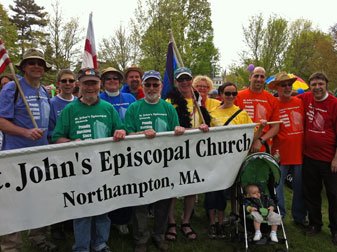
What a change from 20 years ago, when, as old-time residents told me, the local paper consistently misprinted the date of Pride, the city put up endless bureaucratic obstacles in the way of them getting a permit, and some closeted gays had to march with bags over their heads. One activist remembered being chased by a schoolbus full of Christians shouting homophobic slurs. It was a welcome relief this year to see numerous faith-based groups–Jewish, Christian, and Muslim–carrying parade banners.

These folks, naturally, were my favorite:

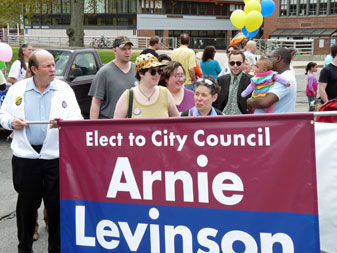
Though the matching T-shirts were tempting, this year our family marched behind our City Council candidate, Arnie Levinson. Arnie stands for transparent government and protecting our natural resources from short-sighted real estate development. He was also active in organizing our Neighborhood Watch after a spate of arson fires that killed two neighbors in 2009.


(Left to right: Arnie, Karen’s boyfriend Rich, moi, my stepsister Karen, and my other mom Roberta.)

Uniquely this year, Pride drew some protesters from the Left: Queer Insurgency, spearheaded by transgender elder, activist and archivist Bet Power, sought to return Pride to its radical origins. QI contended that the public face of the gay community had become too commercialized and bourgeois. A narrow focus on inclusion in mainstream institutions like marriage and the military sidelines the issues that are a higher priority for GLBT people on society’s margins, such as employment discrimination, hate crimes, and the intersection of multiple oppressions (e.g. disability and racial inequality).

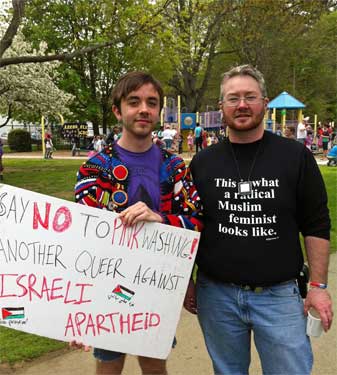
I stopped to compliment this young man on his fabulous jacket, and got an education in the difficult choices that we must make when a regime that seems to support GLBT equality also violates another group’s human rights.


(L-R: Alex Cachinero-Gorman and Ty Power.)

Asked to explain “pinkwashing”, Alex said Israel bills itself as gay-friendly in order to deflect criticism from progressive gays and allies about the country’s mistreatment of the Palestinians.  However, he rejected the false choice between human rights for one group versus another. There are also gay Palestinians and Arabs in Israel who are still oppressed by the regime because of their ethnicity; the GLBT-friendly policies don’t do much for them. Better, he said, to give the Palestinians self-determination and allow them to come up with their own solutions, rather than being dependent on the Israeli government as the only protector of GLBT rights.

As an ethnic Jew who grew up on stories about refugees being turned away from American shores during the Holocaust, I have a knee-jerk emotional reaction to comparisons between Zionism and South African apartheid. Unlike the Dutch and English colonizers, who were already top dog in their home countries and just went to Africa to exploit its riches, Jews in the 1940s had reason to believe they needed a homeland for their tribe because they weren’t safe anywhere else in the so-called civilized world.

But folks like Alex have made me realize I need to be more objective, and get educated about what’s really happening to the Palestinians. Some links he sent me, which I plan to explore, include Palestinian Queers for BDS and Thoughts on Palestine (a Hampshire College study group). (BDS stands for “boycott, divestment, and sanctions”.)

The Palestinian/queer dilemma is an interesting problem of priorities. Currently, the world’s Arab and Muslim regimes are mostly unsafe places for sexual minorities. Would Middle Eastern gays at least temporarily fare worse if there were no Jewish state? Is that a risk worth taking? Whose oppression comes first? (Not that all these anti-pinkwashing groups are calling for Israel’s eradication, but if you argue that Zionism equals racism, the logical next step seems to be that it’s illegitimate for the country to try to maintain a Jewish identity, even if the human rights abuses ceased.)

Around the same time as Noho Pride, the question of competing oppressions was also at the heart of the recent controversy over Sojourners’ refusal to run this ad from Believe Out Loud, a GLBT Christian advocacy group. Sojourners is a well-known progressive Christian organization that reaches across denominational lines to advocate for economic justice and an end to war. The ad, released in conjunction with Mother’s Day, depicts two lesbian moms and their anxious little boy walking slowly down the aisle of a church as parishioners eye them with suspicion, hostility, and curiosity. Just as the tension becomes painful, the minister smiles and says “Welcome … everyone.

Sojourners founder Jim Wallis defended the move by saying that Sojo supports civil rights for gays, but taking an overt political stand could alienate some members of their constituency, who were not all of one mind about what the Bible says about homosexuality. It’s a question of priorities:

But these debates have not been at the core of our calling, which is much more focused on matters of poverty, racial justice, stewardship of the creation, and the defense of life and peace. These have been our core mission concerns, and we try to unite diverse Christian constituencies around them, while encouraging deep dialogue on other matters which often divide. Essential to our mission is the calling together of broad groups of Christians, who might disagree on issues of sexuality, to still work together on how to reduce poverty, end wars, and mobilize around other issues of social justice.

Given the time Sojourners is now spending on critical issues like the imperative of a moral budget, the urgent need to end the war in Afghanistan, and the leadership we are offering on commitments like immigration reform, we chose not to become involved in the controversy that such a major ad campaign could entail, and the time it could require of us. Instead, we have taken this opportunity to affirm our commitment to civil rights for gay and lesbian people, and to the call of churches to be loving and welcoming to all people, and promote good and healthy dialogue.

Sorry, Jim. I’m not buying it. Watch the ad again. I don’t see anything about “sexuality”. I see a family like mine, being shunned in a house of worship simply because they look different, until the minister reminds the crowd how Christians are supposed to treat one another. It’s basically an anti-bullying message for churches.

Why is it incumbent on progressives to compromise here, in order to include people in our anti-poverty coalition who would be offended by the most minimal acknowledgment that queer families exist? Can we really not accomplish our objectives without them? Better to take a stand and leave those conservatives looking like the mean-spirited ones, because they’d rather stop feeding the hungry than treat lesbian moms with respect.

My Interview on the Mass Cultural Council ArtSake Blog


Last year I was honored to receive a fellowship for poetry from the Massachusetts Cultural Council. Since then my gratitude has only increased, to see the publicity support that the MCC gives its fellows and finalists. In conjunction with our reading last week at Forbes Library in Northampton, the MCC’s Dan Blask interviewed me on their ArtSake blog. Here’s a sample:

ArtSake: Along with your poetry, you also write fiction and nonfiction. Do you approach writing prose differently from the way you approach poems?

Jendi: Yes, definitely! Poetry and fiction must be written by hand with a mechanical pencil in a 6×9 Mead Five Star notebook. Nonfiction, by which I mean my blog posts about gay rights and Christianity, is written on the computer. I don’t know how to shape a narrative in creative nonfiction. There are too many facts, and most of them were hard enough to live through once.

When I write poetry, I’m not thinking about an audience. What wants to be written, gets written. It’s like a computer’s self-diagnostic. I write to find out what I think. Naturally, my values and preoccupations are reflected in the poetry, so in that sense, it often contains a critique of society, but it’s driven by my own need to express my authentic inner experience, rather than to have a particular impact on others. (Though I wonder whether the two are really so separable – doesn’t every self-disclosure cherish a tiny hope of being recognized and responded to in kind, however much one tries to cultivate self-protective detachment?)

My novel-in-progress is about a young fashion photographer in 1990s NYC who struggles to reconcile his faith and his sexual orientation. With this project, I have more of a conscious intention to bring about social change, along with telling an entertaining story.

Writing a novel is harder than poetry because it’s impossible to be in the “flow” for that length of time. With a poem, by the time I figure out where my subconscious is taking me, the trip’s over. I don’t have much opportunity to get in my own way. Far more planning has to go into the novel, which means that there are many chances for self-consciousness and ideological agendas to seize control, instead of letting the work tell me, itself, what it needs to be. I counteract this problem by conceiving of the novel as a collaborative effort between myself and my characters. They’ve got to retain the freedom to surprise me. My job is to see enough of the big picture so that they don’t get lost and despondent, but not be so directive that they lose their independent life force. It is a constant, elaborate, frustrating, fascinating dance that calls on all my relationship skills, and maybe even improves them in the so-called real world.

I do my creative writing by hand because this slower, temporally linear method allows intuition to take the lead. Writing on the computer, it’s too easy to pull back and see the big picture, to let the analytical mind start rearranging and criticizing, and skip past that quiet inwardness where the soul of the poem or story gestates.

Read the rest here. Videos of myself and my talented co-readers Rosann Kozlowski, Nancy K. Pearson, Cynthia Morrison Phoel, and Jung Yun are available on the Winning Writers YouTube channel.


My Poem “not with the old leaven” Now Online at the St. Sebastian Review


My poem “not with the old leaven” is now online in the first issue of the St. Sebastian Review, a new literary journal for GLBTQ Christians and allies. Yes, we do exist! As editor Carolyn E.M. Gibney says in her introduction:

Many times over this past year, in the midst of my clumsy attempts to get this journal going (It’s sort of
felt like learning stick shift all over again: You think you’ve got it, then you lurch forward violently for a
few seconds, sit stunned for a moment, and start the damn car once more.), I’ve had people – mostly
genuinely concerned and gentle people – ask me: Why would you create a journal for queer Christians?
How many of you are there?

My answer is always the same: Twelve. There are twelve of us. (At this point in the conversation I smile
and tell them I’m kidding. Which I am. Mostly.)

It’s true that this seems like a bit of a strange niche. Queer Christians tend to fall into the section of the
Venn diagram that most people either A) don’t think exists (which in most cases is easily rectifiable), or B)
vehemently deny is metaphysically possible. ‘You can’t be gay and Christian!’ they say.

Word on the street, though, is that metaphysics can only take you so far. (Buy Martin a beer and he’ll tell
you why, in the end, he never could finish Being and Time.) And, in any case, the problem, unfortunately,
has never been metaphysical. The problem is not whether gay Christians can or should exist. The problem
is that we do exist, and that people still consider our existence a metaphysical question.

The question of being queer and Christian is deeply, terribly physical. And immanent. And quotidian. (‘See
my hands?’ I would like to say back. ‘See, here: Touch the wound in my side.’)

That’s partly why I started this journal. I want to affirm that the question of the intersection of queer and
Christian has moved, must move – entirely and completely – from the realm of the metaphysical to the
realm of the ethical. The question, now, dear friends, as I’m sure you already know, is not ‘What?” but
‘How?’


The issue is available for download as a PDF here.

Videos from Green Street Cafe Poetry Reading with Mark Hart and Jendi Reiter


Last week I shared the stage with poet and Buddhist teacher Mark Hart at a reading at Northampton’s Green Street Cafe. I would do the job for the free dinner alone. If you weren’t there, you’ll just have to imagine the roast duck and polenta, but you can feast your other senses on the videos now posted on the Winning Writers YouTube channel

Here’s a clip of me reading “World’s Fattest Cat Has World’s Fattest Kittens”, which won 2nd Prize in the 2007 Utmost Christian Writers Poetry Contest. Mamas (and daddies), don’t let your babies grow up to be writers.


My Poem “Bullies in Love” Wins Anderbo Poetry Prize


My poem “Bullies in Love” has just won the 2010 Anderbo Poetry Prize judged by Charity Burns and Linda Bierds. Anderbo is a NYC-based online literary journal edited by Rick Rofihe. This poem was inspired by the episode of “Glee” where the homophobic football player kisses sweet little gayboy Kurt. Who says watching TV doesn’t pay?

Bullies in Love

Wouldn’t it be nice to believe all hate is desire,

the bullet that wings the bird

wanting to be a bird?

Believe, if little dead boys can

hold their dear opinions in the ground,

that the fist is only a heart

stunned by too much muscle?

Because then you would still be visible,

chosen as carefully for destruction

as the cities of the plain

or the shy girl in a vampire novel,

the girl who is all elbows and sorrow

and stands outside at weddings.

The truth is, most hatred is different from really rough sex,

neither masked for the sizzle of mystery

nor screaming the name of the defeated, its own.

Not thinking is its flavor.

Deafness, its spice.

But believe, because you are not yet twenty-one

and drowning, not yet lying down at seventeen

beneath the homecoming train, not yet a choking thirteen

hung from your mother’s garage ceiling,

because you are still at home on prom night

watching the Discovery Channel, you will be convinced

that the zebras, by now, must be aware of the cameras

and that the one who tumbles beneath the lion’s

rank delicious weight is choosing

something like the mating that escaped you.