You Gotta Give ‘Em Hope


Today, May 22, would have been the 80th birthday of civil rights leader Harvey Milk . Milk made history as the first openly gay candidate
elected to public office in California.
He served only 11 months on the San Francisco Board of Supervisors before his assassination in 1978. His passion for justice extended beyond his own community, to the struggles of all disenfranchised people, as this clip from his famous “Hope” speech shows:


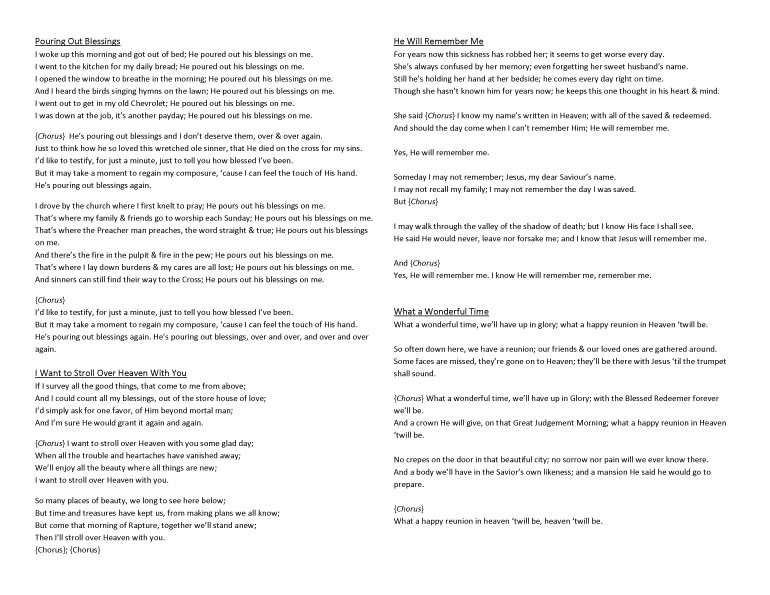
Thursday Random Song: Archie Watkins, “He Will Remember Me”


This song brought tears to my eyes when I heard it on XM Radio’s southern gospel station, Enlighten 34. Like many people, perhaps especially those whose passions and self-worth are bound up with intellectual pursuits, I dread the possibility of losing my mind with age. Archie Watkins’ ballad was a comforting reminder that the meaning and destiny of my life are in God’s hands, not mine.


Read the lyrics to this song and others on Watkins’ “Pouring Out Blessings” CD on his website . Watkins was a founding member of The Inspirations, whose Southern Gospel
Treasury collection is one of my very favorite CDs in any genre. Buy it
on Amazon here .

Catholic Elementary Schools Expel Children of Lesbian Parents


It was widely reported this week that a Catholic elementary school in the Boston area withdrew its offer of admission to a third-grader upon discovering that his parents were lesbians. St. Paul Elementary in Hingham said the couple’s relationship was “in discord” with church teaching, and that teachers would not be able to answer the child’s questions about family life because they could not condone the values he was taught at home.

A similar incident occurred in March when the Sacred Heart of Jesus preschool in Boulder, Colorado expelled the child of another lesbian couple, with the approval of the Denver archdiocese.

I am a happily married heterosexual woman. I’ve achieved a stable home life in spite of the secrecy and shame I experienced as a child in a closeted family, not because of it. It makes me sick to see the proclamations on the U.S. Conference of Catholic Bishops website about “strengthening marriage and family life”. The USCCB makes it a “priority goal to Strengthen Marriage” (capital letters in the original). But what are these schools’ actions really teaching?

I remember what I learned, very early, as the daughter of two women who experienced employment discrimination and family ostracism for their relationship. Though I attended school in gay-friendly Greenwich Village and Brooklyn Heights, my parents still insisted I be discreet (and if necessary, deceptive) in case the truth got back to their non-affirming neighborhood and workplaces.

Every innocent question from other kids or teachers was a minefield for me, since I had to pretend that my two mothers didn’t live together, or that they were just friends. It was one reason we hardly ever invited people to our house. I had a painfully scrupulous personality as a child, and hated lying. As an introvert, I was also pretty bad at it. I wasn’t free to engage in ordinary small talk about family life without facing the awful choice between disloyalty and dishonesty–on top of which, I knew I was only making a fool of myself by denying what was obvious to outsiders.

Self-consciousness. Fear of getting close to people. Internal taboos against confiding in anyone about problems in your home. Such are the lessons a child learns in her parents’ closet.

Are these the relationship patterns that will produce happy marriages, heterosexual or otherwise, for gay couples’ children? I don’t think so.

Jesus came to bring us grace and forgiveness so we could love one another. He said, “The truth will set you free.” That’s the only foundation of a healthy marriage and family life. 

Visit the Human Rights Campaign website to send a protest message to the USCCB.

Get Paid for Being Crazy: Some Quotes on the Writing Life


The prestigious literary journal Crazyhorse recently asked its readers to submit their favorite quotes about writing. The editors’ choices from this batch were included in their latest email newsletter. Below are some of my favorites:

“If you’re going to be crazy, you have to get paid for it or else you’re going to be locked up.”
—Hunter S. Thompson

“I write a little every day, without hope and without despair.”
—Isak Dinesen

“Always pull back—and see how silly we must look to God.”
—Jack Kerouac

“Writing is finally a series of permissions you give yourself to be expressive in certain ways. To leap. To fly. To fail.”
—Susan Sontag

“You owe reality nothing and the truth about your feelings everything.”
—Richard Hugo

“You must stay drunk on writing so reality cannot destroy you.”
—Ray Bradbury

“The process of writing will always be trying to repair something that doesn’t exist with tools you have to invent on the spot.”
—George Saunders

“Any writer who knows what he’s doing isn’t doing very much.”
—Nelson Algren

“Confront the dark parts of yourself…. Your willingness to wrestle with your demons will cause your angels to sing.”
—August Wilson

“Truth is not an unveiling which destroys the secret, but a revelation that does it justice.”
—Walter Benjamin

“Writing isn’t about applause. It’s about humiliation.”
—Steve Almond

“Before I start writing I feel affectionate, interested, and frustrated. In that order. Afterwards I feel relieved, disgusted, and confused. Sometimes I don’t think it’s worth it.”
—Joy Williams

“A poet is someone who stands outside in the rain hoping to be struck by lightning.”
—James Dickey

“Go forth my book and help to destroy the world as it is.”
— Russell Banks

“I always write from my own experiences whether I’ve had them or not.”
—Ron Carlson

Campus Extracurricular Groups Claim “Religious Freedom” to Discriminate


From the April 29 issue of Religion Dispatches comes this story by RD associate editor Sarah Posner:

Last week, the Supreme Court heard oral arguments in Christian Legal Society v. Martinez, a case closely watched by both the religious right and civil liberties advocates. At issue in the case is whether the Hastings College of Law, part of the University of California system, violated the CLS’s First Amendment rights by requiring that the Society comply with the school’s non-discrimination policy in order to receive official school recognition as a club.

Hastings, a state-funded institution, requires school clubs, in order to receive the benefits of official recognition, to adhere to the policy which prohibits discrimination on the basis of, among other things, religion and sexual orientation. CLS, which requires members and those wishing to hold leadership positions in the club to be professing Christians and to disavow “unrepentant participation in or advocacy of a sexually immoral lifestyle,” requested an exemption from these provisions in 2004, which Hastings refused. Although Hastings never denied CLS access to and use of school facililities, the decision meant CLS could not make use of benefits offered to official school clubs, including limited funding from student activity fees. CLS sued in October 2004, lost both at the trial and appellate court levels, and then appealed to the Supreme Court.

CLS’s mission, according to its Web site, is “to inspire, encourage, and equip lawyers and law students, both individually and in community, to proclaim, love and serve Jesus Christ through the study and practice of law, the provision of legal assistance to the poor, and the defense of religious freedom and sanctity of human life.” Through its Law School Ministries, it “encourages students in faith, connection with Christian mentors, professional development, exposure to other Christian students, and future employment. As many secular law schools have abandoned traditional education concerning the origins of law, increasing emphasis is placed on the foundations and practices which integrate faith and practice.”


Read the rest of the story here . Basically, CLS is arguing that it should have the freedom to uphold certain faith-based moral standards for its members, or else its mission is in jeopardy. Almost by definition, if their values weren’t somewhat different from the values of the secular university, CLS wouldn’t need to exist. Meanwhile the ACLU legal expert makes the point that in past generations, business owners who opposed equal pay for women or equal treatment for black customers also sometimes claimed religious exemptions, and it’s a good thing they didn’t succeed. Both sides have some merit, I think.

This story made me remember the young libertarian college student I used to be, who would have come down firmly on the side of CLS. While I always supported gay rights in theory, the issue occupied a much smaller place in my consciousness. The power imbalance that truly incensed me was the power of the institution over the dissenting individual.

I wasn’t yet a Christian, though inching in that direction; my primary religion was the creative life of the mind. I believed in the university as a temple devoted to the pursuit of truth (hey, I was 18). I was infuriated to find that in practice, we had to finesse our real opinions all the time in order to avoid a bad grade that would hurt our employment chances after college, negating our parents’ incredible financial sacrifices for our education. Where did our moral obligations lie – with the truth or with family loyalty?

So, freedom of conscience was very much on my mind. I was also alert to the paradoxes of “liberal tolerance” so incessantly pointed out by Stanley Fish: in the name of “freedom” and “equality”, the administration might use its unequal power to suppress some student perspectives and constrain their ability to act with integrity.

But when you’re a student, you think the university is the entire world, and it revolves around your issues. At least it was like that for me. Non-affirming conservative Christians may well be an oppressed minority on college campuses, but they are the oppressive majority in the rest of America. This is not to say that two wrongs make a right. It’s just important to remember the wider context. CLS presumably wants its members to use their legal skills to block full civil equality for GLBT people when they graduate. Their gathering is not just about personal self-expression.

Now that I am older, queerer, and more politically aware, what do I think the correct outcome should be? Personally, I wish both sides would stand down. It’s unfortunate that the Supreme Court will end up settling what is really a political balancing act rather than a question of constitutional law.

To CLS, I would say, “Suck it up.” It’s a bit disingenuous to define yourself in opposition to liberal-pluralist values, and then invoke those values to win the freedom to discriminate. The hardship you’re being asked to suffer for your faith is relatively minor. It would be a different story if the students were actively penalized for joining CLS, or for expressing their views in the classroom in a non-hostile way. Here, a completely optional extracurricular activity is merely being denied certain privileges.

You kids might also want to reconsider making homophobia the litmus test for Christian purity. You can’t imagine how many people close their minds to the gospel because Christians have such a hateful reputation.

To Hastings College, I would say, “Face your fears.” Don’t act so afraid of controversial viewpoints. Promote dialogue between the CLS and gay student groups. Facilitate debates about different visions of society and how religion should interact with law and politics. After all, anti-gay Christians are out there in the real world. By suppressing those voices on campus (beyond what’s necessary to prevent harassment), are you really equipping your students to handle them as adults?
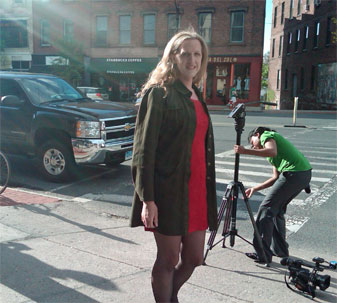
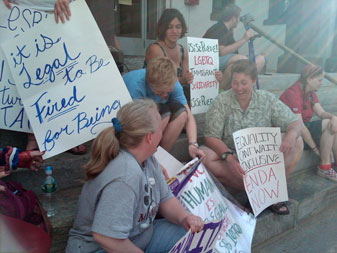
Photos from the Western Mass. Equality Across America Rally for Trans Rights


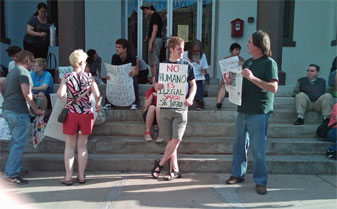
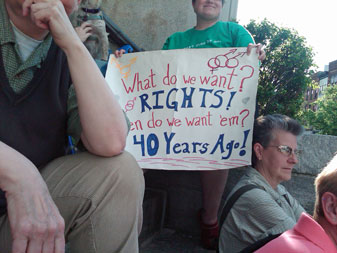
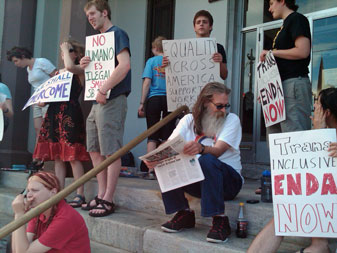
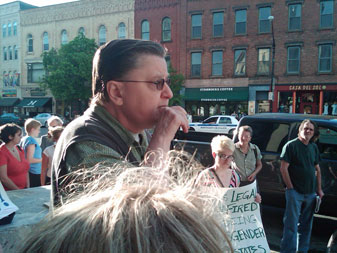
The Western Mass. chapter of Equality Across America held a rally on the steps of Northampton city hall this week to demand that Congress pass a transgender-inclusive Employment Non-Discrimination Act (ENDA). One controversy surrounding this bill is the willingness of some gay-rights groups to accept a version that would not cover discrimination against transgender employees. They argue that a compromise bill would be easier to pass; however, the trans community is legitimately concerned that a stand-alone trans rights bill, if introduced separately at a later date, would never gain enough support.

There’s still a lot of misunderstanding of transgender people, probably because they’re even rarer than gays and lesbians, and often look different from the mainstream. On the issue of gay and lesbian rights, our society is slowly getting the idea that it’s wrong to stand in the way of marriage and family formation. We can relate to the anguish of being separated from the people we love. It’s less common to feel desperately out of sync with the gender expression that society expects from us. (Or at least, we don’t admit it, as we cram our feet into pointy high heels and nip and tuck ourselves to death!) As I get to know more people in the transgender community, and get in touch with my own discomfort with sexual stereotypes, I’m beginning to understand why the right to choose your gender expression is a basic human right.

Equality Across America is best known for organizing the National Equality March in Washington, D.C. last October. Their next planned action in our region will be the May 22 rally at the State House in Boston, urging passage of the long-stalled legislation that would add gender identity and expression to the Massachusetts civil rights law. If you live in our state, fill out the MassEquality web form to tell your elected officials to bring this bill to a vote.

Wherever you live, contact your representatives and senators today and tell them that you support fully inclusive federal protections for GLBT workers!

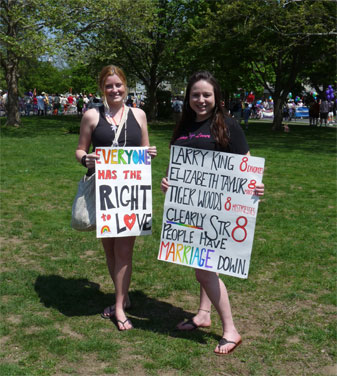
I took these photos with my BlackBerry while sitting on the City Hall steps holding my protest sign.

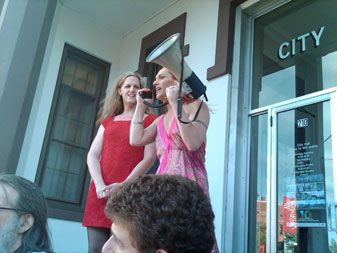
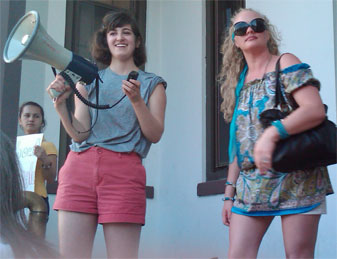
Lorelei Erisis, Miss Trans Northampton 2009, was our charismatic emcee.

Co-organizer Gary Lapon (not pictured) is a Socialist activist, so our rally included signs for workers’ and immigrants’ rights.

Lorelei and Elle St. Claire spoke eloquently for equal rights.

Co-organizer Madeline Burrows with Elle’s proud wife Jessica.

Bet Power, curator of the Sexual Minorities Archive, a local treasure trove of GLBT history.

Northampton Pride 2010


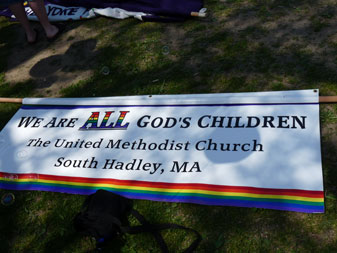
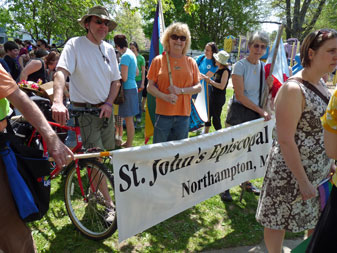
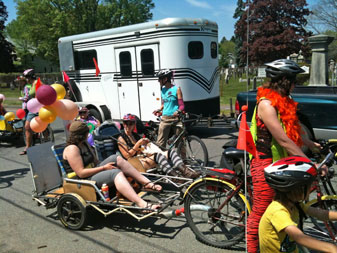
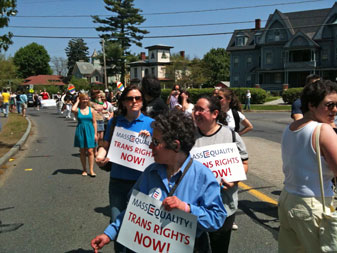
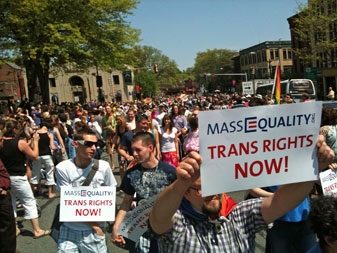
Yesterday was the 29th annual Northampton Pride March. Thousands participated, including numerous church groups and gay-straight alliances from local schools, and thousands more lined the sunny streets of downtown Northampton to cheer us on. My family and I marched with the MassEquality contingent, waving “Trans Rights Now” signs calling for action on the pending bill that would add gender identity and expression as protected categories under the Massachusetts civil rights law. Over a dozen members of our parish also marched under the St. John’s Episcopal Church banner.

The photos below marked with “(AC)” were taken by my husband, Adam. The others are mine.


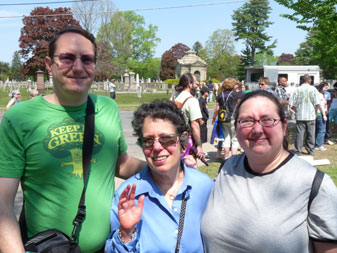
My proud family: Adam, Roberta, and Karen.


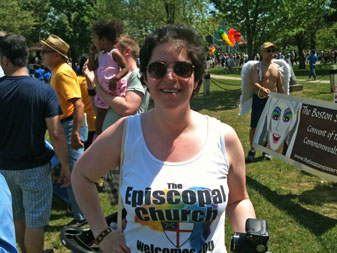
The Episcopal Church welcomes YOU!  (AC)


Preaching the gospel.


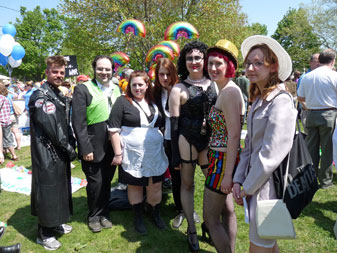
Some fans of the Rocky Horror Picture Show.


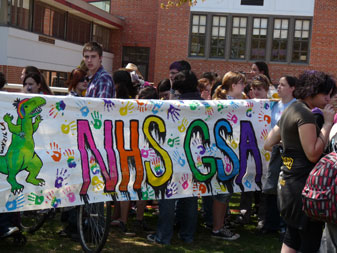
Bullies? No problem. The Northampton High School Gay-Straight Alliance has “Gayzilla” on their side!


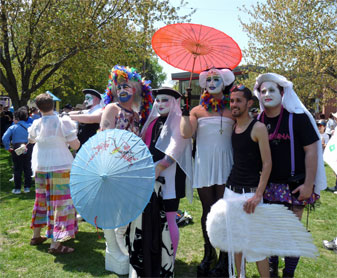
The Boston Sisters Convent of the Commonwealth, an order of queer nuns, bring their big-city style to Northampton. Visit their website at thebostonsisters.org .


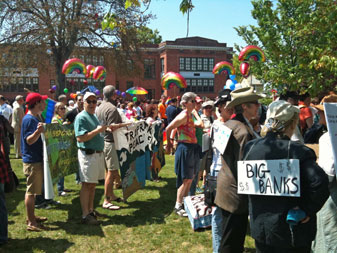
Signs of the times.


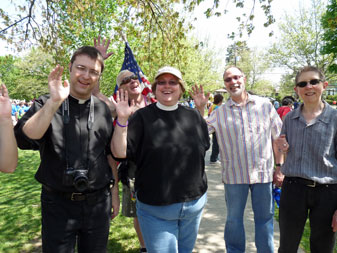
The awesome people of St. John’s!


Our former deacon Eric (we miss you!), our beloved Rev. Cat Munz, Cat’s husband Bill, and fellow parishioner Barbara.


Some marchers connected the gay-rights struggle to other forms of oppression. (AC)


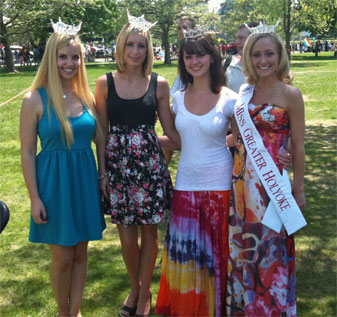
Some of our beauty queens are girls! (AC)


The parade begins from Lampron Park, next to the historic Bridge Street Cemetery. (AC)


We marched down Bridge Street in front of the band. (AC)


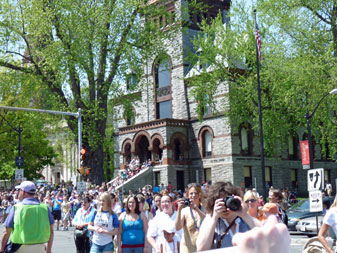
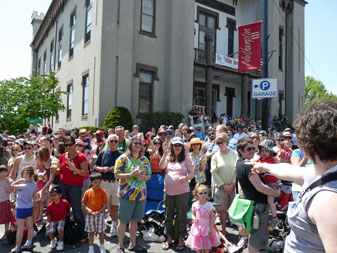
Throngs of supporters outside the old courthouse on Main Street.


A very well-attended parade! (AC)


More fans greet us outside City Hall.


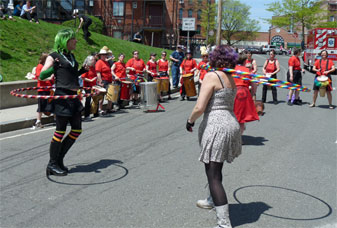
Entertainers at the end of our parade route. Northampton is (or should be) known for its hula-hooping talent.


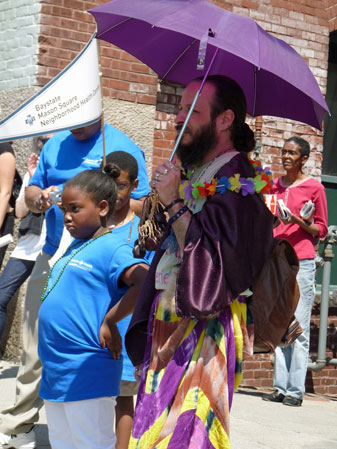
A radical faerie and some folks from the Baystate Medical Center group. A large number of Baystate employees, gay and straight, marched with their families.

Well…Pride is over for another year…leaving me with only happy memories, 200 photos and a bad sunburn. We are so blessed to live in a community where love and diversity can be celebrated in public, and haters don’t dare to counter-protest with their false interpretations of Jesus’ teachings.

But even here in the Happy Valley, there are still churches that preach that gays have an “evil spirit” on them. There are still kids who suffer from anti-gay bullying in their schools. There are still teenagers who think it’s funny to yell epithets at a same-sex couple walking hand in hand.

The collective power we showed yesterday is not visible enough in ordinary life. Too often, a GLBT person or straight ally feels alone in confronting his or her closed-minded community.

What if everyone who marched or cheered yesterday’s Pride march made a commitment to themselves to do something to fight homophobia this year? What would the world look like when Pride comes around again next May?

My Story “Altitude” Forthcoming in Passages North


My flash fiction piece “Altitude” won an honorable mention in the Just Desserts Short-Short Fiction Prize from Passages North, the literary journal of Northern Michigan University, and will be published in Volume 32.1. This contest runs in even-numbered years, alternating with their poetry and nonfiction awards. Here’s the beginning of the story; to find out what happens next, order your copy of the magazine today!

Altitude

The highest point in Pennsylvania is the lowest point in Colorado. Alice had read this on one of the maps Sam had tacked up to decorate his office at the Speedy Garage. The walls’ faded mustard paint job was nearly hidden under bumpy pale pink and green relief maps, annotated maps of states other than their own, and archaic town maps with long-lost structures delineated in copper-plate script: railroad bridge, dairy farm, lunatic hospital.

Alice used to think the maps meant Sam appreciated planning as much as she did, that he understood the expectations invested in ivory notecards and tasting menus, their notarized claim on the future. But maps were also what you saw in real time when you flew above the land, west to east, so high that there were no people visible on the checkerboard of suburbs and cornfields as rust-colored cliffs gave way to slate hills and green valleys. I’ve fallen in love, he said, once at the beginning and once at the end. There were many times in the middle, as well, or Alice wouldn’t have traveled so far down the road of Hawaiian tickets and cake toppers, pew ribbons and arguments with the DJ, but it was the first and last times that mattered, as always. You can fall a lot farther in Colorado, she’d wanted to say. We’re next door to the Grand Canyon.

to be continued…


Wednesday Random Song: The Hooters, “All You Zombies”


It’s from the 1980s! And it’s about the Bible! And zombies! Awesomeness guaranteed.

Holy Moses met the Pharaoh
Yeah, he tried to set him straight
Looked him in the eye
“Let my people go”

Holy Moses on the mountain
High above the golden calf
Went to get the Ten Commandments
Yeah, he’s just gonna break them in half!

{Chorus}
All you zombies hide your faces
All you people in the street
All you sittin’ in high places
The pieces gonna fall on you

No one ever spoke to Noah
They all laughed at him instead
Working on his ark
Working all by himself

Only Noah saw it coming
Forty days and forty nights
Took his sons and daughters with him
Yeah, they were the Israelites

{Chorus}
The rain’s gonna fall on you

Holy Father, what’s the matter
Where have all your children gone
Sitting in the dark
Living all by themselves
You don’t have to hide any more

All you zombies show your faces…
…The pieces gonna fall on you

All you zombies show your faces
(I know you’re out there)
All you people in the street
(Let’s see you)
All you sittin’ in high places
It’s all gonna fall on you

(Lyrics courtesy of LyricsDownload.com)

“Barbie at 50” Wins Cervena Barva Poetry Chapbook Prize


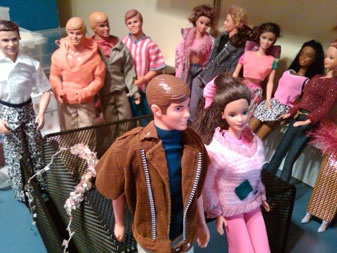
All this time I thought I was just playing with dolls…turns out I was doing research!

Afaa Michael Weaver has selected my poetry chapbook Barbie at 50 as the winner of the 2010 poetry chapbook prize from Cervena Barva Press, an exciting small press based in the Cambridge/Boston area and edited by Gloria Mindock. The book will be published later this year.

Poems in Barbie at 50 have appeared or are forthcoming in The Broome Review, Naugatuck River Review, Phoebe, Conte, Juked, and Istanbul Literary Review, and in the Florence Poets Society annual Silkworm anthology.

Enjoy the title poem, first published in the Winter 2010 issue of Naugatuck River Review:

Barbie at 50

Her little girls no longer bite their nails,
the stubby hands that undressed her
have moved on to trouser buttons.
Pink polish, bitten to the quick,
or younger still, drawn on with purple marker —
now French tips and a diamond or later
an untanned line where the ring once was.
Barbie knows the world by hands and feet.
Her own are forever arched for heels,
hot pink, one sandal and one pump.
Barbie’s been buried in the sand
beside mother’s toes, splayed in flip-flops,
chunky piglet barefoot girls
who dunked her in a bucket,
drew on her nipples, cut and stroked her hair.
Head down in seawater,
she could have told them that midlife nirvana
doesn’t need a plane ticket.
Barbie’s naked as the widows
floating in the Ganges.
She wasn’t there when Ken died.
A lady of her age steers clear of most events
involving small boys and firecrackers.
Pink is the color of mourning
for Barbie, who wore it on every occasion
when there was someone to dress her.
Plump hands brush pink on lined and powdered cheeks.
Barbie is carried out in a box.
Hands turn over tags,
hunting garage-sale bargains.
Nude, she lies back on the picnic table,
points her inked-on breasts to the sky.

Fans wait on line for a signed copy.